News Broadcasting
NAB 2025: LiveU redefines news production with new automated story-centric workflows

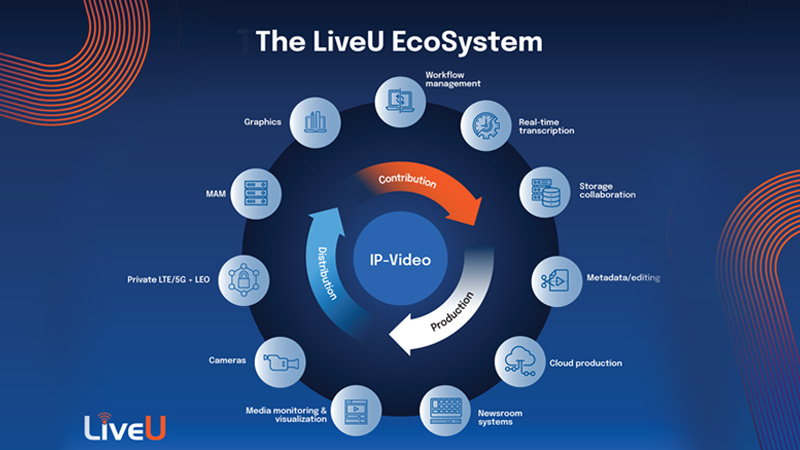
MUMBAI: LiveU will spotlight its latest technical collaborations around efficient story-centric workflows and cloud collaboration in its expanded EcoSystem at the upcoming NAB Show 2025 (south hall lower booth SL4911). With its IP-Positive architecture, the LiveU EcoSystem is designed for easy interoperability between production systems, enabling broadcasters and other organisations to speed up and optimise production processes.
LiveU’s chief product officer & general manager (Americas) Gideon Gilboa said, “Creating more value from video and solving customers’ pain points – that’s our goal. With ever-faster news cycles and the growing demand for more content, these creative workflows enable faster turnarounds, more stories to be covered and an end to costly manual processes. By expanding the LiveU EcoSystem and seamlessly connecting the systems behind the scenes, we free creators up to concentrate on what matters most – crafting compelling content – while opening the doors to new monetisation streams and serving expanding digital audiences.”
The LiveU EcoSystem is a modular set of best-of-breed components, allowing customers to deploy different configurations and workflows, aligned with their production requirements. It is underpinned by LiveU’s resilient and low latency LRT (LiveU Reliable Transport) protocol and further enhanced by LiveU IQ (LIQ), LiveU’s revolutionary connectivity solution.
At the core of these new integrations is the LiveU Ingest automatic recording and story metadata tagging solution. LiveU Ingest allows live content to be accessed from anywhere and is interoperable with other production tools, connecting live video from the field and growing files with NRCSs (newsroom computer systems), AI-enabled transcription, MAM (media asset management), and storage systems.
Story-centric workflows,
. LiveU + Dina, Mimir + Trint: This NEW AI-enabled integrated solution creates immediate value by ingesting live content, making it instantly accessible alongside rich, searchable metadata (via Dina) and growing real-time transcription (via Trint) in Mimir’s MAM system. Content is easier to find and edit so that editors can begin working in real-time from any location as files continue to grow. Content can also be re-used and repurposed for new revenue-generating opportunities. See the solution in action at booths SL6826 (Dina and Mimir), SL6005 (Trint) and SL4911 (LiveU).
. LiveU + Marquis + Avid: LiveU and Marquis are now bringing growing file support to Avid systems to streamline news and sports production workflows. The enhanced solution gives customers the ability to begin editing as soon as live recording starts and supports metadata-based auto-ingest for improved efficiency. See the solution in action at booths SL4528 (Marquis), SL1516 (Avid) and SL4911 (LiveU).
. LiveU + AP Storytelling: LiveU and AP Storytelling are teaming up to support a story-centric workflow whereby AP Storytelling is able to generate story metadata in LiveU Central allowing field operators to easily select them and assign them to any live transmission. Live content is recorded in LiveU Ingest with the relevant associated metadata providing a faster news turnaround. See the solution in action at booths SL1905 (AP Workflow Solutions) and SL4911 (LiveU).
Streamlined creative collaboration
. LiveU + LucidLink: LucidLink and LiveU enable live content to be brought directly into LucidLink’s storage collaboration platform as part of a seamless cloud-based workflow for content creators, broadcasters, and production teams. LiveU DataBridge provides essential connectivity for remote LucidLink users to connect and collaborate from anywhere. See the solution in action at booths SL2705 (LucidLink) and SL4911 (LiveU).
Visitors to the LiveU booth will experience hands-on demonstrations showcasing how these technologies integrate with existing broadcast infrastructures and emerging cloud-based production environments.
In addition, experts from Tupelo Honey, AWS, Vizrt and LiveU will be presenting tried and tested solutions for efficient live cloud sports production based on REMI, hybrid lightweight production workflows. The session will take place on Tuesday, April 8 between 14.00-14.30 PST at the Creator Lab Theater B – south Hall Lower.