iWorld
Motorola, Nokia to cooperate on mobile TV interoperability


MUMBAI: In an effort to encourage greater adoption of broadcast mobile TV services and accelerate service deployment, Motorola and Nokia today announced that they will work to achieve interoperability among their DVB-H (Digital Video Broadcast – Handheld) enabled mobile devices and network services.
The handset manufacturers will work together to support solutions based on open DVB-IPDC standards available for operator partners interested in deploying multi-vendor mobile TV services and trials in 2006 and onward.
For the uninitiated DVB-H technology enables the TV service to be broadcast to one’s mobile device. The parties state that DVB-H provides a superior end-user experience in the mobile environment with excellent picture and reduced battery consumption. Up to 50 TV channels can be delivered with low cost, over one network. With extensive pilots of broadcast mobile TV currently taking place across the globe, involving leading broadcasters, mobile operators, broadcast network operators and handset manufacturers, the market for commercial broadcast services is expected to grow throughout this year.

According to market research firm Informa, the mobile TV market is poised to grow exponentially – by 2010, there are anticipated to be over 50 million DVB-H enabled mobile devices sold globally. The deployment of mobile TV services will offer new business opportunities for companies across the value chain – including content and broadcast companies, mobile service providers, infrastructure and handset manufacturers and technology providers — and the availability of interoperable DVB-H enabled devices and services is a key factor in further opening up the market.
Among the many digital technologies available to deliver mobile TV services, Motorola and Nokia both view DVB-H as an effective technology for deploying broadcast mobile TV. DVB-H technology offers high service level quality, low battery consumption and offers the end-user the ability to simultaneously receive broadcasts while using other mobile services such as telephony and internet access on their device.
Motorola director of broadcast technologies Rob Bero says, “Operators around the world are evaluating broadcast mobile TV as a compelling new service to offer their subscribers – and interoperability will play a key role in bringing these services to market faster.
“As a vocal leader in open standards, including DVB-H, we’re pleased to be working with Nokia to deliver interoperable handset and network solutions that will help enable operators to offer the ultimate mobile TV experience for consumers.”
Nokia director, multimedia experiences Harri Männistö says, “Commercial mobile TV services are on the verge of launching in several markets across the world. In order for mobile TV to be a true success, we need interoperable mobile devices and systems which deliver the best experience for consumers and enable enjoyable, live broadcast TV when and where it suits them, redefining prime times and television program content. Nokia is happy to see that open DVB-H technology has and will have widespread support across the industry players, including Motorola and Nokia, in bringing mobile TV to market”.
In parallel to supporting mobile operators launching mobile TV services based on existing technologies in their networks, Motorola and Nokia are both active in ongoing standardization and technology development to optimize the broadcast mobile TV experience. The companies will work on interoperability efforts using the open DVB-IPDC standard while continuing to participate in industry-wide interoperability efforts within the related standardization bodies.






iWorld
Amazon MX Player unveils 150-show slate for 2026
Free streamer doubles down on originals, reality and microdramas as it courts 250m monthly viewers
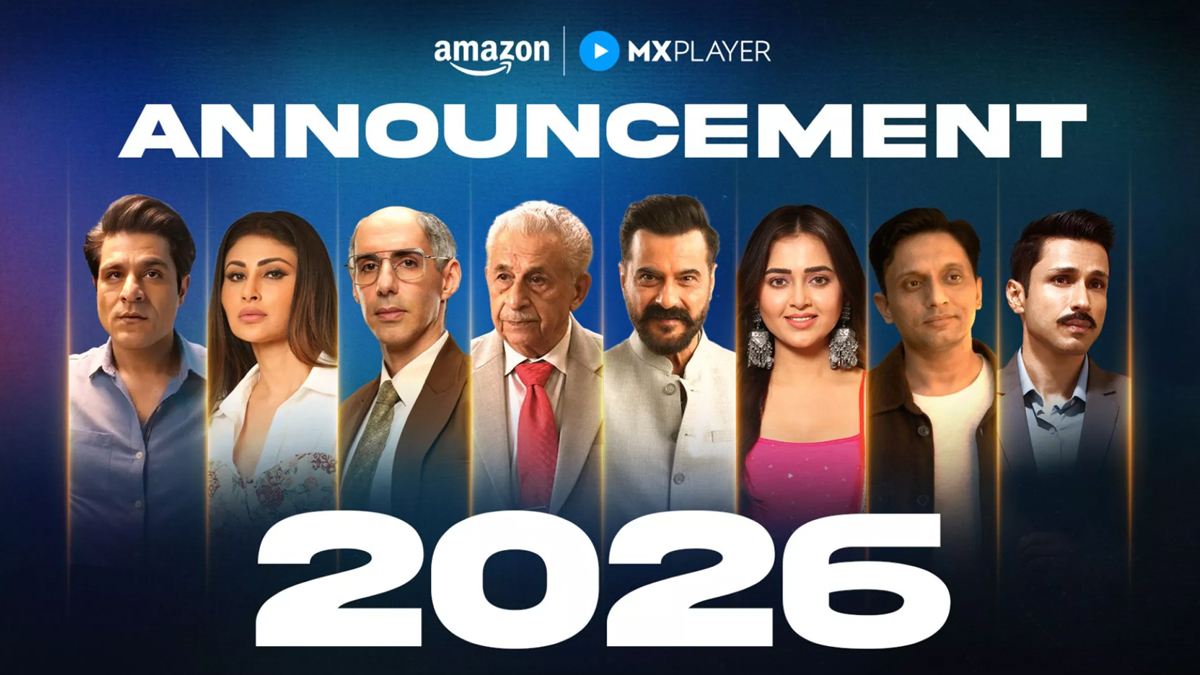
MUMBAI: Amazon MX Player is going big in 2026. India’s free streaming service, which claims more than 250m monthly viewers, has unveiled its largest content slate yet—over 150 new and returning titles spanning drama, action, thrillers, reality and its mobile-first microdrama format.
Leading the scripted lineup is Made In India: The Titan Story, a sweeping ambition-and-legacy drama starring Naseeruddin Shah and Jim Sarbh. Also headlining the slate is Sankalp, a socio-political thriller exploring power and leadership, featuring Nana Patekar, Sanjay Kapoor, Neeraj Kabi and Mohammed Zeeshan Ayyub.
The platform is stacking the deck with a mix of genres. Ab Hoga Hisaab, a justice-and-retribution thriller, stars Shaheer Sheikh, Mouni Roy and Sanjay Kapoor. Administrative drama The Bureaucrat features Amol Parashar, while action entertainer Kaptaan stars Saqib Saleem. The survival thriller Vimal Khanna features Sunny Hindhuja, cop drama Waiting Hai stars Divyenndu Sharma and Bhuvan Arora, and crime drama Clean Up Crew brings together Ravi Kishan, Amey Wagh and Vishal Jethwa.
The slate builds on the momentum of recent originals including courtroom drama Amar Vishwas, starring Rajeev Khandelwal, Aamir Ali, Ravi Behl and Barkha Bisht, and the romantic thriller Psycho Saiyaan featuring Tejasswi Prakash and Ravi Kishan, both of which drew strong audience engagement.
Reality programming remains a key pillar. Competition series Rise & Fall returns for a second season, while the fitness reality show Battleground also comes back for Season 2 with Shikhar Dhawan reprising his role as lead mentor. The platform recently wrapped Bharat Ke Super Founders, fronted by Suniel Shetty, which saw winning startups receive funding worth Rs100 crore ($10.8m).
Franchise favourites are also making a comeback. Crime saga Raktanchal returns for Season 3, alongside youth-focused titles Campus Beats Season 6, Campus Diaries Season 2, Heartbeats Season 2 and Who’s Your Gynac Season 2.
Karan Bedi, head of Amazon MX Player, said the platform is riding strong momentum as viewers gravitate towards free, premium streaming. “With our growing premium content slate and scale, we are uniquely positioned to drive the shift from linear television to streaming for millions of viewers across India.”
Amogh Dusad, head of content, said the focus is on building “a diverse and inclusive content ecosystem that reflects the many voices, cultures and experiences of audiences across the country.”
Beyond long-form shows, the platform is doubling down on MX Fatafat, its mobile-first microdrama vertical designed for short, snackable storytelling. It is also expanding MX Vdesi, its library of localised international content from Korea, China and Turkey, alongside a curated anime slate available in Japanese and Hindi.
Girish Prabhu, head of Amazon Ads India, framed the strategy in commercial terms. With a reach of 250m users, he said, brands can connect with audiences through content “powered by shopping and streaming signals” that generate measurable outcomes.
All titles will stream free on Amazon MX Player across mobile devices, connected TVs, the Amazon shopping app, Prime Video, Fire TV, Jio TV and Airtel Xtreme.
The message is clear: as India’s streaming wars intensify, Amazon MX Player is betting big on scale, speed and free access—flooding the zone with content and inviting millions of viewers to press play.