eNews
Moneycontrol exclusive: PM Narendra Modi on G20, global affairs, economy, and more

Mumbai: In an exclusive interview to Moneycontrol days before India readies to host the G20 Leaders Summit, PM Narendra Modi spoke at length on global issues, India’s growth prospects and its role in G20 and the overall economy.
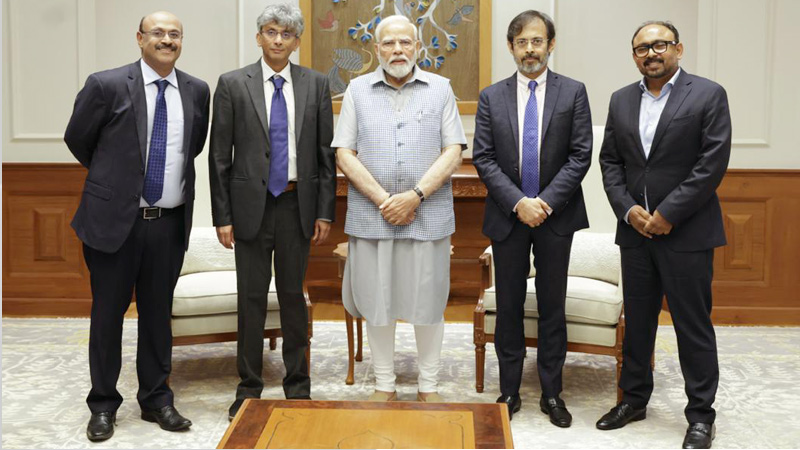
In an hour-long conversation at his 7, Lok Kalyan Marg office with Network 18 editors (Network18’s editor-in-chief Rahul Joshi, Network18 chief content officer Santosh Menon, Network18 managing editor (digital) Karthik Subbaraman, Moneycontrol’s chief content & strategy officer Javed Sayed), the prime minister also shared his views on inflation and the dangers of freebies.
Talking about the India growth story, the prime minister said, “India’s growth is not only good for Indians but also for the world. India’s growth is clean and green growth. India’s growth is being achieved with a human-centric approach that can be replicated in other countries too. India’s growth helps further the interests of the Global South.”
It’s the prime minister’s first interview to a digital-only publication in his second term. The full interview will be published on Moneycontrol.com at 7:30 am on Wednesday 6 September.
Sharing his views on India’s role in the G20, the prime minister said that India has been advancing the interests of the developing world, including the interests of nations not represented in the G20, such as the countries of the African Union.
“Perhaps for the first time in the history of G20, the troika is with the developing world—Indonesia, India, and Brazil. This troika can amplify the voice of the developing world, at a crucial time when there are increased tensions due to global geopolitics.”
The prime minister said that India has been proactive in finding solutions for global issues and the same is also reflected in the country’s agenda for G20. “When we laid out our agenda for the G20, it was welcomed universally, because everyone knew that we would bring our proactive and positive approach to help find solutions for global issues.”
Prime minister Modi also said that the world is now convinced that India will play a larger role in shaping the global future.
“When global leaders meet me, they are filled with a sense of optimism about India due to the efforts of 140 crore Indians across various sectors. They are also convinced that India has a lot to offer and must play a larger role in shaping the global future. This has also been witnessed in their support for our work through the G20 platform.”
Talking about the G20 events and conferences that took place across the length and the breadth of the country in the last few months, the Prime Minister said, “Our democratization of the G20 Presidency is our investment in the capacity building of the people, especially youth, of various cities across the country.”
Asked about India’s guiding principle for engaging with the world, the prime minister said it was no different from what his government followed at home.” We have followed the approach of Sabka Saath, Sabka Vikas, Sabka Vishwas, Sabka Prayas in our country over the last 9 years…. This is our guiding principle in global relations as well.”
Talking about the problem of heightened inflation globally and its impact on India and countries of the Global South, prime minister Modi said, “As far as India is concerned, we have taken a number of steps to control inflation. Even in the face of adversities and global dynamics, India’s inflation was two percentage points lower than the global average inflation rate in 2022. Yet, we are not resting at that and are continuing to make pro-people decisions to boost ease of living. For example, recently on Raksha Bandhan, you saw how we reduced the prices of LPG for all consumers.”
Sharing his views on debt vulnerabilities and damage to the economy from freebies, “The long-term implications of such policies destroy not only the economy but also society. The poor pay a heavy price. Yet again, the good thing is that people are becoming increasingly aware of the problem,” the prime minister said.
“In this information age, news about the debt crisis in one country is travelling to many other countries. People are analysing the situation and awareness is spreading. This is helpful for other countries to take precautionary steps to avoid a similar situation in their own countries, with the people’s support. In our own country too, on multiple platforms, I have spoken about the need to be alert against financially irresponsible policies,” he added.
The prime minister said that India’s political stability is the main reason why every sector could see deep reforms which led to stronger economic prospects for the country. “Due to this political stability, every other sector could see deep structural reforms. The economy, education, social empowerment, welfare delivery, infrastructure – I can keep on mentioning sectors that have seen reforms.”