GECs
Mipcom/MipTV reach out to Mumbai’s content community

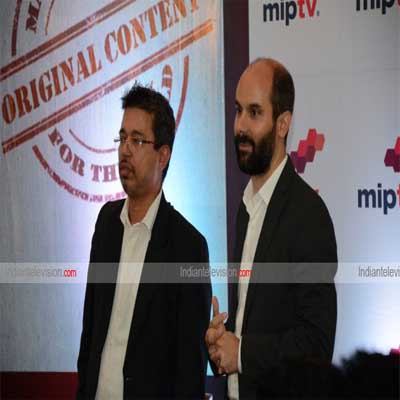
MUMBAI: The Mumbai leg of Reed Midem’s Mipcom and MipTV road show went off like a dream with an attendance from about 80 professionals from the world of television and digital content. It was addressed by Reed Midem international business development director Ted Baracos, Asia sales manager Paul Barbaro and Indian representative (and indiantelevision.com founder & CEO) Anil Wanvari.
The theme like the other two venues was “Can Indian content leave its stamp on the world?” But unlike Delhi and Hyderabad, the attendees were primarily professionals from TV and digital content production, broadcast syndication and distribution.

TV producers were represented by Shyamashish Bhattachharrya, JD Majethia, Sumeet Mittal, Rakesh Paswan, Abhigyan and Mrinal Jha, Sudhir Sharma, Lalit Sharma, Asad Abid, Ram Talkit, Rahul Sarangi and Roopak Saluja. Zee TV, Indiacast, 9XM, Sahara TV, Times Television Network, and Travel XP HD were some of the broadcasters who attended. Independent film producers Imtiaz Barolia and Javed Rahman Khan also attended. Amongst the distributors included Bhupin Chhadva, Yuvamira Dwivedi, Vivek Lath, Ratnakar Kumar, Sanjay Hinduja and Rashmmi Menon.
Rajjat Barjatya, Sandeep Mehra and Ram Seshan made up the digital players. Education companies Educmedia and Laughing Buddha Entertainment Knowledge were in attendance.
Extremely interactive, the two hour seminar had all the constituents expressing their views. Broadcasters expressed that the two markets are a must attend for TV professionals and that the two markets help generate substantial business for content syndication for them. “Indian TV shows command about $350 to $700 per half hour,” said one of the broadcasters. “The sticker price of non-fiction shows is about $1,500 and above,” said another. “Films sell at anywhere from $500 to $15,-20,000 depending on the territory,” said a third.
According to them, Pakistan, Afghanistan, Russian, CIS, Mynamar, Poland, middle east and other east European markets are some of the markets which have taken to Indian content well. Most of the attendees expressed that they would like to see an Indian pavilion come up at MipTV and Mipcom, representing the Indian content creation industry, just like 26 other regions from all over the world are doing, Wanvari said he was in conversation with National Film Development Corporation to set up the pavilion once again this year, while the Animation, VFX, Comic & Gaming Industry of Andhra Pradesh was also in the process of doing the same for this year’s Mipcom from 7-10 October.
Film producer Javed Khan expressed that Mipcom is very conducive to doing co-production deals. He is currently executing a coproduction film with support from Turkey. “We nearly closed one co-production contract at Mipcom three to four years ago,” he said.
Creative professional and producer Rahul Sarangi spoke about a non-fiction format developed by him which is going on the floors in four different countries. “Indian broadcasters were not very accommodating of my paper format,” he says. “So I invested about $40,000 and created a nice trailer and one of the overseas format distributors agreed to license it. It will be seen in several countries very soon. Mipcom and MipTV have really helped me realise my ambitions. Now an Indian broadcaster is negotiating to buy the licence for India.”
The entire room gave a rousing ovation to digital producer Rajjat Barjatya who has generated 1.5 billion views for his 45 odd channels on YouTube. “Indian content can travel and is already travelling through my channels,” he said. “The most popular offering is a video Ba Ba Black sheep which has got 76 odd million views,” he said. “And it is being watched by a German mother and her daughter, an English mother and her son.. it has crossed language and cultural boundaries.”
TV producers stated that they were totally hemmed in by the fact that they did not have the rights to the content they produce, but they would nonetheless like to attend to expand their horizons. Baracos said the Indian case was not unique. He gave the example of UK independent producer organisation Pact. “The UK market was quite similar to India’s as is Japan. The producers lobbied with industry and government to get their rights back again,” said Baracos. “They were successful with a caveat: they would share revenues with broadcasters on sales they achieved. Today, the UK Indies pavilion is generating close to 30 million pounds worth of deals annually. Everyone is happy: the broadcasters, and the producers.”
Barbaro highlighted that it is imperative that India builds a brand for itself at international markets. “Korea has done it over years; China is doing it. India needs to do it,” he said. “Today, their content is traveling all over the world. Yes, the government supports their efforts with funds, but the Indian content community needs to awaken the Indian government about the opportunities available and what other governments are doing to help and propagate their culture – and indirectly generate national economic benefits – through markets such as Mipcom and MipTV.”







GECs
Sahara One reports financial results, notes director exit and business realignment
Muted revenues, steady expenses and strategic adjustments shape company’s current phase

MUMBAI: In a tale where the sands seem to be slipping faster than they can be gathered, Sahara One Media and Entertainment Limited has reported another quarter of wafer-thin income and widening losses, even as a boardroom exit adds to the unease.
The company informed the Bombay Stock Exchange that its board, in a meeting held on April 4, approved its unaudited financial results for the quarter ended September 30, 2025. The numbers paint a stark picture. Total income for the quarter stood at just Rs 0.13 lakh, unchanged sequentially and sharply down from Rs 0.26 lakh a year earlier.
Losses, meanwhile, deepened. The company posted a net loss of Rs 24.16 lakh for the quarter, compared to Rs 18.81 lakh in the June quarter and Rs 39.69 lakh in the same period last year. For the six months ended September 2025, the cumulative loss stood at Rs 39.69 lakh, while the full-year loss for FY25 was reported at Rs 60.72 lakh.
Expenses continued to outweigh income by a wide margin. Total expenses for the quarter came in at Rs 24.30 lakh, led by employee benefit costs of Rs 6.51 lakh and other expenses of Rs 17.78 lakh. Earnings per share remained in the red at Rs (0.11) for the quarter.
The balance sheet reflects a company with significant assets on paper but limited operational momentum. Total assets stood at Rs 23,065.57 lakh as of September 30, 2025, broadly unchanged from March 2025. Equity share capital remained steady at Rs 2,152.50 lakh, while total equity was reported at Rs 18,004.85 lakh.
Cash and cash equivalents saw a modest uptick to Rs 6.75 lakh from Rs 4.68 lakh earlier, supported by a positive operating cash flow of Rs 180.01 lakh for the period.
Yet, beneath these numbers lies a more complex narrative. The company’s auditors flagged their inability to obtain sufficient evidence to form a conclusion on the financial statements, citing lack of access to records. They also raised concerns over the company’s ability to continue as a going concern, pointing to insufficient funds, delayed recoveries, and stalled content investments.
Adding to the governance overhang, the company disclosed that Rana Zia has resigned as whole-time director, effective October 16, 2025, citing other professional commitments. The resignation, noted and accepted by the board, also brings an end to her role across company committees.
Regulatory pressures continue to loom large. The Securities and Exchange Board of India has already initiated penal actions for non-compliance with listing norms, with trading in the company’s shares remaining suspended. There is also a risk of promoter demat accounts being frozen.
Legacy legal issues remain unresolved. A substantial deposit of Rs 694,027.88 thousand linked to the long-running OFCD dispute involving Sahara group entities is still under the purview of the Supreme Court of India. Restrictions on asset disposal continue to weigh on the company’s financial flexibility.
Operationally, challenges persist across multiple fronts. Advances worth Rs 1,92,916 thousand given for film content remain stuck, with delays in project completion and uncertain recoverability. The company’s YouTube channel, despite being operational, has generated no revenue for over three years due to compliance lapses. In a further twist, management has indicated that revenues may have been fraudulently diverted through unauthorised changes to its AdSense account, with a police complaint in the works.
There are also missed revenue opportunities. Television content rights continue to be used by a related party despite the expiry of the licence agreement, with fresh negotiations still underway.
For now, Sahara One Media and Entertainment Limited appears caught between legacy disputes and present-day operational hurdles. As losses linger and governance questions mount, the road to recovery looks less like a sprint and more like a slow trudge through shifting sands.






