News Broadcasting
Media needs ‘auto-correction’, guidelines to restore order: Venkaiah Naidu

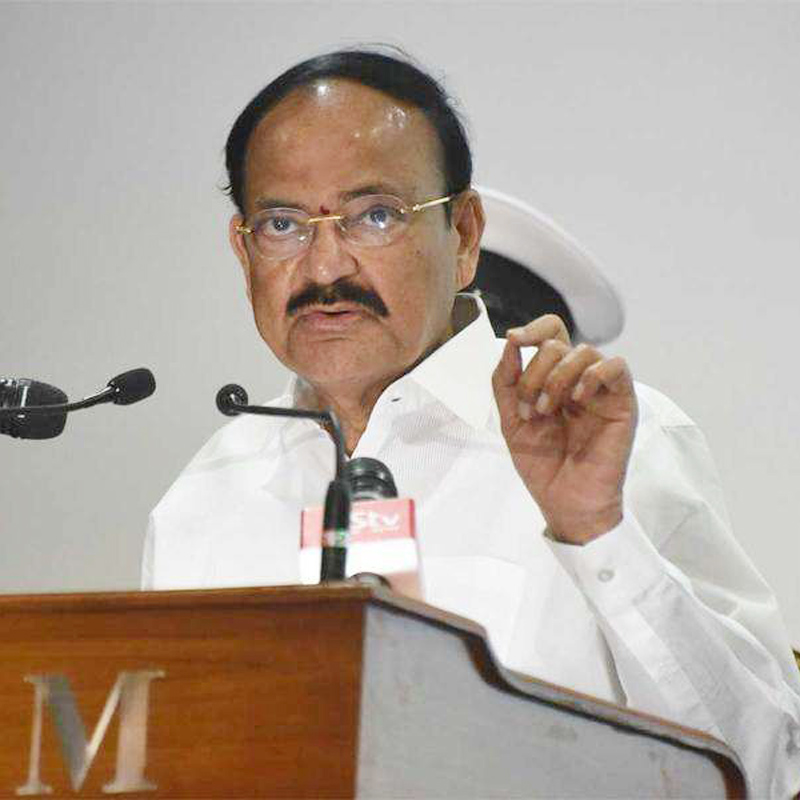
NEW DELHI: Expressing concern over the future of journalism and the sanctity of news in the face of disruptive technological advances, vice president of India and Rajya Sabha chairman M Venkaiah Naidu urged all stakeholders to ensure credible journalism, since media is an effective tool of empowerment of people for informed public discourse.
“While the democratisation and decentralisation that followed the rapid expansion of social media enabling freedom of expression are welcome, the world is witnessing the downside of it in the absence of self-regulation and protocols. In this era of saturated information and overabundance of news, the very news is getting devalued,” he pointed out. Naidu was speaking at the MV Kamat Memorial Endowment Lecture.
The vice president lamented the side effects of internet driven 'instant journalism' due to which the credibility of fact based journalism has taken a beating. He further noted that technology giants have emerged as algorithmic gatekeepers of information and the web has taken over as the main distributor of news.
In particular, he highlighted the financial implications for traditional media like the newspapers when their journalistic products are time and again leveraged by technology giants, who do not share the revenue back with them.
Some countries were taking measures to ensure revenue sharing by the social media behemoths like Google and Facebook to the print media.
"We also need to take a serious look at this problem and come out with effective guidelines and laws with a consensus to enable print media get their share from the huge revenues of the technology giants," Naidu emphasised.
Referring to the crisis situation being faced by the media and journalism for various reasons and uncertain future amidst disruptive changes, Naidu stressed that an ‘auto-correction’ is needed and in fact, inevitable for a better future. He suggested enabling guidelines and regulations for restoring order while maintaining he’s against any restrictive regulations.
The media has always led the way in reporting and analysing the socio-political and economic transformation of the country. Naidu reminded mediapersons to be consistent in reporting such change instead of using different yardsticks for different periods.
He said, “I am not suggesting media to be like a chameleon. Media should use a standard set of reporting and analytical tools that capture the change without imposing respective positions. Media should not be seen by the public as discrediting the change that is happening since such a change is contrary to their long-held positions.”
Naidu further listed the concerns about media and journalism as issues relating to; freedom of press, censorship, flouting of norms of reporting, social responsibility of journalists, a decline in the values and ethics of journalism, yellow journalism, journalism of false crusades, reporting for profit, disinformation in the form of fake and paid news, disruptions caused by the internet and the future of media amidst these concerns and challenges.
“Yellow journalism seeks to cloud the facts by resorting to eye-catching headlines and promotes distortion and misinformation. Journalism based on taking up false crusades as witnessed in the case of suicide of a film actor recently. Both are aimed at increasing readership and viewership and should be avoided,” he said.
With the rapid rise and use of social media, wherein mobs can be gathered with a WhatsApp message and riots can be sparked off by a tweet, the former I&B minister stressed on the need to ensure sanity given the implications for social harmony, common good, peace, and national security. “Freedom of expression doesn’t mean unfettered outburst of anger and hate against each other that may lead to chaos,” Naidu remarked.
He urged the media to be a part of the solution and not part of the problem since like every citizen, government and other stakeholders, media too, has a certain responsibility towards the nation.