Hindi
‘Maximum’ stress on ones senses
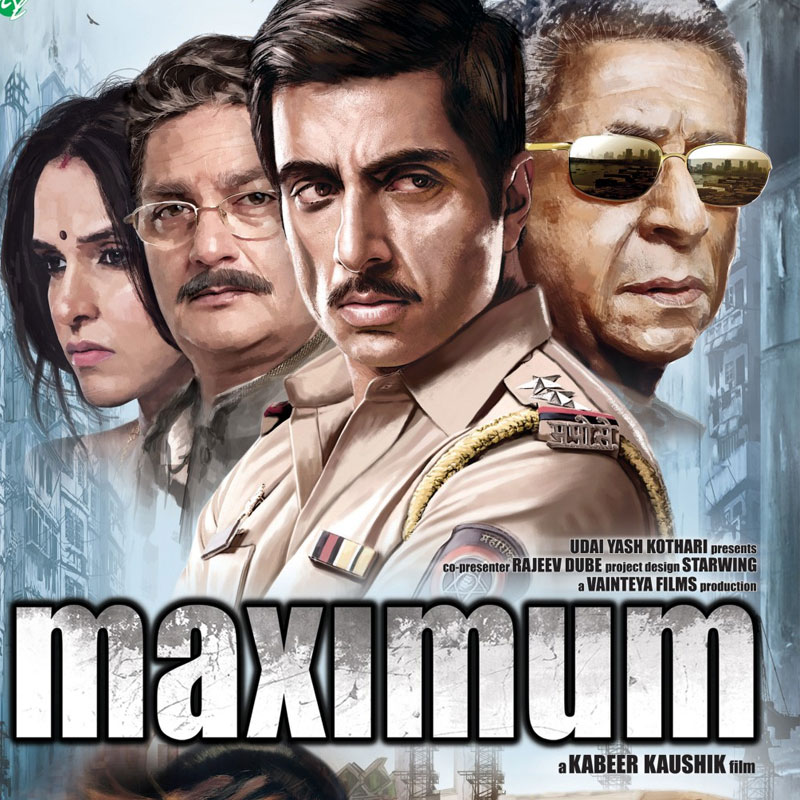
MUMBAI: In his earlier film Saher, director Kabeer Kaushik took Hindi filmmaking to Lucknow and made a reasonably plausible film. Why the film did not work should have dawned on him though. In Maximum, he imports Lucknow to Mumbai and comes up with a film which has no beginning and an end which makes no sense, with two senior policemen shooting each other in the finale!
There are no preambles, no once upon a time. As the film Maximum opens, you have this trigger happy policeman, Sonu Sood, shooting at all and sundry with glee. But all cops are normal at home, so we get to meet his family. He has a doting wife (Neha Dhupia), a daughter who can‘t manage her shoelaces and a father (Rajendra Gupta) who adds pathos and human angle to the story by suddenly collapsing of a heart attack.
Whatever one can understand of the story in the film is that Sonu Sood is a be-all and end-all of cops. He is an encounter specialist of the post-2003 police force of Mumbai and everybody, from fellow cops to politicians to underworld goons to starlets, is scared of him because he has a license to kill and no explanations are sought. He has but one adversary in Naseeruddin Shah, another senior encounter specialist, who wants to be in the place Sonu Sood enjoys. Both have a lobby supporting them, either within the police force or among politicians and builders. Finally, both end up shooting each other at, of all the places, Valsad railway station in Gujarat. The maker has a fascination with trains or probably that is how he defines the pace of life in Mumbai for a scene or sound of local trains is ubiquitous in the film.
The film is a reunion of Lucknow alumnus in Mumbai in that Sonu Sood is from Lucknow; his dad, Rajendra Gupta, is a professor from Lucknow who has dropped in on Sonu Sood to die on him; politician Vinay Pathak is from Lucknow (and conveniently an ex-student of Rajendra Gupta) and then there is a news channel reporter, also from Lucknow, who is, according to the film, the only and the star reporter on Mumbai‘s TV scene.
But, then there is a Lucknow reunion wrecker in Naseeruddin Shah. His antecedents are not deemed necessary to be established. He just pops up to spoil Sonu Sood‘s party. It seems that there is a rivalry between Sood and Shah over the body count of the encounter killings both have executed. Both cops, however, have one thing in common; they owe loyalty to opposing politicians, shooting unidentified extras in the day, mingling with big builders in the evening and dancing and making merry with nautch girls in bars at night. That, in general, is the sketch of Mumbai encounter cops for you.
There is no definite villain in the film. It is about the game of one-upmanship between two cops, two politicians and two builders and that too is given without dwelling on details. As the two cops play their games, Sood has the backing of Vinay Pathak and the news reporter, Aman Sadh, while Naseeruddin Shah has the backing of the all powerful home minister, Mohan Agashe. Someone had to give and it is Pathak who betrays Sood leading to final bloodbath culminating in both policemen killing each other in their fight for supremacy.
Maximum has no coherent script and comes across more as a live telecast of two warring cops. The story telling skill has been done away with. If the film is trying to tell two facets of a policeman when Sood is a caring husband, son and father at home, it is not relevant or of interest in any way. There is no scope for music but an item number has been forced in and wasted. Sonu Sood performs well but it is pointless as you don‘t know whether he is a hero or an antihero. Naseeruddin Shah has been miscast.
Vinay Pathak is convincing as a sweet-talking politician. Rajendra Gupta and Neha Dhupia, brought into contribute domesticity to the story, fail to do that as their parts are superficial. Neither dialogue not editing are appealing. The film, even at 106 minutes, is maximum stress on ones senses.
As for the box office prospects, Maximum has none.

Hindi
Jio Studios unveils AI-powered Krishna teaser at NAB Show 2026
Global first look of Krishna uses Galleri5 AI pipeline on Azure, Historyverse slate as Jio’s Dhurandhar crosses Rs 3,000cr worldwide.
MUMBAI: Krishna has just dropped a divine teaser and this time the gods are powered by silicon, not just scripture. Jio Studios and Collective Studios’ Historyverse stole the spotlight at the NAB Show 2026 in Las Vegas with the world’s first teaser for their upcoming theatrical feature Krishna, directed by Manu Anand. The big reveal happened during Microsoft’s keynote “Powering Intelligent Media, From AI Experimentation to Real-World Impact,” where the film’s AI-native production pipeline took centre stage alongside Collective Artists Network’s in-house platform, Galleri5.
At the heart of this mythological spectacle lies a fresh cinematic workflow built by Galleri5 on Microsoft Azure’s advanced AI and cloud infrastructure. Forget bolting AI onto traditional VFX or animation, this is an end-to-end, production-grade system woven into every layer: world-building, character creation, shot design and final output. Yet the storytelling remains firmly director-led, emphasising emotional depth, stillness, music and performance rather than pure spectacle. The result? Large-format theatrical cinema rooted in Indian history and culture, but conceived in ways that were simply not possible before.
Collective Artists Network runs Galleri5 natively on Azure, leveraging Microsoft Foundry and cutting-edge AI tools to handle film, episodic and advertising workflows in a secure enterprise environment. Microsoft highlighted Collective as a “Frontier” organisation successfully moving AI from pilot projects to real production-scale deployment in cinema. The technology is also on display at Microsoft’s NAB booth in the West Hall (Booth W1731).
Jio Studios (Media & Content Business, Reliance Industries), president Jyoti Deshpande said the project advances the studio’s mission to take Indian stories global with scale, ambition and authenticity, “With Krishna, we are embracing cutting-edge AI-led filmmaking while democratising these tools to make them more accessible, intuitive and cost-effective for storytellers everywhere.”
Collective Artists Network founder & group CEO Vijay Subramaniam added, “We’re using technology developed in India to carry our culture and history to audiences worldwide at a scale never seen before.”
Microsoft, vice president for telco media & entertainment, gaming Silvia Candiani noted that the media industry has reached an inflection point, “AI is no longer about experimentation but delivering real impact at production scale… By building AI-native creative systems on Microsoft Azure, Collective exemplifies how storytellers can unlock new formats, move faster and realise a true return on intelligence while keeping human creativity at the centre.”
Krishna forms part of Historyverse, Collective Studios’ ambitious slate of history and culture-driven IPs. The slate draws from iconic figures and traditions that shaped the Indian subcontinent, including stories inspired by Kali, Karna and Durga. It builds on the already-released Mahabharat: Ek Dharmayudh series, showing how ancient narratives can be reimagined for modern screens.
Jio Studios, India’s leading content studio and the media and content arm of Reliance Industries, continues its blockbuster run. The studio’s Dhurandhar franchise led by Dhurandhar and Dhurandhar: The Revenge has become the first Indian film series to cross Rs 3,000 crore worldwide. It also delivered three consecutive years of India’s highest-grossing Hindi films: Stree 2 (2024), Dhurandhar (2025) and Dhurandhar: The Revenge (2026). In just eight years, Jio Studios has assembled a library of over 160 films and series, with more than 60 titles winning over 500 awards. Other notable successes include Laapataa Ladies (India’s official Oscar entry 2025), Stree, Article 370, Shaitaan and Mrs.
The NAB unveiling marks another step in Jio Studios and Collective’s push to blend Indian storytelling talent with frontier technology proving that the future of cinema may well be both ancient in spirit and thoroughly modern in execution. For audiences who love epic tales with a fresh twist, Krishna promises to deliver divine drama, this time with a little help from the cloud.