iWorld
Local OTT players not distressed by YouTube’s Originals plan


MUMBAI: YouTube is battling OTT giants neck-to-neck with its introduction of Originals. YouTube’s wide reach in India is well-known to everyone. For a decade almost, it has been go-to place for any type of video. According to the KPMG 2018 report, the typical time spent by an average user on YouTube is around 8-12 minutes per session, time spent by subscribers on various OTT platforms ranges from 30-50 minutes per session. This statistics also indicates YouTube’s need to turn things around.
“Originals are the next big bait for all players and the entry of YouTube in this category is going to fire up the competition further. With our original content slate lined-up for the coming months, we are certain that it will stand out. We are confident of our understanding of the audience preference and believe that YouTube’s entry will be a healthy competition,” SPNI digital business head Uday Sodhi says.
The platform’s norm in other countries is to put original content behind a paywall but for now, it will focus on the ad-supported model in India. “There is no doubt that YouTube has a good internet / digital reach but it is not necessary that it will translate into great paid subscriber reach as well. The business of YouTube was built on the discovery of videos via search catering to predominantly shorter form viewership on the platform. Running a paid subscription service is a starkly different ball game,” Eros Now COO Ali Hussein comments.

Netflix and Amazon, two international rivals of YouTube, have been also upping their investment in local originals to woo the audience, with different business models though. These two platforms are known for loosening their purse strings when it comes to production cost. YouTube is also likely to invest heavily.
Viu content head India Bimal Unnikrishnan cites the example of the FMCG market where the existence of multinational companies could not desist the growth of local players. He thinks international OTT players coming in and commissioning original content would be good for the overall industry. Moreover, for local players, producing local content is easier while international players’ ability to create such content is limited.
“I think it will have an overall positive impact on OTT industry because YouTube is the biggest content aggregator in the market. Its entry in the space of creative originals will, of course, boost the overall dynamic of the market,” he adds.
Indian OTT players aren’t worried about YouTube’s entry into originals because their focus is on regional content library and multilingual originals and movies. “However, when we talk about YouTube’s foray into original content space, they are still in an initial stage and it is too early to say anything at this point in time,” says Hussein.
Sodhi mentions another important point. The expert says broadcaster-backed OTT platforms will always have a differentiated content strategy than independent players or production house-backed platforms. Notably, the KPMG report highlights that consumers spend more than half of their time watching TV content on OTT platforms.
In the Indian market, AVOD and freemium models dominate the business while SVOD is at a nascent stage. While YouTube, the undeniable king of digital ad has started with celebrity-led content, it is obvious more advertisers will show interest in their content if it increases the quantity.
Unnikrishnan thinks YouTube’s entry will boost the overall digital ad spend from advertisers. As all OTTs have a different target audience to reach, advertisers will not stick to one big player only. Sodhi on a similar note says that the rise in the number of players will enhance content quality, thus giving a thrust to revenues in digital advertising. Hussein also says that brands would tend to associate with the platforms wherein their OTT brand and content resonate with their objectives to deliver the brand story.
Marketing will be a big game for players to follow. “When it comes to marketing outlay, I don’t think marketing cost will be that critical. Each one will spend as much money as needed to reach out to the target audience. In digital, we are extremely focused in terms of target. I think the strategy will play a bigger role than cost itself,” says Unnikrishnan.
Though the tech giant’s Indian originals are going to be a game changer, at least for now they will not affect local OTT players. YouTube India entertainment head Satya Raghavan himself insisted that the move is about growing the video pie not just for their own creators but for the entire online video industry.







iWorld
Micro-Dramas Surge in India, Redefining Mobile Content Habits
Meta-Ormax study maps rapid rise of short-form storytelling among 18–44 audiences.
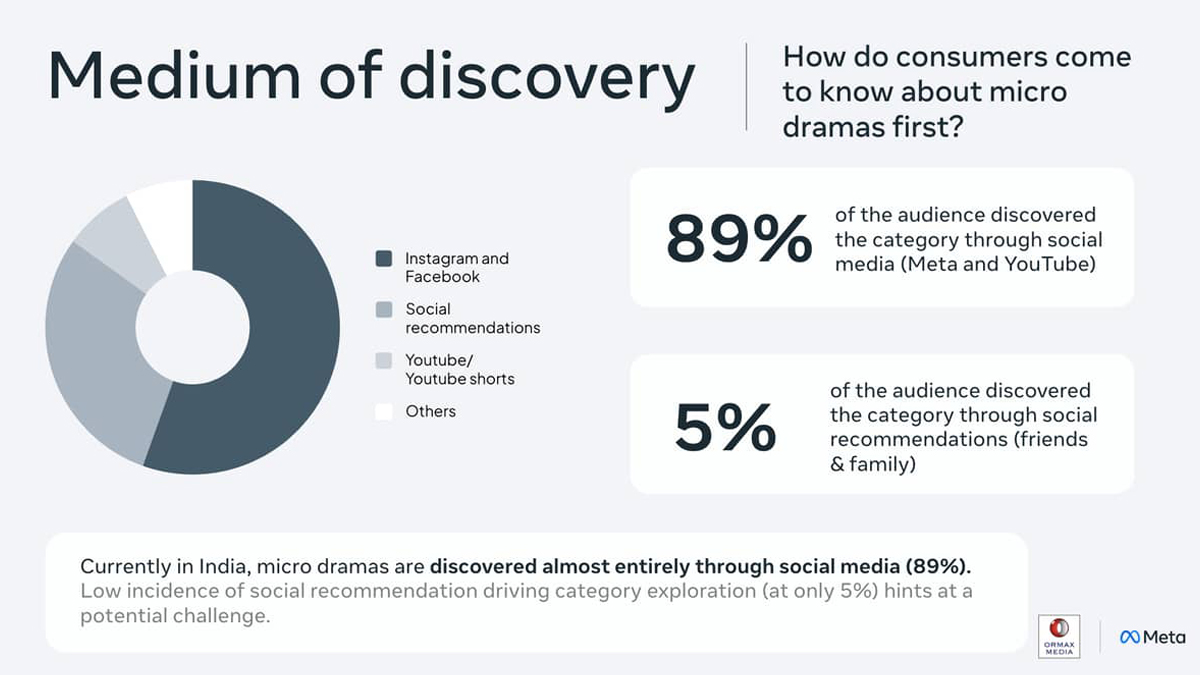
MUMBAI: Micro-dramas aren’t just short, they’re the snack that ate Indian entertainment, and now everyone’s bingeing between the sofa cushions. Meta, in partnership with Ormax Media, has released ‘Micro Dramas: The India Story’, a comprehensive study unveiled at the inaugural Meta Marketing Summit: Micro-Drama Edition. The report maps how the vertical, bite-sized format is reshaping content consumption for mobile-first audiences aged 18–44 across 14 states.
Conducted between November 2025 and January 2026 through 50 in-depth interviews and 2,000 personal surveys, the research reveals that 65 per cent of viewers discovered micro-dramas within the last year proof of explosive adoption. Nearly 89 per cent encounter the format through social feeds and recommendations, making algorithm-driven discovery the primary engine rather than active search.
Key viewing patterns show a median of 3.5 hours per week (about 30 minutes daily) spread across 7–8 short sessions. Consumption peaks between 8 pm and midnight, with additional spikes during commutes and work breaks classic “in-between moments” that the format fills perfectly. Around 57 per cent of viewing happens in ambient mode (while doing something else), and 90 per cent is solo, enabling more intimate, personal storytelling.
Romance, family drama and comedy lead genre preferences. Audiences show growing openness to AI-generated content, 47 per cent find it unique and creative, while only 6 per cent say they would avoid it entirely. Regional languages are surging after Hindi and English, Tamil, Telugu and Kannada dominate consumption.
Meta, director, media & entertainment (India) Shweta Bajpai said, “Micro-drama isn’t a passing trend, it’s rewriting the rules of Indian entertainment. In under a year, an entirely new category of platforms has emerged, built audience habits from scratch, and created a business vertical that is scaling fast.”
Ormax Media founder-CEO Shailesh Kapoor added, “Micro-dramas are beginning to show the early signs of becoming a distinct content category in India’s digital entertainment landscape. When a format aligns closely with how audiences naturally engage with their devices, it has the potential to scale very quickly.”
The study proposes ecosystem-wide responsibility, universal signposting of commercial intent, shared accountability among advertisers, platforms, creators, schools and parents, built-in safeguards, and formal media literacy in schools.
In a feed that never sleeps and a day that never stops, micro-dramas have slipped into the cracks of every spare minute turning 30-second stories into the new national pastime, one vertical swipe at a time.







