Hindi
KIFF opens amid glitz and glamour


KOLKATA: The 19th Kolkata International Film Festival kicked off with a bang on Sunday with actors including Amitabh Bachchan, Jaya Bachchan, Shah Rukh Khan, Mithun Chakraborty and Kamal Haasan gracing the show. The eight-day festival that paid tribute to 100-years of Indian cinema was inaugurated by the West Bengal Chief Minister Mamata Banerjee at Netaji Indoor Stadium, who also announced that from its next edition, it will be a competitive affair.
Other distinguished guests like filmmaker Sandip Ray, Bengali film actress Sabitri Chatterjee and Supriya Devi, Dipankar Dey and music director Dwijen Mukherjee, also participated in the lamp lighting ceremony that concluded with Big B releasing the fest’s brochure.

Actors of the regional film industry Dev and Koel Mallick felicitated Big B with an uttariya (scarf) and a metal-cast memento. The other luminaries were welcomed subsequently in a similar manner.
Over the next eight days, the festival will feature 189 films from 63 countries at 13 venues including Nandan-Rabindra Sadan complex, Inox City Centre 1 and Star Theatre. The festival will witness an estimated 3,000 delegates and 24 international guests. Noted Israeli filmmaker Amos Gitai is also likely to attend the film festival and also conduct a workshop for film students.
Others who are expected at the event include Bollywood actor Sharmila Tagore, director Madhur Bhandarkar and Shoojit Sarkar, National Award-winning Malayali filmmaker Adoor Gopalakrishnan, among others. Actors Sushmita Sen, Konkona Sen Sharma, Moushumi Chatterjee, Bipasha Basu and Rani Mukherjee will attend the closing ceremony on 17 November.
“The film screening is going to be an enriching experience for cinema connoisseurs,” said experts present at the event.
Shah Rukh Khan, who is also the brand ambassador of West Bengal, hopes that platforms like the KIFF will take Indian films to greater heights. “Creative interactions of this scale will help Indian films reach new heights, something that great filmmakers present tonight, and those who have passed away, like the wonderful Rituparno, dreamt for Indian cinema,” said Khan.
Thousands of film lovers swarmed the venue to attend the glittering ceremony and get a glimpse of their favourite stars present at the event. They were mesmerised by the speech of the actors, especially Bachchan, who interspersed his speech with Bengali words and renditions of Bengali poems.






Hindi
Remembering Gyan Sahay, the lens behind film, television and advertising
From a puppet rabbit selling poppadums to Hindi cinema, he framed it all.
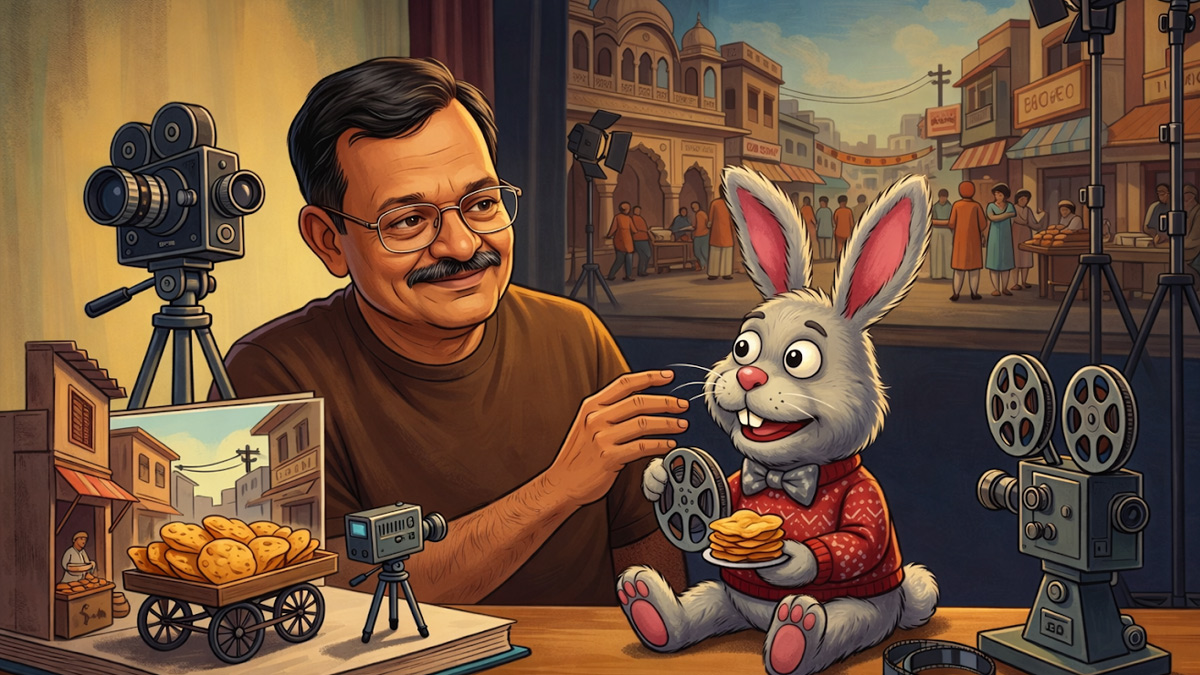
MUMBAI: There are careers, and then there are canvases. Gyan Sahay, the veteran cinematographer, director, and producer who passed away on 10 March 2026 in Mumbai, had one of the latter. Over several decades in the Indian film and television industry, he turned lenses, lights, and the occasional puppet rabbit into something approaching art.
A graduate of the Film and Television Institute of India (FTII) in Pune, Sahay built his reputation as a director of photography across a career that stretched from the early 1970s all the way to the digital age. He was the kind of craftsman who understood that a well-composed shot is not merely a technical achievement but a quiet act of storytelling.
For most Indians of a certain age, however, Sahay will forever be the man behind the rabbit. His direction of the iconic long-running television commercial for Lijjat Papad, featuring its now-legendary puppet bunny, gave the country one of its most cheerfully persistent advertising images. It was the sort of work that sneaks into the national subconscious and takes up permanent residence.
His big-screen credits as cinematographer include Anokhi Pehchan (1972), Pagli (1974), Pas de Deux (1981), and Hum Farishte Nahin (1988). In 1999, he stepped behind a different kind of camera altogether, making his directorial debut with Sar Ankhon Par, a drama that featured Vikas Bhalla and Shruti Ulfat, with a cameo by Shah Rukh Khan for good measure.
On television, Sahay was particularly prized for his command of multi-camera production setups, a skill that made him a go-to technician for large-scale shows and reality programmes. In an industry that has never been especially patient with complexity, he was the calm hand on the rig.
In later life, Sahay turned teacher. He participated regularly in masterclasses and Digi-Talks, often hosted by organisations such as Bharatiya Chitra Sadhna, sharing hard-won wisdom on cinematography, the comedy of timing in a shot, and the sweeping changes brought by the shift from celluloid to digital. He was also said to have been involved in a project concerning a biographical film on Infosys co-founder N.R. Narayana Murthy.
Tributes from the film industry poured in following the news of his passing, with colleagues remembering him as a senior cameraman who served as a rare bridge between two entirely different eras of Indian cinema. That is, perhaps, the finest thing one can say of any craftsman: he kept up, and he brought others along with him.







