iWorld
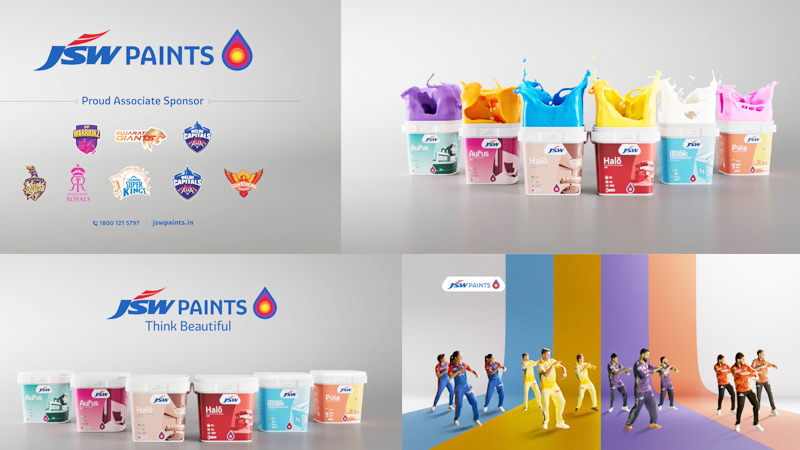
JSW Paints hits a six with ‘Rangon Ka Khel 2.0’ for IPL 2025
MUMBAI: When cricket meets colour, sparks fly — and in JSW Paints’ case, so do sponsorships, anthems and a whole lot of vibrancy. The brand has returned to IPL 2025 with ‘Rangon Ka Khel 2.0’, a souped-up sequel to its previous campaign that paints the town (and your screen) in fifty shades of fandom.
The campaign comes packed with a new anthem, a blockbuster brand film, and a dazzling display of sporting partnerships. Sunil Gavaskar and Mithali Raj, cricketing royalty themselves, lend gravitas and nostalgia to the campaign, bridging generations with ease. Their inclusion ensures that this isn’t just a marketing play — it’s a celebration of legacy.
“Cricket is not just a game; it is a festival of emotions, and unity… With ‘Rangon Ka Khel 2.0,’ we aim to capture this essence,” said JSW Paints joint MD & CEO AS Sundaresan.
JSW Paints has gone big on the cricket pitch by sponsoring five IPL teams — Delhi Capitals, Kolkata Knight Riders, Sunrisers Hyderabad, Rajasthan Royals, and Chennai Super Kings. And the rainbow doesn’t stop there. The brand has also partnered three WPL teams: Gujarat Giants, Delhi Capitals, and UP Warriorz, making it one of the most aggressive brand placements this season.
“Our expanded partnership with IPL and WPL teams reflects our commitment to connecting with fans on a deeper level,” said JSW Paints CBO Ashish Rai.
The campaign film is a technicolour explosion of energy, unity, and raw cricket love. It celebrates how rival jerseys may clash, but passion paints us all the same.
“Rival colours light up the field, but the colour of love for the game never changes… This anthem celebrates cricket’s magic—vivid, vibrant, and unifying,” said TBWAIndia CEO Govind Pandey.
And if that wasn’t enough to get you grooving in your living room, TBWAIndia CCEO Russell Barrett wrapped it up perfectly, “Our campaign brings together the energy of IPL, the excitement of cricket, and the unifying spirit of the game…”
Whether you’re a Dhoni devotee or a Gill geek, JSW Paints is giving every fan a reason to cheer — in high-definition hues.

iWorld
Meta plans 8,000 layoffs in new AI-led restructuring wave
First phase from May 20 may cut 10 per cent workforce amid AI pivot.
MUMBAI: At Meta, the future may be artificial but the cuts are very real. The social media giant is reportedly preparing a fresh round of layoffs, with an initial wave expected to impact around 8,000 employees as it doubles down on its artificial intelligence ambitions. According to a Reuters report, the first phase of job cuts is slated to begin on May 20, targeting roughly 10 per cent of Meta’s global workforce. With nearly 79,000 employees on its rolls as of December 31, the move marks one of the company’s most significant workforce reductions in recent years.
And this may only be the beginning. Sources indicate that additional layoffs are being planned for the second half of the year, although the scale and timing remain fluid, likely to be shaped by how Meta’s AI capabilities evolve in the coming months. Earlier reports had suggested that total cuts in 2026 could reach 20 per cent or more of its workforce.
The restructuring comes as chief executive Mark Zuckerberg continues to steer the company towards an AI-first operating model, committing hundreds of billions of dollars to the transition. Internally, this shift is already visible: teams within Reality Labs have been reorganised, engineers have been moved into a newly formed Applied AI unit, and a Meta Small Business division has been created to align with broader structural changes.
The trend is hardly isolated. Across the tech sector, companies are trimming headcount while investing aggressively in automation. Amazon, for instance, has reportedly cut around 30,000 corporate roles nearly 10 per cent of its white-collar workforce citing efficiency gains driven by AI. Data from Layoffs.fyi shows over 73,000 tech employees have already lost jobs this year, compared with 153,000 in all of 2024.
For Meta, the move echoes its earlier “year of efficiency” in 2022–23, when about 21,000 roles were eliminated amid slowing growth and market pressures. This time, however, the backdrop is different. The company is financially stronger, generating over $200 billion in revenue and $60 billion in profit last year, with shares up 3.68 per cent year-to-date though still below last summer’s peak.
That contrast underlines the shift underway. These layoffs are less about survival and more about reinvention. As Meta restructures itself around AI from autonomous coding agents to advanced machine learning systems, the question is no longer whether the company will change, but how many roles will be left unchanged when it does.