Hindi
Jab Tak Hai Jaan: A feeble swansong by Chopra

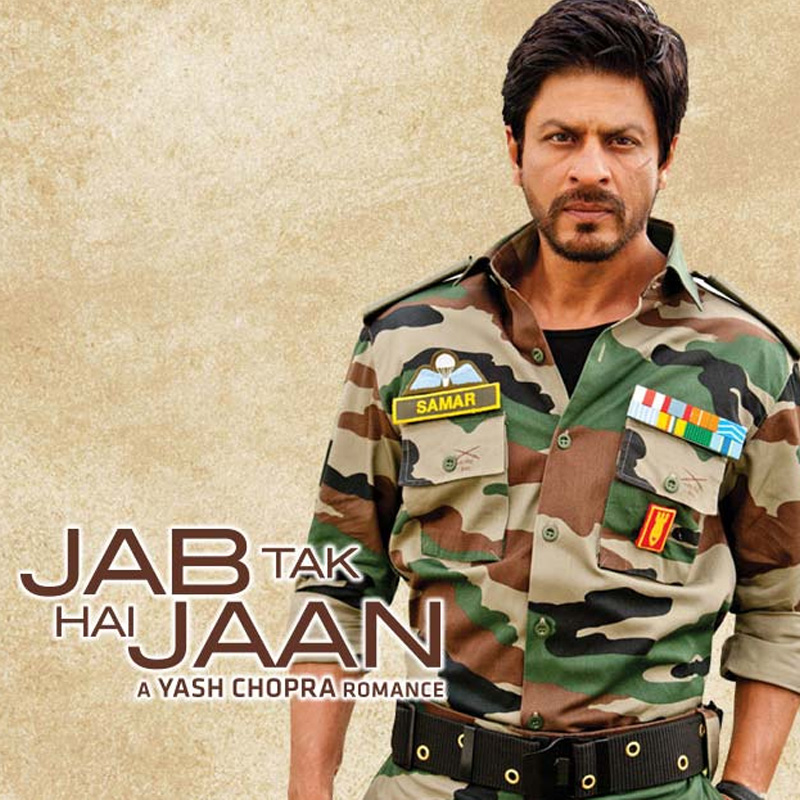
MUMBAI: A Yash Chopra film means romance and soulful music that stays with you for a lifetime and emotions that tug at your heart. A Yash Chopra film is also expected to be made of a totally homemade recipe, his leanings towards Punjab culture being part of his package.
Jab Tak Hai Jaan, Yash Chopra‘s last hurrah, alas, does not live up to the maker‘s lifelong formula and belief of his idea of a film story: romance, music, bonding. For Shah Rukh Khan‘s character of the bomb expert, the writer has chosen to borrow the character of Jeremy Renner, the hero of Hurt Locker; the character also brings along with him all the bomb diffusion sequences from the film. And the resemblance of Khan‘s London years with Jeremy Renner‘s own life story cannot be purely incidental.
Anushka Sharma jumps into a pond at a deserted location in Ladakh and pretends to be drowning to draw the attention of Khan, who is camping solo on the shore taking break from his journey. He travels like a cowboy, using his Bullet bike instead of a horse. He saves her, drapes her in his army jacket and departs as if nothing had happened. For Sharma, this was just a game as she has shot the event on a video camera to win a bet with her friends. The jacket Khan leaves behind contains his diary where he has meticulously penned his life till date. As Sharma starts reading the pages, Jab Tak Hai Jaan unfolds in flashback.
Khan is in the UK making a living by being a busker at times (a busker sings or performs in a public place to earn money), a restaurant waiter at others, when he is not clearing your driveway of heavy snow. He is a multifaceted Punjabi man who sings only Punjabi tunes to the London masses, which generously fill his begging bowl with coins and notes (beggar being how a busker would be seen in India). But for a loner who has no demands in life, that is not enough for the hero Khan. He also washes cars and serves as a waiter for God knows who since he has no aspirations! The idea is to make him a larger-than-life hero.
Khan, among his other jobs, is strumming his regular Punjabi song, Challa…, on the streets and over the bridges of London and it so happens that Katrina Kaif, the daughter of a tycoon (Anupam Kher), happens to pass him by notwithstanding his change of location each day! She even drops a pound or two in his collection plate. Soon, the rich vs poor love has happened and the two are inseparable. The only problem is that, Kaif answers only to ‘Sir Jesus‘, her confidante and faith keeper; she trades with the Lord on regular basis giving up her favourite things for wishes granted.
One fine day, Khan drops her off after their little rendezvous. On the way back, he meets with a near-fatal accident. Kaif swears by ‘Sir Jesus‘ that she would never meet Khan again if his life is spared; ‘Sir Jesus‘ does the needful. Kaif keeps her commitment and severs all ties with Khan. Khan, on his part, is somehow not disappointed with Kaif-he holds ‘Sir Jesus‘ responsible. He decides to court death everyday of his life and visits the church to challenge the Lord to kill him. Kaif‘s parting request to him is that he leaves London and he duly obliges by returning to India.
Before the parting of the lovers, Kaif had made a one-month pact with him that he would teach her a Punjabi song which she then would sing for her father as a surprise to him and overwhelm his Punjabi heart. She in turn would teach him English. Possibly thanks to that one-month crash course in English, Khan qualifies to join as an officer in the bomb disposal squad of the Indian army.
There are age bars and minimum education qualifications required to join an army but that does not seem to apply to a film hero. Khan is now a Major in the Indian Army‘s Bomb Disposal Squad. He leads a group but when it comes to a mission, he works alone and wears no protective gear; his dare to ‘Sir Jesus‘ stands. Khan has become a legend and like the encounter specialist cop‘s Ab Tak Chhappan, his score stands two short of a century, having diffused 98 bombs.
Sharma has finished reading the diary and is not sure if this is Khan‘s story or fiction. But if it is his story, she has already fallen for him! The diary has changed this believer of one-night stands into a romantic. She is enamoured and wants to do a feature on Khan for Discovery Channel, which would bring her close to him as well as cement a permanent job for her with the channel. In the process of making her feature on Khan, she manages to break the ice with him as he softens up to her. Her admiration keeps mounting for after all, he not only excels at diffusing bombs but can even repair her video camera when it breaks.
The feature is complete and approved by the channel heads but the rules dictate that the maker as well as the protagonist needs to be present at the launch. Reluctant at first, Khan agrees to visit London for the event only to meet with another accident this time. The accident causes retrograde amnesia in Khan; this takes his memory status back by ten years to when he had met with his first accident and takes the film‘s script level to 1960s films.
Khan can‘t remember a thing about past ten years now; not his army days nor his tryst with Sharma. All he does is keep asking for Kaif. The doctor treating Khan, Sarika, seems to be familiar with 1960s films and devises a way to cure Khan without risking a side effect. According to her therapy, Kaif needs to pretend to be Khan‘s wife, accompany him to all those places in London he was familiar with. The scheme works, memories of the missing ten years come in flashes till there is a bomb situation on a London underground train and he instinctively volunteers to diffuse it and he is back to normal status with everything falling in place. It is time for the original lovers to unite.
Jab Tak Hai Jaan is a lengthy film: 40 seconds short of three hours. Three characters are expected to see those hours through, a tough call as the film is put together by a script of convenience. The music does not come up to levels set by Yash Chopra films; it is too heavy on Punjabi words and flavour with uninspiring lyrics. The romance between Khan and Kaif is not very convincing (their cause for parting is superficial), the film lacks on solid emotions and fails to touch the viewer. To add to these woes, the major let down is Khan; he looks jaded, his pairing against two much younger women making it jarringly obvious. He fails to charm his fans as always. Kaif, on her part, shares little chemistry with Khan if at all. Sharma brings some life to the film but her role does not get her very far. So, what does one have the film to remember by? Well, it is a cameo by Rishi Kapoor and Nitu Singh, who land the film a few minutes of freshness.
Yash Chopra‘s direction shows his usual touch of class and finesse aided by excellent cinematography by Anil Mehta at the same time showing his blind faith in a weak script.
Jab Tak Hai Jaan drains the viewer of patience, falls short of the expectations generated by the pre-release hype and its makers‘ label which, despite its Diwali release, is bound to reflect on its box office outcome.
Son Of Sardar: A rom-com..almost
 |
|
Producers: Ajay Devgn, NR Pachisia, Pravin Talreja. |
Son Of Sardar is a typical masala comedy of the sort the South churns out, with action and full star cast trying to raise laughter. The plot is basic: boy meets girl, they fall in love but they both belong to warring families. And why not! Even if Son Of Sardar is a remake of the Telugu film Maryada Ramanna, the later is a lift from the 1923 Buster Keaton silent movie, My Hospitality. Despite its title, the film is about two Sardar families, one Pagree clad and the other an assorted lot.
Ajay Devgn is in London ‘doing what all Punjabis do, looking for something to do‘. Six months into his stay in London, he has already caused enough trouble. Whatever he does, his Pathan friend, Salman Khan (cameo) promises to stand by him. That is when he receives a mail from a tehsildar in a small town in his native Punjab informing him that he has inherited a huge plot of farm and that he should come back to claim it. Simple enough, Devgn decides to go there, sell of his land and return with money to start a business in London. Turns out that things are not all that simple and waiting for him in his native town is a bunch of another clan of Sardars who want to kill him and end an age old feud, a feud Devgn is not even aware of.
In India, Devgn takes a train to his hometown and the ground is laid for romance and to connect the feuding families. Sonakshi Sinha boards the same compartment as Devgn. Some pranks and odd situations later, the girl is duly charmed. After landing in town, the first attempt to liquidate Devgn comes from Mukul Dev, one of the enemy clan members; having given a lift to Devgn halfway down the road he learns that this is the guy they had been waiting for since 25 years. His attempts, first with a gun and later with a sword, chasing Devgn through the by lanes of the small town, prove disastrous for himself while his victim is oblivious of the charade. The sequence sort of sets the tone of things to follow when Devgn comes face-to-face with the enemy clan led by Sanjay Dutt. Dutt has sworn off marriage till he kills last of the Devgn‘s family hence his fiancé, Juhi Chawla, calls herself his Muhboli biwi!
This happens soon enough as Devgn is advised against going to tehsildar and to go to Dutt instead, the de facto boss of the town who can settle things faster than the tehsildar. Being a comedy, Devgn ends up asking Dutt where he could find Dutt! The problem is reported to Dutt, surrounded by his family and cronies who include Vindu, Rajesh Vivek and others. Sinha, Dutt‘s niece is around and seeing that Devgn and Sinha know each other, Devgn is invited to a lunch and sees the family‘s hospitality by Dutt.
Over lunch Devgn‘s family roots are revealed and all hell breaks loose. Every man in the room and a small army outside the house is ready to kill him. But it has been conveyed at the outset that the Dutt clan‘s rules prohibit harming a guest while he is on family premises: Atithee Devo Bhava–Guest Is God–and all that. Devgn now knows what is happening and decides to keep finding reasons not to leave the house even as his hosts are itching to get him out and finish the job. The compulsion also gives him chance to woo Sinha till he is finally led into a trap with the town cop and taken to a secluded place where he is surrounded by Dutt‘s cronies.
It is time to move from comedy to some hardcore action and also some computer-generated action. However, actions involving an animal, a horse in this event, mandates a footnote in the film‘s frame asserting it is a computer generated stunt so that no animal was harmed, a fact that takes away the thrill of that effort. The other problem in fights with Devgn and Dutt is that neither of the two can be shown to be losing and the bout only amounts to both exchanging countless blows for nothing. Meanwhile, there is an ample supply of Punjabi and Sardarji jokes with Dev playing the dimwit of the family and Vindu complementing him.
Son Of Sardar is an action comedy but since none in its main cast is a natural comic, the funny scenes are generally situational and jokey. Devgn is good in his comic scenes with Sinha while in action he maintains his image. Dutt has to look menacing which he does without effort. Dev and Vindu are good with Vivek, Tanuja and Arjan Bajwa supporting well. Sinha‘s frame is expanding faster than her career. Chawla still manages to look bubbly. Directorially, the film is okay with some scenes stretched unnecessarily. The music is foot tapping with the title song sure to be a favourite in the wedding seasons in the North. Dialogue has a mix of wit and puns and some are good while some are PJs. Other aspects are passable.
Son Of Sardar has some juvenile entertainment to offer but nothing that has not been seen many times in last few years. Its range at the box office, hence, is limited.






