News Headline
Isro unveils Satellite Integration and Testing Establishment

BANGALORE: Finding the current facility too small and congested, Indian Space Research Organisation (ISRO) has come up with a brand new facility spread over 100 acres of land on the outskirts of Bangalore. The facility is christened ISRO Satellite Integration and Testing Establishment (ISITE).
So far, Isro had to carry the satellite from one part of the complex to the other for various tests. The new facility at Marthahalli offers world class Assembly Integration and Test (AIT) complex bringing all spacecraft integration under one roof. A tested satellite comes out of the same door through which its knocked down parts go into.
ISITE is equipped with world class facilities and will enable Isro to assemble, and carry out various tests and then pack the assembled satellite for dispatch to the launch site. Some of the state of art facilities and equipment include:

(1) Assembly Integration & Test (AIT) Clean room – this is a huge room of size 54.6mts (about 179 feet) x 34.6m (about 113.5 feet) x 16.7m (about 55 feet) height which is maintained at a temperature of about 22 deg C (72 deg F) with a relative humidity of around 55, a cleanliness level of 1,000,000 class maintained at a positive pressure of 20 mbar.
The bare structure of Insat 4B, which is scheduled for launch in January 2007, was under assembly when Indiantelevision.com visited the site. This room can integrate up to six satellites in various stages of assembly simultaneously of Insat 4B class and is equipped to integrate around 800 elements in the bare structure of the spacecraft. This area has an Electro Static Discharge (ESD) floor to dissipate the micro electric charges from human bodies which could effect some sensitive equipment in the room.
(2) Comprehensive Assemble and Test Vacuum Chamber (CATVC) is capable of testing satellites under vacuum conditions and at temperatures as low as 173 deg K {(-)100 deg C or (-)343 deg F }. Satellites up to 4.5m diameter (about 14.75 feet) and 6 meters length (about 20 feet) having a weight of 3 metric tons can be tested in this Chamber which has Ariane-5 adapter interfaces.
(3) Comprehensive Assembly and Test Vibration Facility: This test facility has a peak sine force of around 29 ton-force and a maximum bare table acceleration capacity of 75 gm.
(4) Compact Antenna Test Facility (CATF): This is a 30 meter long (100 feet), 20 meter wide (67 feet) and 16m high (52 feet) chamber for testing of antenna in space simulated conditions. ISRO officials claim that no other facility in the world has a similar arrangement.
The facility was officially thrown open by national security advisor M K Naraynan. Other dignitaries who were present to witness the inauguration included former Isro chairmen U R Rao and K Kasturirangan, secretary Department of Ocean Development P S Goel (formerly from Isro and one of the persons who conceived the idea for the Integration and Testing facility) and ISAC director K Shankara. On completion, the project is estimated to cost around Rs 4 billion.




NEW DELHI: Hamdard Laboratories gathered a cross-section of India’s achievers in New Delhi on Friday, handing out the Hakeem Abdul Hameed Excellence Awards to figures who have left their mark across healthcare, education, sport, public service and the arts.
The ceremony, attended by minister of state for defence Sanjay Seth and senior officials from the ministry of Ayush, celebrated individuals whose work blends professional success with a sense of public purpose. It was as much a roll call of achievement as it was a reminder that influence is not measured only in profits or podiums, but in people reached and lives improved.
Among the headline awardees was Alakh Pandey, founder and chief executive of PhysicsWallah, recognised for turning affordable digital learning into a mass movement. On the sporting front, Arjuna Awardee and kabaddi player Sakshi Puniya was honoured for her contribution to the game and for pushing women’s participation onto bigger stages.
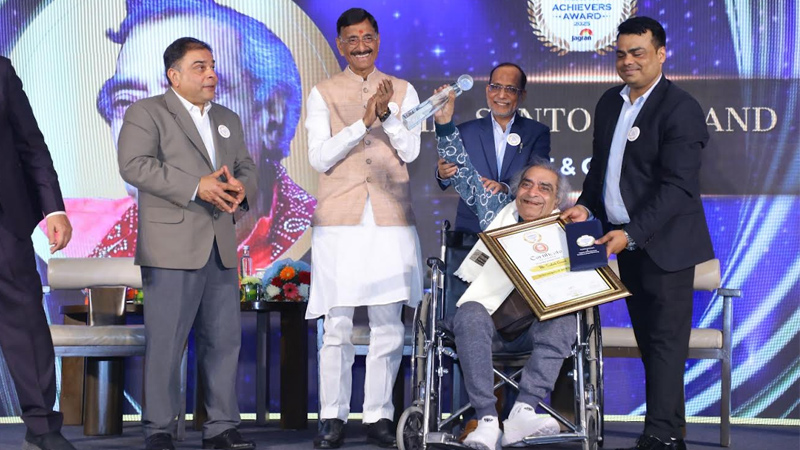
The cultural spotlight fell on veteran lyricist and poet Santosh Anand, whose songs have echoed across generations of Hindi cinema. At 97, Anand accepted the honour with characteristic humility, reflecting on a life shaped by perseverance and hope.
Healthcare honours spanned both modern and traditional systems. Manoj N. Nesari was recognised for strengthening Ayurveda’s place in national and global health frameworks. Padma shri Mohammed Abdul Waheed was honoured for his research-backed work in Unani medicine, while padma shri Mohsin Wali received recognition for his long-standing contribution to patient-centred care.
Education and social development also featured prominently. Padma shri Zahir Ishaq Kazi was honoured for decades of work in education, while former Meghalaya superintendent of Police T. C. Chacko was recognised for public service. Goonj founder Anshu Gupta received an award for his dignity-centred rural development initiatives, and the Hunar Shakti Foundation was honoured for empowering women and young girls through skill development.
The Lifetime Achievement Award went to former IAS officer Shailaja Chandra for her long career in public healthcare and governance, particularly in the traditional systems under Ayush.
Speaking at the event, Hamdard chairman Abdul Majeed said the awards were a tribute to those who combine excellence with empathy. “These awardees reflect Hakeem Sahib’s belief that healthcare, education and public service must ultimately serve humanity,” he said.
Minister Seth struck a forward-looking note, saying India’s young population gives the country a unique opportunity to become a global destination for learning, health and wellness by 2047.
The ceremony also featured the trailer launch of Unani Ki Kahaani, an upcoming documentary starring actor Jim Sarbh, set to premiere on Discovery on 11 February.
Instituted in memory of Unani scholar and educationist Hakeem Abdul Hameed, the awards have grown into a national platform that celebrates those building a more inclusive and resilient India. For one evening at least, the spotlight was not just on success, but on service with substance.






