News Headline
IPL: Multiple media rights is an advantage for the bidders

MUMBAI: The three-day e-auction of IPL media rights 2023-2027 has concluded on Tuesday, with Disney-Star bagging TV rights for the Indian subcontinent and Viacom18/ Reliance sweeping the digital segment.
The total value of digital broadcast rights for IPL has reached Rs 23,757.52 crore. This means that the value of digital media rights to the IPL has surpassed the TV broadcast rights valued at Rs 23,575 crore. The total valuation of IPL media rights for the next five years has reached Rs 47,332.52 crore.
We have asked experts about why IPL media rights being distributed among broadcasters is a positive approach. Do experts think one can get leverage against the other players and there would be a fair deal in place?

Speaking on the IPL media rights being distributed, Madison Media & OOH Group CEO Vikram Sakhuja noted that rights being split up is a good thing for media buyers. “My point of view is that from a media buying standpoint it is probably an advantage. This is because if you deal with two or three partners your ability to leverage one against the other is better compared to all the cards being held by one person.” He noted that while the fall in IPL ratings on TV was disappointing, hardly anybody comes on to it just for cost per rating point (CPRP). They look to create an impact in a short time. That is why, he explains why many startups in categories like ed-tech are advertising.
Broadcasters, he explains, are generally good for making up the shortfall in ratings by giving things like bonus spots. Benchmarks are there and everyone is here to provide value. “Ratings alone is not why people take the IPL. It is about the passion behind the property and the impact that you get. This is huge. Clients get the reach, conduct a relatively clutter-free campaign and also get strong visibility. It is the clients who wanted to grow their business quickly who came onto the IPL.”
For him, the bigger challenge facing the rights holders for the IPL in the next season is the funding for startups, which is facing a winter. If the funding dries up and that situation stays, bad startups will have to cut back on marketing spending. Their outlays for the IPL will get affected. “Outlays rather than ratings will be the deciding factor for the next season. Will clients who like the IPL have enough outlay for next season? How many of them will have the appetite to return next year is the bigger question. If the startup money is there, things will be fine. But if not then will anybody else come in their place? For FMCG CPRP is very important. For that reason, they do not come to the IPL.”
Meanwhile, D & P India Advisory managing partner N Santosh feels that IPL will be a loss leader for both the TV rights holder and the digital rights. It would be a bit of a stretch to expect a profit. The amount of ad revenue in a season on television is around Rs 3000 crore in a best-case scenario. Of course, with more matches, this amount will rise. Then there are production costs. “It is good to have content but the TV rights holder may start making money only in the fourth or fifth year if viewership has risen significantly and ad rates have risen significantly. Then for those years, they might make a profit. But this content is important to have. It will grow its general entertainment business as subscription bundles can be offered. GEC can be sold with sports and that could add subscription revenue. For advertisers, bundles can be offered and revenues can be maximised. The GEC business is always profitable and IPL will only add profits to the GEC business.”
On the digital front, he thinks that Reliance due to Jio as a Super App will be able to monetise it slightly better compared to if another OTT platform had got the rights to Package B. The IPL can help add subscribers to Reliance’s telecom business. The IPL will be a bigger loss leader in digital. Ad revenue on digital is not that significant based on research that his company has done. “Ad revenue, the way it has been monetised so far on OTT platforms is not that material. But the IPL can be used to improve the subscription monetisation of the platform including the GEC, and movie library business. So digital ad revenue will not be that important. It will mostly be about the subscription. I have not seen OTT platforms monetise advertising that well.”
He also does not think that the rights being split up will affect monetisation ability. “I don’t see a major difference compared to one party having both TV and digital rights. The advertisers and subscribers are anyway different. Star and Hotstar from a subscription point of view were not bundled together. The packages were different.”
When asked about the per match value of the IPL from a broadcast rights point of view being the second in the world ahead of the premier league he noted that cricket is advertiser-friendly. Meanwhile, soccer relies more on subscriptions. Also, in the premier league often more than one match is played at the same time. So the viewership gets spread out. The IPL matches only take place one at a time, which is an advantage. In soccer, a Manchester United fan will only watch matches featuring that club. Whereas with the IPL even if you are a RCB fan you will still watch an IPL match not featuring that team as there are no other IPL matches going on at the same time.
In the context of ratings, IPG Mediabrands CEO Shashi Sinha said as far as TV is concerned, the ratings are an indicator, it is a question of advertiser’s supply and demand. If there is a huge demand then the property will do well next year. He noted that one will have to see how the economy is faring when the next edition of the IPL happens.
“Ratings are one part of it but finally it is about supply and demand. Ratings are just an indicator. We will have to see what big product launches are happening around the IPL. What are the new categories coming up? If the economy grows then the advertiser response will be good. If the Indian economy does not grow then it will be a problem. It is also not a question of just one year,” Sinha added.
He said that the winner must have taken a call of the economy doing well in the next five years. Sinha also noted that competitor’s pressure will play a role in IPL sponsorship. He gave the example of Byjus doing a deal with FIFA for the World Cup later in the year. For him the ability of Disney-Star to take the sponsorship and spot rates up will depend on the economy. It will also be upto Disney-Star on whether they go for an increase in rates at one go or raise rates gradually over the years.
He further noted the digital rights holder, in this case, Viacom18 will depend a lot on subscription. “All sports properties including EPL rely on subscription to an extent. Sometimes the dependence on subscription is higher. I am sure that Reliance will focus on subscription being a major telecom player,” he concluded.





NEW DELHI: Hamdard Laboratories gathered a cross-section of India’s achievers in New Delhi on Friday, handing out the Hakeem Abdul Hameed Excellence Awards to figures who have left their mark across healthcare, education, sport, public service and the arts.
The ceremony, attended by minister of state for defence Sanjay Seth and senior officials from the ministry of Ayush, celebrated individuals whose work blends professional success with a sense of public purpose. It was as much a roll call of achievement as it was a reminder that influence is not measured only in profits or podiums, but in people reached and lives improved.
Among the headline awardees was Alakh Pandey, founder and chief executive of PhysicsWallah, recognised for turning affordable digital learning into a mass movement. On the sporting front, Arjuna Awardee and kabaddi player Sakshi Puniya was honoured for her contribution to the game and for pushing women’s participation onto bigger stages.
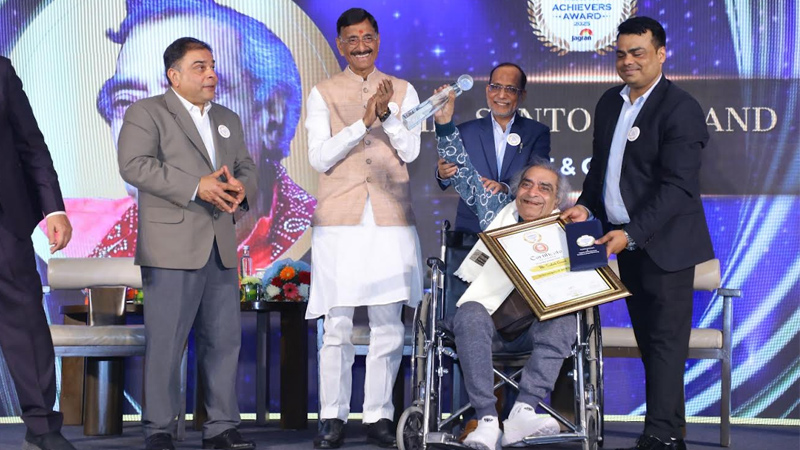
The cultural spotlight fell on veteran lyricist and poet Santosh Anand, whose songs have echoed across generations of Hindi cinema. At 97, Anand accepted the honour with characteristic humility, reflecting on a life shaped by perseverance and hope.
Healthcare honours spanned both modern and traditional systems. Manoj N. Nesari was recognised for strengthening Ayurveda’s place in national and global health frameworks. Padma shri Mohammed Abdul Waheed was honoured for his research-backed work in Unani medicine, while padma shri Mohsin Wali received recognition for his long-standing contribution to patient-centred care.
Education and social development also featured prominently. Padma shri Zahir Ishaq Kazi was honoured for decades of work in education, while former Meghalaya superintendent of Police T. C. Chacko was recognised for public service. Goonj founder Anshu Gupta received an award for his dignity-centred rural development initiatives, and the Hunar Shakti Foundation was honoured for empowering women and young girls through skill development.
The Lifetime Achievement Award went to former IAS officer Shailaja Chandra for her long career in public healthcare and governance, particularly in the traditional systems under Ayush.
Speaking at the event, Hamdard chairman Abdul Majeed said the awards were a tribute to those who combine excellence with empathy. “These awardees reflect Hakeem Sahib’s belief that healthcare, education and public service must ultimately serve humanity,” he said.
Minister Seth struck a forward-looking note, saying India’s young population gives the country a unique opportunity to become a global destination for learning, health and wellness by 2047.
The ceremony also featured the trailer launch of Unani Ki Kahaani, an upcoming documentary starring actor Jim Sarbh, set to premiere on Discovery on 11 February.
Instituted in memory of Unani scholar and educationist Hakeem Abdul Hameed, the awards have grown into a national platform that celebrates those building a more inclusive and resilient India. For one evening at least, the spotlight was not just on success, but on service with substance.






