News Broadcasting
Infomedia launches gadget magazine ‘T3’ in India


MUMBAI: Infomedia India Limited has unveiled T3 (Tomorrow’s Technology Today), the gadget magazine in India. The Indian edition of T3 is published under a licensing arrangement with Future Publishing, UK’s special interest publishers, and is the 23rd international edition of T3.
T3 is aimed at early adopters and gadget aware audiences abreast with the latest in the gadget universe. It uses photography and a blend of news, reviews and features to bring readers up to scratch with the fast paced world of consumer technology. It spans different areas including lifestyle, consumer products, cars, hi-fi, mobile, video gaming products and leisure products, informs an official release.
The cover story of the first issue Gadgets 2.0 focuses on the new generation of gadgets taking over the world. The story covers the spectrum of digital entertainment devices from the Sony PS3 to Toshiba HD DVD Player to the Sony Ericsson W950 mobile phone.

Other sections include a sneak peek at the N95 and the Asus Lamborghini Laptop, over 30 pages of gadget reviews and an entire section on home entertainment media. The first issue will feature supermodel Deepika Padukone as the T3 cover girl. T3 tops this up with a first-ever interview with Bollywood superstar Shah Rukh Khan and film director Farhan Akhtar on their favourite gadgets.
The monthly issue of the magazine will be available on newsstands and will be priced at Rs 100.
Infomedia India MD Prakash Iyer said, “It gives me immense pleasure in launching the first edition of the world’s best gadget magazine in India. Our main objective to launch the magazine is to convey to the gadget crazy community that here is a magazine that is celebrating their passion. “
Previously editor of hi-fi magazine AV Max, Nishant Padhiar is editor of T3.
Padhiar adds, “With increasingly high disposable incomes and the start-ups of new concept tech stores, the consumer electronic industry is booming. We feel it is the right time to educate the consumer and T3 will provide all the information needed to do so.”







News Broadcasting
Network18 channels lead YouTube news viewership in March 2026
CNN-News18, News18 India and CNBC channels top categories with record views
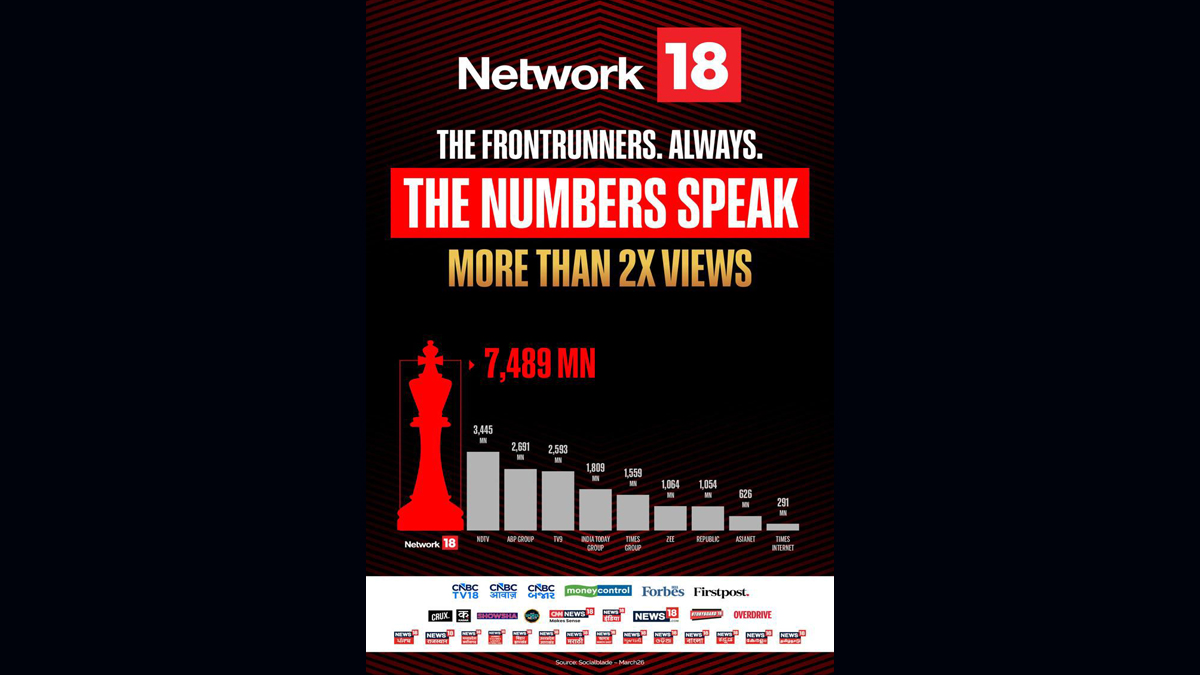
MUMBAI: When the world hit refresh on breaking news, Network18’s channels were already streaming ahead. As geopolitical tensions and war-driven headlines fuelled a surge in global news consumption, the network’s digital playbook delivered big clocking record Youtube viewership across English, Hindi and business news categories in March 2026.
At the forefront was CNN-News18, which emerged as the clear leader in the English news segment with 130 million live and video-on-demand views. The channel edged past competitors such as Times of India (126.5 million), Times Now (101.1 million), India Today (88.2 million) and NDTV (77.5 million), according to Databeings data for March.
In the Hindi news arena, News18 India delivered a commanding performance, racking up a staggering 3,297 million views on YouTube. The channel comfortably outpaced NDTV India, which recorded 3,119 million views, underlining its deep reach and consistent engagement with mass audiences, as per Playboard data.
The network’s dominance wasn’t confined to general news. In the Hindi business segment, CNBC Awaaz topped the charts with 92 million views, narrowly ahead of Zee Business (90 million) and well ahead of ET Now Swadesh (57 million). Meanwhile, its English counterpart CNBC-TV18 posted a strong 58 million views, reinforcing the network’s cross-category strength.
The spike in viewership reflects a broader shift in audience behaviour, with viewers increasingly turning to digital platforms particularly Youtube for real-time updates and in-depth coverage during high-intensity news cycles. For Network18, the numbers signal more than just scale; they underline the effectiveness of a multi-platform strategy that blends speed, credibility and continuous coverage.
In a month where the news never paused, it seems viewers chose to stay tuned where the stream never stopped.






