News Broadcasting
Industry cream turns up in strength for Tellys ’02


MUMBAI: It was a fitting tribute to the best of the small screen talents in the country. An evening where the Indian television industry congregated to celebrate excellence; to honour and recognise those who outshone their peers on the small screen – both behind the scenes and on it.
At a dazzling function held at the Tulip Star (formerly Juhu Centaur) Poolside in Mumbai on Friday evening, the best of channels, actors and TV shows along with television personalities who left a lasting impression on TV in 2001 were feted with the best awards in the television industry – The Indian Telly Awards 2002.
In the presence of media luminaries like Dr Prannoy Roy, Peter Mukerjea and Yash Chopra, the awards, in their second year, felicitated the popular awards categories on Friday evening. It was perhaps appropriate that the hugely popular TV personalities Aman Verma and Nausheen (Kkusum) kicked off the proceedings with a tribute to two TV, film and theatre artistes who passed away recently.

Priya ‘Rajani’ Tendulkar and Dina Pathak were remembered fondly through audio visual clips.
The evening’s entertainment commenced with the sultry and voluptuous Meghna Naidu. Naidu swayed and sashayed to the beats of a song which has made her a household delight and which she had performed a day earlier at The Indian Trade & Technical Awards. The song: Kaliyon ka Chaman,.
The first set of awards commenced with the Best Current Affairs programme which was pocketed by NDTV and Star News for Reality Bites for its coverage LOC/Doda , followed by Business Show of the year (India Business Hour, TV18, CNBC India), Best Sports Programme (Super Selector, ESPN Software India), Best Music Show (Chalti Ka Naam Antakshari, B.A.G. Films, Star Plus), and Best Game Show (Kaun Banega Crorepati, Synergy Productions, Star Plus).
A Band of Boys trotted on to stage to belt out Meri Neend, You Drive Me Crazy, and Tirchee, after the first set.
The next set of awards began with Best Sitcom/Comedy Show of the Year (Office Office, Eagle Films, Sabe TV) and was followed by the category of Best Comic Shorts (Fully Faltoo, MTV). Star Gold and Miditech were presented with an Indian Telly for Kuch Yaadein, Kuch Baatein, in the Best Non-fiction Show category. The Best Thriller/Horror Show category followed (Dial 100, Tijori Films, SabeTV) followed. , The Best Continuing TV show category had two joint firsts (Kyuunki Saas Bhi Kabhi Bahu Thi – Balaji Telefilms, Star Plus – and CID – Fireworks Productions, Sony).
The Best Drama Series category, won jointly by Balaji Telefilms for Kahaani Ghar Ghar Ki and Kkusum, for Star and Sony Entertainment respectively followed.
Isha Koppikar swam out of the Tulip Star poolside in a performance that set the entire stage and venue alight. Dressed in a pair of jeans and a backless bustier, she rocked and rolled on Khalaas, Bombay Dreams, and Ishq Samaandar.
Awards for Best News Channel (Aaj Tak), Music Channel (MTV India) and the biggie Best Entertainment Channel (Star Plus) formed the next segment. It was then time for Viva the first Indian girl band to be born out of a television show to perform, with Hum Naye Geet Sunaye, Tumko Ho Agar.
The TV actor in a comic role award was bagged by Pankaj Kapur for Office Office, while the award for TV actress in a comic role was won by Reema for Tu Tu Main Main. Govind Namdeo won the award for TV actor in a negative role, while Shweta Kawatra bagged the TV actress in negative role.
Diya Mirza, despite suffering from a strained ligament in her thigh, appeared on stage in all black and gave a performance which had all the makings of a winner. Zara Zara, Sattarangi were some of the numbers that the audience were hypnotised by.
Rajdeep Sardesai won the award for TV news anchor of the year award while Amitabh Bachchan, winner of last year’s personality of the year award, won the TV anchor of the year this year for KBC.
Aman Verma, the evening co-host, was also the winner of the TV personality of the year award, while Star Plus’ Tarun Katial bagged the TV programming executive of the year award. The TV CEO award was shared by Aaj Tak’s G Krishnan and Star India’s Peter Mukerjea.
Balaji Telefilms, makers of the most popular serials on TV today, walked away with the production house of the year award, while Umesh Padalkar got the award for the TV director of the year award.
TV show of the year was bagged by Kyunki Saas Bhi Kabhi Bahu Thi. Smriti Malhotra Irani was adjudged the TV actress of the year, while the TV actor award was shared by Shivaji Satam for CID and Kiran Karmarkar for Kahaani….
Among the highlights of the evening came when Ashutosh Lagaan Gowariker presented the Lifetime Achievement Award to NDTV’s Dr Roy. While accepting the award, Dr Roy, whose public appearances are extremely rare, said he felt truly privileged to be receiving it from someone who had bequeathed to the country a great work of cinema in Lagaan. Dr Roy also emphasised how invaluable to NDTV was the role of his wife Radhika Roy, who he referred to as a real source of strength and an “organisation builder.”





News Broadcasting
Network18 channels lead YouTube news viewership in March 2026
CNN-News18, News18 India and CNBC channels top categories with record views
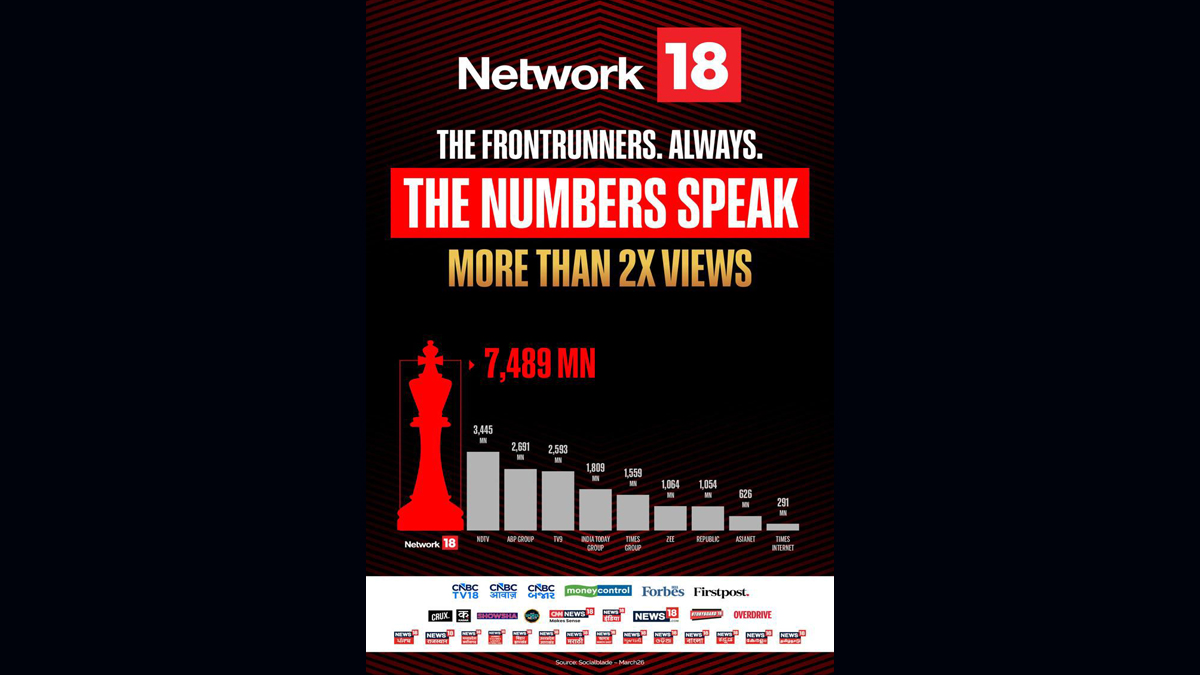
MUMBAI: When the world hit refresh on breaking news, Network18’s channels were already streaming ahead. As geopolitical tensions and war-driven headlines fuelled a surge in global news consumption, the network’s digital playbook delivered big clocking record Youtube viewership across English, Hindi and business news categories in March 2026.
At the forefront was CNN-News18, which emerged as the clear leader in the English news segment with 130 million live and video-on-demand views. The channel edged past competitors such as Times of India (126.5 million), Times Now (101.1 million), India Today (88.2 million) and NDTV (77.5 million), according to Databeings data for March.
In the Hindi news arena, News18 India delivered a commanding performance, racking up a staggering 3,297 million views on YouTube. The channel comfortably outpaced NDTV India, which recorded 3,119 million views, underlining its deep reach and consistent engagement with mass audiences, as per Playboard data.
The network’s dominance wasn’t confined to general news. In the Hindi business segment, CNBC Awaaz topped the charts with 92 million views, narrowly ahead of Zee Business (90 million) and well ahead of ET Now Swadesh (57 million). Meanwhile, its English counterpart CNBC-TV18 posted a strong 58 million views, reinforcing the network’s cross-category strength.
The spike in viewership reflects a broader shift in audience behaviour, with viewers increasingly turning to digital platforms particularly Youtube for real-time updates and in-depth coverage during high-intensity news cycles. For Network18, the numbers signal more than just scale; they underline the effectiveness of a multi-platform strategy that blends speed, credibility and continuous coverage.
In a month where the news never paused, it seems viewers chose to stay tuned where the stream never stopped.






