News Broadcasting
Indiantelevision.com’s VR news journalism workshop gives fresh insights

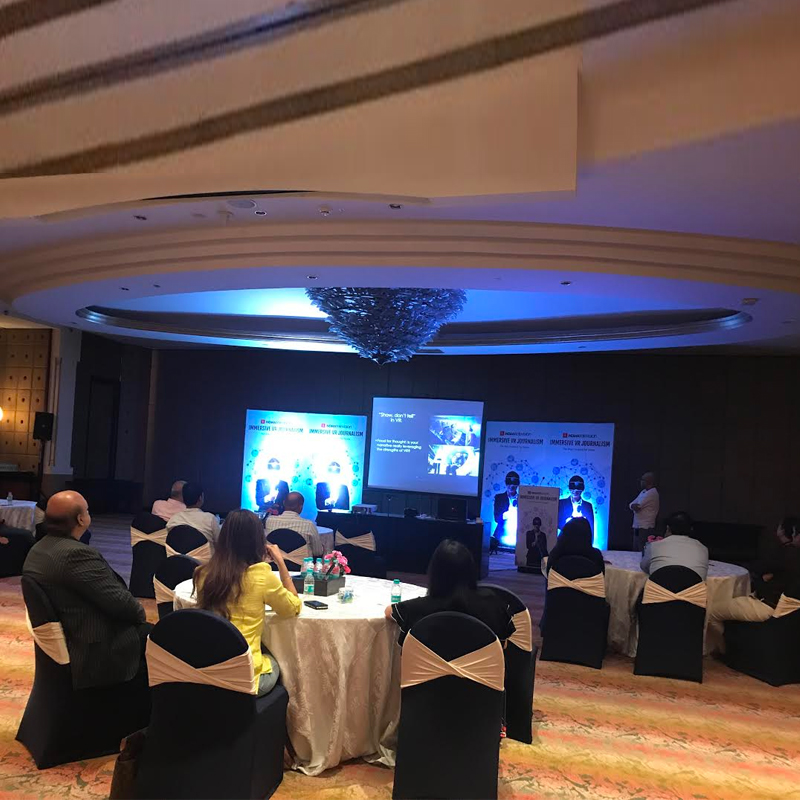
MUMBAI: “Immersive Journalism.” “The Use of VR in News Journalism”
Indian broadcast news journalists have heard these terms being used either online or in conversations. But, apart from NDTV, Republic and Times Network, not many of them have explored the innovation that is currentl engaging TV news viewers worldwide.
To fill this gap, indiantelevision.com organised a half-day workshop in Noida’s Radisson Blu MBT Hotel on 26 September.

In the house were a select group of tech professionals from news organisations such as NDTV, ABP News, India Today and News18 Television. The workshop was presented by VR expert, the Dubai-based Clyde Desouza.
Indiantelevision.com founder, CEO and editor-in-chief Anil Wanvari stated at the start of the workshop that VR journalism is not just in an experimental stage currently, it is a reality amongst many broadcasters worldwide. The reason for this is the falling prices of 360 VR cameras and VR headsets.

Clyde Desouza gives his take I’ve just completed a whirlwind initiative to bring awareness of Immersive Journalism to media organisations in India, thanks to the support and thrust provided by IndianTelevision.com. What started out as a series of discussions with the founder of IndianTelevision.com, Anil Wanvari, culminated in an exclusive, invite-only seminar on the future of factual storytelling – Virtual Reality and Mixed Reality Journalism at the Radisson Hotel, Noida, India. The top news and media organisations are headquartered in Noida, and CxO-level professionals from these organisations attended along with news editors and graphics teams to look into the future of news reporting and what I’d like to term as “Experiential Journalism.” The audience was informed and engaged. I won’t hesitate to say I’ve learned equally as much from the questions posed, as from the non-linear discussions that ensued well past the two-hour time allotted for the workshop. It was encouraging to see attendance from such prestigious organisations as E&Y, alongside respected NEWS and media organizations such as NDTV, ABP, and Network 18 in India. The seminar started with an overview of what Immersive Journalism is, with due credit given to the such luminaries as Noni De La Peña, but also the current state of the art in Virtual Reality news reporting and looking forward to Mixed Reality storytelling. As a tech / creative evangelist for VR, I was happy and impressed with the questions asked, and was genuinely excited to field queries ranging from Photogrammetry offer ideas on how CG “assets” could be created, and a library built for rapid Immersive Journalism pieces, with existing television CG packages and solutions such as VizRT and Wasp3D. There is certainly an appetite among the media and NEWS organisations in India, to take reporting beyond what’s possible on linear TV. While I’m currently bringing one of India’s leading news channels up to speed in VR, it was heartening to see almost all other major and emerging media organisations, aware that in order to build loyalty to their channel and brand, they need to engage their audiences on a level that goes beyond sensationalism and traditional news reporting. Twitter @cly3d Linkedin: https://www.linkedin.com/in/clydesouza |
Many of the broadcasters are foraying into it because they want to get brand innovation credibility, apart from attaining a sense of future preparedness. Wanvari added that currently most of the players are actually producing a lot of 360 videos, rather than fully immersive ones.
The early adopters apart, most news broadcasters are treading cautiously because the monetisation models have yet to be developed, and though prices have been heading southwards, the cost of VR gear – both at the producer end and at the consumer – still make it an elitist hobby, said Wanvari.
He added that around three million headsets have been sold internationally.
He urged the Indian news industry to get together under the NBA umbrella to work cohesively with tech partners, and platforms to increase awareness amongst its members as well as to negotiate on both production equipment and content standards.
Desouza, on his part, began by explaining to the audiences what VR really seeks to achieve.
“VR is not VR for VR’s sake,” he said. “It’s the experience that your brain feels.”
He explained the difference between VR and AR. “AR is when digital assets are added into the real world,” he said. “VR is when it’s entirely virtual and digital.”
Desouza pointed out that care should be taken while filming 360-degree videos. “You have to keep the viewer in mind. You can’t pan and swish and zoom in like you would do with a normal camera. These kinds of motions give the VR viewer a headache.”
He pointed out that many organisations are investing hundreds of thousands of dollars and producing videos that don’t really work as VR or immersive journalism.
“The VR video has to draw the viewer into understanding that it is his point of view which he is experiencing,” he said.
Desouza added that news brands internationally are using — and can use — VR to galvanise the audience into action.
“For instance, a feature on haemophiliacs can be told from a victim’s point of view and the viewer should be able to feel and experience what the haemophiliac is feeling and going through and how we need to deal with them,” he explained.
His view is that Indian news organisations would do well to keep aside budgets of about US$ 100,000 to start up their VR departments as well as a room with young, trained journalists so that costs can be kept under control.
His talk was illustrated with the best and the worst examples of VR and immersive journalism videos from global studios.
Desouza is currently consulting a leading Indian English news broadcaster to help steer it into VR journalism, and is in talks with a couple of others for the same.
To read Clyde Desouza’s perspective on the workshop, click here.






News Broadcasting
News TV viewership jumps 33 per cent as West Asia war draws audiences
BARC Week 8 data shows news share rising to 8 per cent despite T20 World Cup

NEW DELHI: Even as individual television news channel ratings remain under a temporary pause, the genre itself is seeing a clear surge in audience attention.
According to the latest data from Broadcast Audience Research Council India, television news recorded a 33 per cent jump in genre share in Week 8 of 2026, covering February 28 to March 6.
The news genre accounted for 8 per cent of total television viewership during the week, up from 6 per cent the previous week. The spike in attention coincided with escalating geopolitical tensions involving the United States, Israel and Iran, which have kept global headlines firmly fixed on West Asia.
The rise is notable because it came at a time when cricket was dominating television screens. The high-stakes stages of the ICC Men’s T20 World Cup, including the Super 8 fixtures and semi-finals, were being broadcast during the same period.
Despite the cricket frenzy, viewers appeared to be toggling between sport and global affairs, boosting the overall share of news programming.
The surge in genre share comes even as the government has enforced a one-month pause on publishing ratings for individual news channels. The move followed regulatory scrutiny of the television ratings ecosystem.
While channel-level rankings remain temporarily out of sight, the genre-level data suggests that when global tensions escalate, audiences continue to turn to television news for real-time updates.