News Broadcasting
Indian Broadcasting Foundation (IBF) moves SC against HC’s NTO 2.0 verdict


New Delhi: The Indian Broadcasting Foundation (IBF) has filed a petition in the Supreme Court against the Bombay high court verdict, which had upheld the constitutionality of the amended New Tariff Order (NTO 2.0) passed by the Telecom Regulatory Authority of India (Trai).
After a legal tussle that lasted over a year, Trai had managed to get a green signal from the court on 30 June on the implementation of amended NTO 2.0 passed in January, 2020. The division bench of the high court stated that the challenge to the constitutional validity of the 2020 rules and regulations of Trai does not hold any water. At the same time, it termed one of the twin conditions “arbitrary”, according to which the maximum retail price of an a-la-carte channel could not be more than one third of the maximum rate of a channel in the bouquet.
The court had passed the judgement on petitions filed by several broadcasters under the umbrella of the Indian Broadcasting Foundation (IBF) including Zee Entertainment, Star India, TV18, and Sony Pictures Network India (SPN) who had opposed the order, challenged the tariff order and termed it “arbitrary and in violation of their fundamental right.”

According to broadcasters, the new order could lead to a drop in the subscription revenue, especially now, when the industry is reeling under pandemic-induced low advertising revenue. NTO 2.0 has prescribed linkage between a-la-carte price and bouquet, and reduced the price cap on the subscription fees for pay channels. So, TV broadcasters can include a channel in a pack only if it is priced at Rs 12 or less than that. Earlier, this limit was Rs. 19.
The broadcasters only got partial relief when the high court struck down one of the twin conditions relating to the average pricing of a channel in a bouquet terming it as ‘arbitrary’. This will allow broadcasters to increase the number of channels they want to provide in the bouquet and enhance the value delivered to consumers.
According to the condition the a-la-carte rates of each pay channel (MRP), forming part of a bouquet, shall in no case exceed three times the average rate of a pay channel of that bouquet. So, if the maximum price of a channel in a pack was Rs.12, a broadcaster could not charge more than four rupees for an a-la-carte channel.
The high court had also extended its previous interim order, asking Trai not to take any coercive action against the broadcasters, if they did not implement the new tariff order. The order was extended for the next six weeks.







News Broadcasting
News18 India launches Command Centre war explainer with Arya
New show shifts from debates to decoding global conflicts and impacts
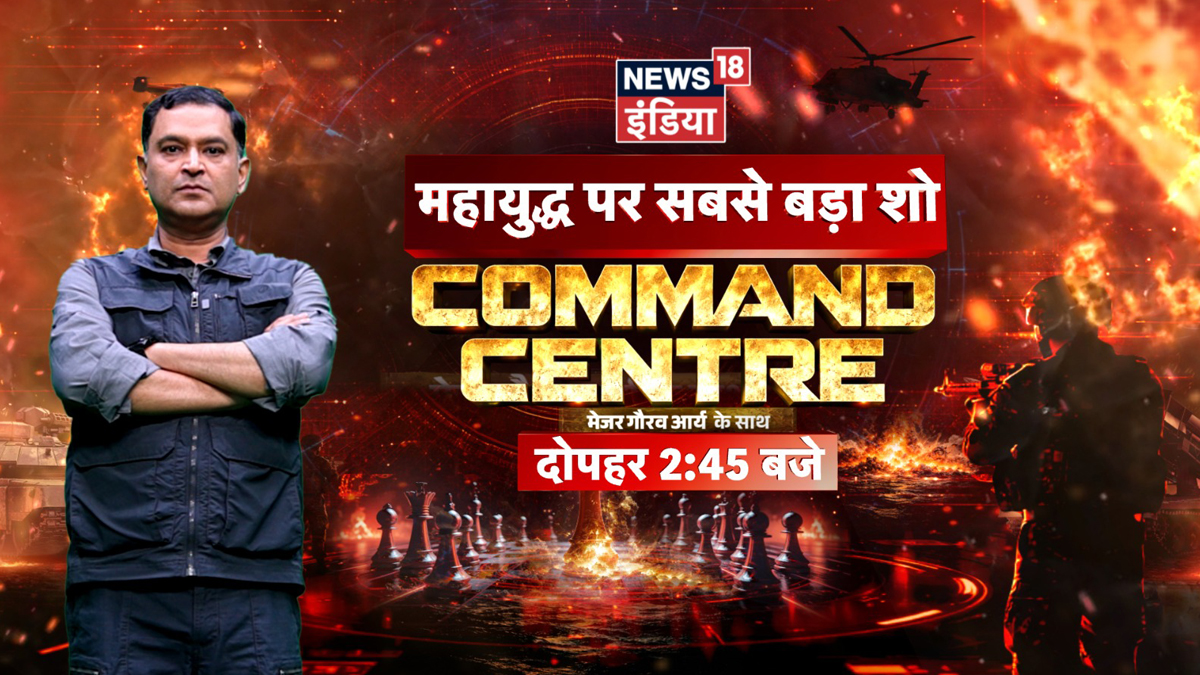
MUMBAI: News18 India has rolled out a new war-focused programme, Command Centre, featuring Gaurav Arya, as it looks to offer viewers a sharper, more grounded take on global conflicts amid rising tensions in West Asia.
Positioned as an “insider war room”, the show moves away from conventional panel debates and instead focuses on explaining military developments, decoding strategy and connecting global events to their everyday impact, from fuel prices to economic shifts.
The format leans heavily on visuals and data. The studio has been designed like a command hub, complete with large LED war maps, real-time graphics and an alert system to track developments as they unfold.
At the centre of it all is Arya, who brings his military background to simplify complex war strategies for viewers. His signature line, “Seedhi baat samjhiye”, anchors the show’s promise of clarity over noise.
News18 India managing editor Jyoti Kamal said, “Command Centre, featuring Major Gaurav Arya is designed to deliver accurate insights and a clear perspective on how evolving conflicts impact everyday life, from household budgets to national security. With expert voices analysing every development in real time, the show goes beyond headlines to decode what’s happening now, what it means, and what could come next.”
Echoing the intent, Gaurav Arya added, “In times of war, confusion is the biggest threat. With News18 India’s Command Centre, we are bringing viewers inside the war room, decoding strategies, tracking every escalation, and explaining, in the simplest terms, what it means for India and for every household. Seedhi baat samjhiye, this is where you understand not just what is happening, but what happens next.”
The weekday show will air in the afternoon slot and will also feature Gaurav Shukla, adding to its editorial depth.
With its mix of analysis, visuals and a clear focus on impact, the show reflects a broader shift in news consumption. Viewers are no longer just watching events unfold, they are looking to understand what those events mean for them.







