News Broadcasting
India TV getting serious about news?


MUMBAI: Frequent allegations of sensationalist journalism notwithstanding, India TV has managed to stay at the top of its game, what with veterans like Rajat Sharma associated with the Hindi news channel.
And now when the channel is in the middle of a refresh to let people know it has become serious about the news business, what better than ‘Brand Sharma’ to lend credibility to the exercise.

As India TV MD and CEO Ritu Dhawan puts it: “Till recently, audiences were more interested in non-political and ‘popular’ content, so we were catering to that. Now with elections and various other news events, the flavour of hard news is back, so we have refreshed our programming completely. Today, the number of news stories on India TV is more than that on any other news channel. With Rajat Sharma leading the pack and Q W Naqvi at the helm of affairs, our viewers can be assured of the most accurate and responsible news reporting, which will further cement our leadership position in the Hindi news genre.”
In fact, the channel’s reliance on Sharma’s popularity emanates from a position of knowledge wherein it actually commissioned research to find out how best it could highlight its repositioning. “One thing that came out very clearly is that ‘Brand Rajat Sharma’ riding on the credibility it brings in, will have a towering effect on ‘Brand India TV’. It further suggested that people may like to see that connect personified both in terms of communication and programming. And so, not only is the editor-in-chief back on prime time news with his daily analysis show, Aaj Ki Baat Rajat Sharma ke saath, he is also the face of the brand campaign,” reveals Dhawan.
Indeed, as part of the revamp, India TV has embarked on an ambitious, six-week-long marketing campaign which leverages Sharma’s popularity with the audience. The first leg of the campaign will run for 21 days across Hindi speaking markets like Mumbai, Delhi, Agra, Lucknow, Allahabad and Gorakhpur. Life-size images of Sharma will adorn hoardings and billboards across these cities as well as digital ports at arrival and departure terminals in Mumbai, Delhi and Kolkata.
The banners focus on Sharma’s pensive expression along with the words, ‘You, me and India TV – let’s change the face of the nation’ and have been designed by Saints & Warriors, one of the three creative agencies that were short-listed for the job.
“Three agencies made it to the final short-list for the job, basis what they had presented in response to the brief given. Eventually, Saints & Warriors was chosen for the assignment, basis further discussions with them. Their credentials, clarity of thought, and extended execution sampling helped us clearly decide in their favour,” informs Dhawan.
Working on ad placement on news websites by geographically targeting them to suit audiences is Agency Ecosystem by Amar Ujala, which has a target to reach 35 million impressions through websites like Dainik Bhaskar and Amar Ujala. “We have tried to keep a close leash on expenditures. The first leg of 21 days of the campaign is to the tune of Rs 5.5 crore,” reveals Dhawan.
It is learnt that the revamp is not only to tone down sensational news but also because of the increase in the number of news channels which has led to severe fragmentation of viewership. While India TV was launched at a time when its competitors could be counted on one’s fingers, it now has several competing channels swimming in the same pond. “With so many new and small channels taking up a large percentage of the market, it has become a highly competitive space so the brand refresh was done to mainly maintain our viewership,” a source from India TV tells this website.
Whatever the reasons for the refresh, it’s just two days since the campaign has kicked off and people are getting used to the posters of Sharma in his signature pose with folded hands. What remains to be seen however is to what extent Sharma will help change people’s hitherto perception of India TV.





News Broadcasting
UDF poised to return to power in Kerala, says Manorama-CVoter survey
Massive opinion poll projects shift in Kerala politics ahead of 2026 Assembly elections.
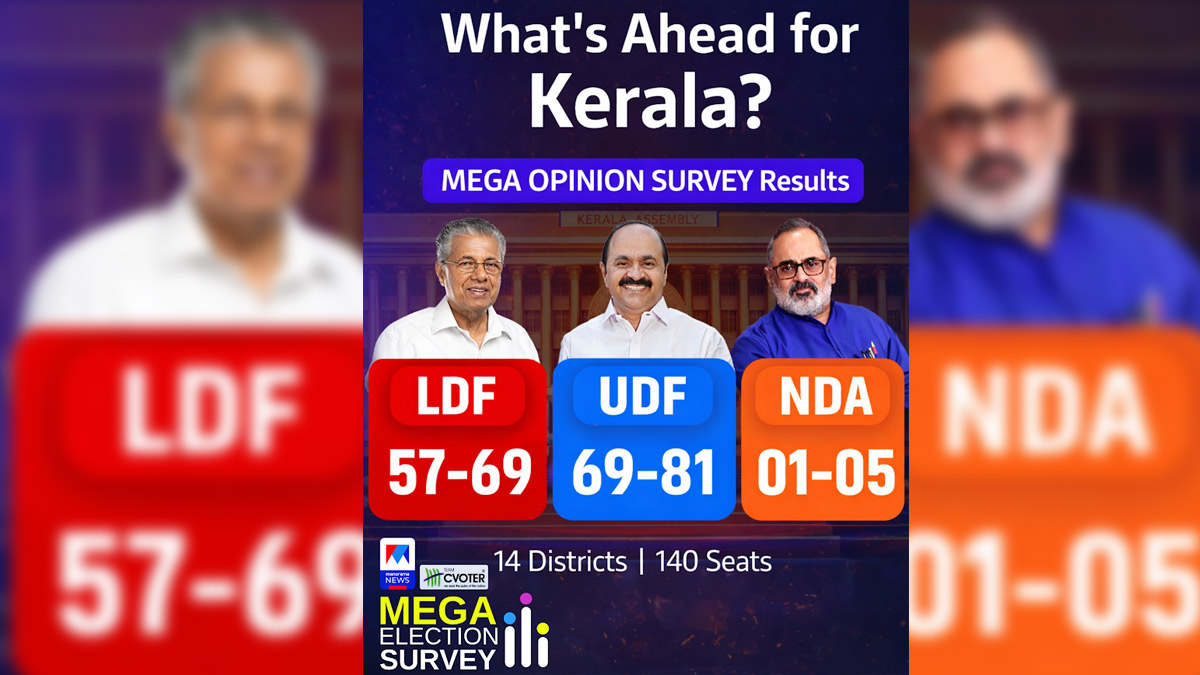
MUMBAI: The winds of change appear to be blowing through Kerala’s political landscape and this time, they seem to favour the United Democratic Front. A comprehensive mega opinion survey conducted by Manorama News in partnership with CVoter projects a potential comeback for the UDF in the upcoming Kerala Legislative Assembly Elections 2026. The survey, covering all 140 constituencies with a massive sample size of nearly 90,000 respondents, predicts the UDF could win between 69 and 81 seats.
The ruling Left Democratic Front (LDF) is expected to secure 57 to 69 seats, a significant drop from the 99 seats it won in the 2021 elections. This would mean the LDF losing 30 to 42 of its sitting seats. Meanwhile, the National Democratic Alliance (NDA), which drew a blank in 2021, is projected to open its account with 1 to 5 seats.
Region-wise, the UDF is expected to make strong gains in Malabar, winning 25 to 34 out of 48 seats, and in Central Kerala, where it could bag 29 to 33 out of 53 seats. In South Kerala, the LDF is likely to retain an edge with 21 to 25 seats, while the UDF may improve to 12 to 16 seats. The NDA could pick up 1 to 3 seats in the southern region.
The survey was conducted between 14 and 26 March 2026, with additional tracker and snap polls carried out from December 2025 to March 2026. A total of 89,693 respondents participated, ensuring representation across all demographics and social segments.
Manorama News has a strong track record of accuracy, with its previous projections closely matching the actual results of the 2019 and 2024 Lok Sabha elections as well as the 2021 Kerala Assembly polls.
In Kerala’s famously fierce political battles, this survey suggests the pendulum may be swinging back. Whether the final verdict matches these numbers or throws up another surprise, one thing is clear, the 2026 Assembly elections are shaping up to be one of the most keenly watched contests in the state’s history.






