Jobs
India on fast track to upper middle-income status by 2030: SBI Research
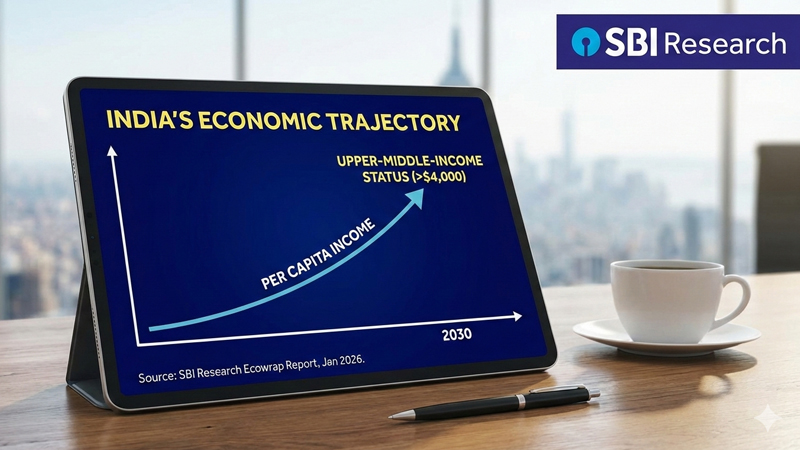
NEW DELHI: India is accelerating up the global income curve, with the country set to become an upper middle-income economy by 2030, in step with its rise as the world’s third-largest economy by 2028, according to a new SBI Research report.
After taking six decades to climb out of low-income status, India’s growth engine has shifted gears. Per capita GNI, which stood at just $90 in 1962, crossed $2,000 in 2019 and is projected to touch $4,000 by 2030, putting the country within striking distance of the World Bank’s upper middle-income threshold of around $4,500, the report said.
The pace is telling. India reached $1 trillion in GDP in 60 years, added the next trillion in seven, the third in another seven, and the fourth in just four. At this clip, the $5 trillion mark is barely two years away. Nominal GDP growth in dollar terms of around 11.5 per cent, seen consistently before and after the pandemic, makes the climb achievable, SBI Research noted.
India’s growth credentials are also improving in relative terms. Over the decade ended 2024, the country ranked in the 95th percentile of global real GDP growth, up from the 92nd percentile over a 25-year horizon, placing it firmly in the upper tier of the global growth distribution.
The comparison with peers is stark. China and Indonesia have already made the leap to upper middle-income status, while countries such as Guyana have vaulted all the way to high income. India, which transitioned to lower middle-income only in 2007, is now compressing decades of growth into years, the report said.
Looking further out, India could hit high-income status by 2047 if per capita GNI grows at 7.5 to 9 per cent annually. The task is demanding but not implausible given performance over the past two decades. Manufacturing expansion, reforms and sustained investment will determine how quickly the gap closes.
For now, the direction is clear. India is no longer inching up the ladder. It is climbing faster, with momentum firmly on its side.

Jobs
India to hold its first ‘workplace happiness’ awards in Mumbai
A new initiative wants to make employee wellbeing a boardroom priority, not an afterthought
MUMBAI: India’s corporate world has a new trophy to chase, and this one is not for profits or market share. Happiest Places to Work has announced the country’s first awards dedicated entirely to workplace happiness, with the inaugural ceremony set to be held at the Jio World Convention Centre in Mumbai towards the end of July.
The timing is deliberate. As employee experience increasingly shapes business outcomes, the awards aim to shift the conversation from perks and policies to something harder to fake: how people actually feel at work. Entries are open to organisations across sectors and sizes, and the evaluation process is designed to cut through corporate spin, combining a structured Happiness Dialogue, a culture audit and a final jury review to produce measurable insights into employee experience.
The awards will be chaired by Harsh Goenka, chairman of RPG Group, and judged by a heavyweight jury that reads like a who’s who of Indian business and human resources. It includes Achal Khanna, chief executive of SHRM for the Asia-Pacific and MENA regions, Harit Nagpal, managing director and chief executive of Tata Play, Pavitra Singh, chief human resources officer at PepsiCo India and South Asia, and Sunita Cherian, former chief culture officer at Wipro, among others.
“Workplace happiness is becoming central to how organisations grow and perform,” said Goenka. “Platforms like these help bring that conversation to the forefront.”
Raj Nayak, founder of Happiest Places to Work, was more direct. “Organisations often overlook the everyday employee experience,” he said. “These awards recognise companies that get it right consistently, where how people feel at work truly matters.”
India’s corner offices have long measured success in revenue, headcount and market capitalisation. If this initiative takes hold, employee happiness may finally earn a place on that list.
The question now is whether the companies that need it most will bother to enter.