News Broadcasting
IBF issues press release on CAS


The Indian Broadcasting Foundation (IBF) members met in New Delhi today to discuss the implication of the proposed Conditional Access Systems (CAS).
Any propsoal that addresses the two fundamental issues of transparency and breaking up of the existing ground monopolies of the cable TV operators that face the industry is welcomed by the IBF. The reality is that today only 20 per cent of the ground revenue collected from the consumers accross the country comes back to the broadcasters.
The IBF members are of the view that there should be a planned and phased transition to enable the Indian consumers to comprahensively benefit from switching over to the Conditional Acceas Systems. To make CAS a realIty in the current form, the IBF believes that there are many issues concerning technology, funding, avaIlabilIty of set top boxes, regulation and non- discriminatory implementation and there is a need for a detailed analysis.

Further all the issues related with Implementation of CAS need to be looked at and addressed in totality. An amendment to the Cable TV Regulation Act is unlikely to resolve the fundamental issues that face the industry. It may in fact result in exploitation of customers in terms of prices of the services charged by the cable TV operators due to monopolies on ground.
Members of the Industry, Broadcasters, Vendors, Cable operators and the regulators need to work together to arrive at the correct CAS model. In the interim, the bradcasters have decided to come together and focus on the immediate problem of under declaration and demand 100% transparency from the cable TV operators.
The IBF also suggests that the existing parliamentary Select Committee headed by Parliamentarian Somnath Chatterjee looking into the Convergence Bill is ideally positioned to examine all the matters in totality so that the consumer gets the true benefit of the channels and the value added services.







News Broadcasting
Network18 channels lead YouTube news viewership in March 2026
CNN-News18, News18 India and CNBC channels top categories with record views
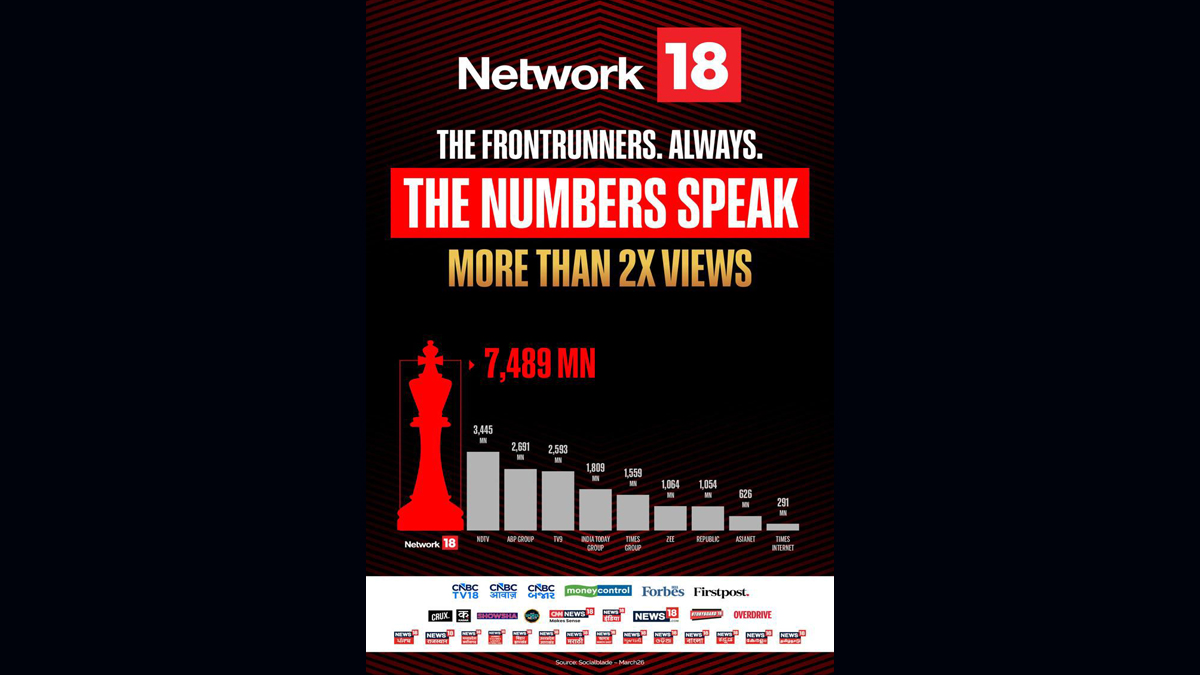
MUMBAI: When the world hit refresh on breaking news, Network18’s channels were already streaming ahead. As geopolitical tensions and war-driven headlines fuelled a surge in global news consumption, the network’s digital playbook delivered big clocking record Youtube viewership across English, Hindi and business news categories in March 2026.
At the forefront was CNN-News18, which emerged as the clear leader in the English news segment with 130 million live and video-on-demand views. The channel edged past competitors such as Times of India (126.5 million), Times Now (101.1 million), India Today (88.2 million) and NDTV (77.5 million), according to Databeings data for March.
In the Hindi news arena, News18 India delivered a commanding performance, racking up a staggering 3,297 million views on YouTube. The channel comfortably outpaced NDTV India, which recorded 3,119 million views, underlining its deep reach and consistent engagement with mass audiences, as per Playboard data.
The network’s dominance wasn’t confined to general news. In the Hindi business segment, CNBC Awaaz topped the charts with 92 million views, narrowly ahead of Zee Business (90 million) and well ahead of ET Now Swadesh (57 million). Meanwhile, its English counterpart CNBC-TV18 posted a strong 58 million views, reinforcing the network’s cross-category strength.
The spike in viewership reflects a broader shift in audience behaviour, with viewers increasingly turning to digital platforms particularly Youtube for real-time updates and in-depth coverage during high-intensity news cycles. For Network18, the numbers signal more than just scale; they underline the effectiveness of a multi-platform strategy that blends speed, credibility and continuous coverage.
In a month where the news never paused, it seems viewers chose to stay tuned where the stream never stopped.






