Applications
HSEMI AI debuts on Republic Day with a human plus machine approach

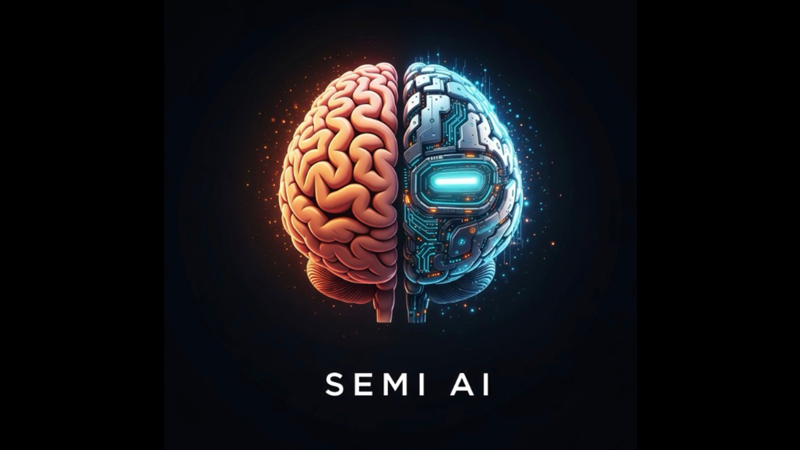
MUMBAI: Brains met bytes on Republic Day as SEMI AI quietly stepped into the spotlight. Marking India’s 77th Republic Day, the tech platform announced its soft launch, positioning itself as the world’s first “half-machine, half-human” AI system, a hybrid designed to marry the speed of algorithms with the nuance of human judgement. The aim: decisions that are not just faster, but fairer, more ethical and deeply aware of context.
At the heart of SEMI AI is an intelligent routing engine. Incoming queries are analysed to determine what can be resolved by machine learning models and what demands human insight. Routine tasks are handled instantly by AI, while complex issues involving ethics, culture or judgement are escalated to domain experts within SEMI AI’s human network. Each interaction feeds a loop where human decisions refine the system, and the system, in turn, improves scale and efficiency.
SEMI AI founder and CEO Saurabh Bhambri described the timing as symbolic, calling SEMI AI “Made in India, by Indians, and for Indians”, and dedicating the platform to citizens on Republic Day. SEMI AI co-founder and CTO Bijay Singh Rajput added that the model could help citizens and institutions take smarter decisions, while also giving India a distinctive voice in the global AI conversation.
The platform is designed for use across sectors where purely algorithmic answers often fall short. In healthcare, it can support diagnostics under doctor supervision. In finance, it blends automated risk assessment with human validation. In education, it enables personalised learning guided by teachers, while in public services it helps resolve citizen queries, escalating only the most complex cases.
By blending code with conscience, SEMI AI is pitching itself as an alternative to black-box automation. Its Republic Day debut underlines a broader ambition: to show that India’s next wave of AI innovation can scale globally without losing sight of human values.






