Applications
HDFC Ergo twins up with Consumr.ai to insure AI-driven customer journeys

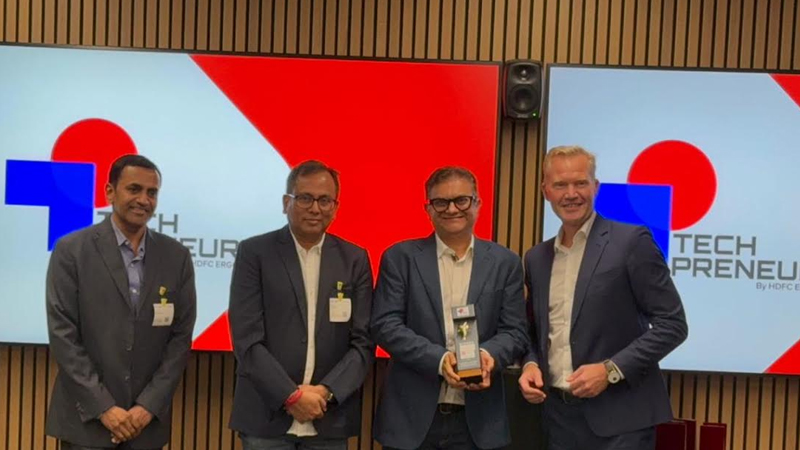
MUMBAI: Insurance just found its digital double. HDFC Ergo has roped in Consumr.ai, India’s next-gen customer intelligence platform, to pilot a proof-of-concept (POC) that could transform how policyholders experience insurance from the first ad to the final claim. The partnership was sealed after Consumr.ai emerged as one of four winners of Techpreneur Season 2, an innovation programme that drew over 140 AI and tech companies worldwide. Winners were picked through a rigorous evaluation by leaders from BCG, Google, HDFC Ergo and Ergo International.
At the centre of the POC lies Consumr.ai’s proprietary AI Twins technology virtual doppelgängers of consumer cohorts built on real behavioural data. These AI-powered twins simulate how different audiences respond to creative campaigns, products, and messages, enabling “always-on” customer-informed decision-making. In other words, it helps HDFC Ergo keep the customer firmly in the driver’s seat of every marketing, product, and creative choice.
The POC will tap into deterministic behavioural data from hundreds of millions of global users via integrations with Meta, Google, DV360, Linkedin, Snap, and Amazon. HDFC Ergo’s own first-party data can also be securely onboarded, anonymised at cohort level, and modelled into AI Twins, all while maintaining full GDPR and CCPA compliance and without ingesting personally identifiable information.

Consumr.ai co-founder Vivek Bhargava said: “Our AI Twins technology transforms real behavioural data into actionable intelligence that enables real-time personalisation at scale. This aligns perfectly with HDFC Ergo’s vision of a digitally agile, customer-first future.”
On successful completion, the POC could be scaled across HDFC Ergo’s business lines, distribution channels, and even new frontiers such as influencer marketing, regional positioning, and voice-of-customer programmes. The model could also be replicated for Ergo International’s global markets, turning the Indian POC into a global insurance playbook.
Consumr.ai already has a strong BFSI track record, having deployed AI Twins for Rustomjee, Aditya Birla Insurance, and even a Fortune 100 US insurer. With HDFC ERGO in the mix, the three-year-old platform has doubled down on its mission to be the innovation engine powering the insurance industry’s leap into the future.






Applications
With 57 per cent single new users, Ashley Madison rebrands as discreet dating platform
Platform says majority of new members now identify as single

INDIA: Ashley Madison is shedding the “married-dating” label that defined it for two decades, repositioning itself as a platform for discreet dating in what it calls the post-social media age.
The rebrand, unveiled in India on 27 February, 2026, marks a structural shift in business model and identity. Once synonymous with married dating, the company now describes itself as the “premier destination for discreet dating” under a new tagline: Where Desire Meets Discretion.
The pivot is data-driven. Internal figures show that 57 per cent of global sign-ups between 1 January and 31 December, 2025 identified as single: a notable departure from the platform’s married core. The company argues that its community has already evolved beyond its original positioning.
“In an age where our lives have been constantly put on public display, privacy has become the new luxury,” said Ashley Madison chief strategy officer Paul Keable. He framed the platform’s offering as “ethical discretion” for singles, separated, divorced and non-monogamous users seeking private connections.
The shift also taps into wider digital fatigue. A global survey conducted by YouGov for Ashley Madison, covering 13,071 adults across Australia, Brazil, Canada, Germany, India, Italy, Mexico, Spain, Switzerland, the UK and the US, found mounting discomfort with hyper-public online lives.
Among dating app users, 30 per cent cited constant swiping and messaging as a source of fatigue, while 24 per cent pointed to pressure to curate public-facing profiles and early personal disclosure. Some 27 per cent said fears of screenshots or information being shared contributed to exhaustion; an equal share cited unwanted attention.
The retreat from oversharing appears broader. According to the survey, 46 per cent of adults actively try to keep most aspects of their life private online. Only 8 per cent feel comfortable sharing most aspects publicly, while 35 per cent say they are becoming more selective about what they disclose.
Ashley Madison is betting that this cultural recalibration towards controlled visibility can be monetised. By doubling down on privacy infrastructure and reframing itself around discretion rather than infidelity, the company is attempting to convert reputational baggage into a premium proposition.






