English Entertainment
HBO looks to boost original series franchise with Rome

MUMBAI: In a bid to strengthen its line up of original content, English movie channel HBO will kick off the series Rome from 20 February 2006 at 11 pm. It will air every Monday after the 9 pm movie.
The show is a co-production between HBO and BBC Worldwide. As had been reported earlier by indiantelevision.com the show deals with two Roman soldiers who become entwined in the historical events of ancient Rome. The series has a budget of $100 million. By comparison one Harry Potter movie cost a little more at $120 million.
It has the distinction of being the first English-language series to be shot entirely in a non-English-speaking country Italy. It took 14 months to film the first season. By contrast one episode of a network drama usually takes a week, not a month, to shoot. During the shoot there was a historian on call 24/7. Rome won an award from the Directors Guild of America earlier this month.

HBO South Asia country manager Shruti Bajpai says, We are extremely excited to bring one of the biggest series ever, Rome, the groundbreaking HBO original productions to India. Rome is closer to India than most people would imagine as a lot of the elements such as the costumes, set design, colours and the look and feel of the show have either drawn inspiration from India or have been created by craftsmen in the country.
As a preview HBO will air a special Making of Rome on 20 February at 9 pm. Viewers will get an insiders view of the series with clips, cast and crew interviews and behind-the-scenes footage
Rome deals with love and betrayal, masters and slaves, husbands and wives. The 12-episode first season begins in 52 B.C., as Julius Caesar completes his conquest of Gaul after eight years of war, and prepares to return to Rome. He brings with him legions of battle-hardened, loyal men, unimaginable riches in slaves, gold and plunder, and a populist agenda for radical social change. The aristocracy is terrified, and threatens to prosecute him for war crimes if he enters Rome.
The delicate balance of power lies in the Senate with Caesar’s old friend, partner and mentor, Pompey Magnus. Such is the situation when two soldiers of Caesar’s 13th Legion, Lucius Vorenus and Titus Pullo, are ordered into the wilds of Gaul to retrieve their legion’s stolen standard, the unifying symbol of Caesar’s legion, setting off a chain of circumstances that led to the fall of ancient Rome. The series stars among others Ciaran Hinds, Polly Walker who got a Golden Globe nomination, Indira Varma, Ray Stevenson, Kenneth Cranham and Kevin McKidd.
Readers maybe interested to know that Rome was put into development as an HBO miniseries way back in 1998 by executive producer Anne Thomopoulos, who at the time was a senior vice president, original programming. Writer Bruno Heller began work in 2000. Following delivery of the first three scripts in 2001, HBO chairman Christ Albrecht and HBO Entertainment president Carolyn Strauss decided that Rome should be developed as a continuing series instead of a miniseries. Co-production partners The BBC came on board in August 2002.
The series’ writer and producer Bruno Heller says, “You rarely see onscreen the complexity and colour that was ancient Rome. It has more in common with places like Mexico City and Calcutta than quiet white marble.”
The set cost $10 million and is the largest standing set in the world. The set comprises 20,234 square metres of backlot and 6 soundstages. The series required over 4,000 pieces of wardrobe, 2,500 being used in the first three episodes alone. Much of the material came from India, as well as Prato, Italy, Tunisia and Morocco. Approximately 1,250 pairs of shoes and sandals were made in Bulgaria, and 250 chain mail tunics, each weighing 16 kg, were made in India. The prototype for the detailed leather cuirass worn by army officers was handmade at Cinecittà, and 40 were replicated in India. Prototypes for all of the metalwork – helmets, buckles, belts and insignia – were handmade on set and replicated in India as well.
Building the Rome set involved an international crew of 350. All of the fabrics used in the costume design and set dressing are authentic to the time wool, linen, cotton and silk. Fabrics came from Prato, Italy, as well as India, Tunisia and Morocco. They were purchased in their natural state and dyed on set.
Other interesting facts about Rome include
– 40 leather cuirasses were made for the legionary officers mostly from India
– 750 actors/extras were involved in the largest shooting scenes
– 40 horses were used in one scene
– 45 members of the cast were sent on a two-week boot camp run by a former British Royal Marine. 43 completed boot camp.
– The Forum set is approximately 60% the size of the original Foro Romano, and 25% of it is invisible in the form of wiring, pipes and gas to fuel its working braziers and torches
– Battles scenes in Rome represent one of the first times authentic techniques are portrayed, for example, no large, slashing sword movements like Gauls and Celts used; instead the series featured a tightly-packed Roman Wall of men shoulder-to-shoulder, thrusting straight from above and below their shields. The front line rotated to the back every 30-45 seconds, ensuring well-rested soldiers in the fray at all times.
That HBO and the BBC are satisfied with the audience response can be gauged from the fact that a second season will start shooting next month.




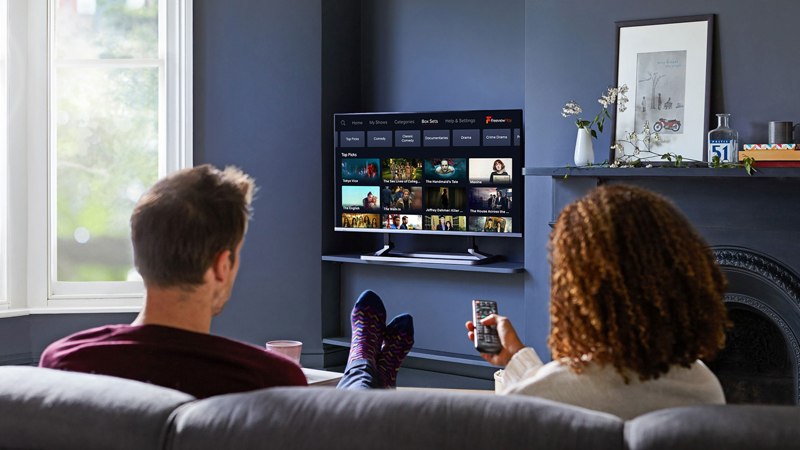
UK: The aerial is losing its grip. As broadband becomes the default way Britons watch television, the UK is edging towards a decisive, and divisive, question: should Freeview be switched off by 2034? The issue, highlighted in reporting by The Guardian, has exposed deep fault lines over access, affordability and the future of public service broadcasting.
For nearly 25 years, Freeview has delivered free-to-air television from the BBC, ITV, Channel 4 and Channel 5 to almost every corner of the country. Even now, it remains the UK’s largest TV platform, used in more than 16m homes and on around 10m main household sets. Yet the same broadcasters that built it are now pressing for its closure within eight years.
Their case rests on a structural shift in viewing. Smart TVs, superfast broadband and the Netflix-led streaming boom have pulled audiences online. Advertising economics have followed. By 2034, the number of homes using Freeview as their main TV set is forecast to fall from a peak of almost 12m in 2012 to fewer than 2m, making digital terrestrial television, or DTT, increasingly costly to sustain.
But critics say the rush to switch off risks abandoning those least able, or least willing, to move online.
“I don’t want to be choosing apps and making new accounts,” says Lynette, 80, from Kent. “It is time-consuming and irritating trying to work out where I want to be, to remember the sequence of clicks, with hieroglyphics instead of words. If I make a mistake I have to start again.”
Lynette is among nearly 100,000 people who have signed a “save Freeview” petition launched by campaign group Silver Voices. She fears the government is about to “take [Freeview] away from me and others who either don’t like, can’t afford, or can’t use online versions”.
Official figures underline the fault lines. A report commissioned by the Department for Culture, Media and Sport estimates that by 2035, 1.8m homes will still depend on Freeview. Ofcom’s analysis shows those households are more likely to be disabled, older, living alone, female, and based in the north of England, Wales, Scotland and Northern Ireland.
Freeview is owned by the public service broadcasters through Everyone TV, which also operates Freesat and the newer streaming platform Freely. After two years of review, DCMS is expected to set out its position soon, drawing on three options proposed by Ofcom: a costly upgrade of Freeview’s ageing technology; maintaining a bare-bones service with only core PSB channels; or a full switch-off during the 2030s.
The broadcasters have rallied behind the third option. They argue that 2034 is the logical cut-off, when transmission contracts with network operator Arqiva expire. By then, they say, the cost of broadcasting to a dwindling audience will far outweigh the returns from TV advertising.
Ofcom agrees a crunch point is approaching. In July, the regulator warned of a “tipping point” within the next few years, after which it will no longer be commercially viable for broadcasters to carry the costs of DTT.
Others see risks beyond economics. Questions remain over whether internet TV can reliably deliver emergency broadcasts, such as the daily Covid updates, in the way that universally available DTT can. The UK radio industry has also warned that an internet-only future for TV could push up distribution costs and force some radio stations off air if PSBs no longer share Arqiva’s mast network.
“It is a political hot potato,” says Dennis Reed, founder of Silver Voices, who says he has “dissociated” his organisation from the government’s stakeholder forum, which he believes is “heavily biased” towards streaming.
The Future TV Taskforce, representing the PSBs, counters that moving online could “close the digital divide once and for all”. “We want to be able to plan to ensure that no one is left behind,” a spokesperson says, adding that rising DTT costs could otherwise mean cuts to programme budgets.
The numbers show the scale of the challenge. Of the 1.8m Freeview-dependent homes projected for 2035, around 1.1m are expected to have broadband but not use it for TV. The remaining 700,000 are forecast to lack a broadband connection altogether.
Veterans of the analogue switch-off, completed in 2012 after 76 years, recall similar fears of “TV blackout chaos”. Around 6 per cent of households were labelled “digital refuseniks”, yet a targeted help scheme and a national campaign, fronted by a robot called Digit Al voiced by Matt Lucas, delivered a largely smooth transition.
This time, the BBC is less keen to foot the bill. Tim Davie, the outgoing director general, has said the corporation should not fund a comparable support programme for a Freeview switch-off.
Research for Sky by Oliver & Ohlbaum suggests that with early awareness campaigns and digital inclusion measures, only about 330,000 households would ultimately need hands-on help ahead of a 2034 shutdown.
Meanwhile, viewing habits continue to fragment. Audience body Barb says 7 per cent of UK households no longer own a TV set, choosing to watch on other devices. In December, YouTube overtook the BBC’s combined channels in total UK viewing across TVs, smartphones and tablets, albeit measured at a minimum of three minutes.
That shift may accelerate. YouTube has recently blocked Barb and its partner Kantar from accessing viewing session data, limiting transparency just as online platforms consolidate power.
“When the government chose British Satellite Broadcasting as the ‘winner’ in satellite TV it was Rupert Murdoch’s Sky instead that came out on top,” says a senior TV executive quoted by The Guardian. “There already is such an outsider ready to be the winner in the transition to internet TV; it is YouTube.”
Freeview’s future now hangs on a familiar British dilemma: modernise fast and risk exclusion, or protect universality and pay the price. Either way, the aerial’s days as king of the living room look numbered.






