Broadband
Google puts pedal to the metal on AI at I/O 2025
MUMBAI: Forget slow-burn product cycles and hush-hush unveilings. At Google I/O 2025, Google parent Alphabet CEO Sundar Pichai made one thing very clear: in the Gemini era, Google isn’t waiting for the stage — it’s shipping on Tuesdays.
“We’re moving faster than ever,” Pichai told the crowd, revealing a dizzying array of AI-powered updates, model breakthroughs, and bleeding-edge products — all underpinned by Google’s latest powerhouse: Gemini 2.5 Pro. The model has surged 300 Elo points since its first generation and now sweeps the LMArena leaderboard. The driving force? Ironwood, Google’s seventh-gen TPU, serving up a brain-melting 42.5 exaflops per pod.
The pace of adoption is just as staggering. Over the past year, Pichai explained that:
* Token usage exploded from 9.7 trillion to 480 trillion a month.
* More than seven million developers are building with Gemini — up five times.
* The Gemini app has clocked 400 million monthly users, with a 45 per cent spike among 2.5 Pro users.
With scale like that, Pichai says, “we’re in a new phase of the AI platform shift — turning decades of research into daily reality.”
Say hello to Google Beam — the spiritual sequel to Project Starline. The new AI-first video chat platform uses six cameras, advanced head-tracking and 3D lightfield displays to create a shockingly lifelike experience. In short: Zoom calls, eat your heart out. With HP on board, Beam hardware hits early testers later this year.
Also in the mix: real-time speech translation for Google Meet, matching tone, voice and facial expressions. English and Spanish are live in beta now; more tongues to come.
Google’s AI assistant ambitions are now tangible. Agent Mode, based on Project Mariner, is headed to the Gemini app. Think digital butler with brains: it browses listings, tweaks filters, and can even schedule a house tour — all while chatting like a pro.
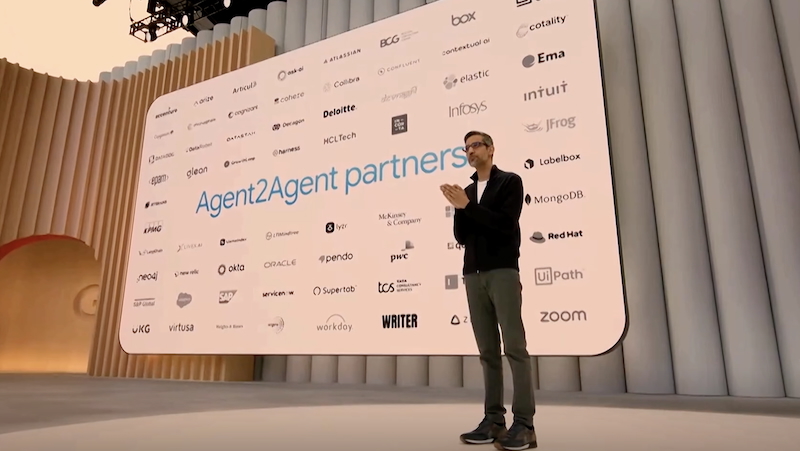
Expect agents to be everywhere soon: Search, Chrome, Workspace — even chatting with each other using the new Agent2Agent protocol. Google also confirmed Gemini API and SDK support for Anthropic’s Model Context Protocol.
On the personalisation front, Smart Replies in Gmail are getting a glow-up. With permission, Gemini will mine your emails and files to craft eerily you-like responses, complete with tone and pet phrases. Yes, your AI is about to start writing better emails than you.
AI is now baked right into Google Search. The newly announced AI Mode allows for longer, more complex queries and natural follow-ups — already available in the US. With Gemini 2.5 Pro now powering it, Search just got a serious IQ boost. AI Overviews are already live in 200 countries and growing fast, especially in the US and India., revealed Pichai.
Developers, meet your new best friend: Gemini 2.5 Flash, a lightning-fast, low-cost version built for speed and scale. But the headline act is Deep Think, a new reasoning mode for Pro users that layers in parallel thinking and long-context analysis. Consider it AI with a PhD.
Creatives, your time has come. Google dropped Veo 3, its most advanced video model yet — now with native audio generation. It also rolled out Imagen 4 for image generation, and Flow, a slick tool for building cinematic clips on the fly.
Throw in Canvas integration, support for quizzes, infographics and multilingual podcasts, and the Gemini app is shaping up to be a Swiss Army knife for creators.
Pichai closed with a personal anecdote: a Waymo ride in San Francisco with his 80-something father. “He was amazed,” Pichai said. “It reminded me just how powerful technology can be — not just to dazzle, but to bring people along.”
The message was clear: AI at Google is no longer a moonshot — it’s now a movement.

Broadband
Tejas Networks names Arnob Roy as MD and CEO, overhauls top leadership team
The Bengaluru-based telecom gear maker reshuffles its entire top team even as quarterly revenue collapses by 83 per cent
BENGALURU: Tejas Networks is changing the guard at the top, and doing so at speed. The Bengaluru-headquartered telecom equipment maker has elevated Arnob Roy as managing director and chief executive officer, effective April 15, 2026, for a term running through to August 3, 2028, and in the same breath announced new appointments across operations and finance. The timing is pointed: the company is navigating one of the roughest patches in its recent history.
Roy steps up from his role as executive director and chief operating officer, a position he has held since March 2019. He brings more than three decades of experience in the high-technology sector across research and development, operations, and sales. His predecessor, Anand Athreya, resigned last year citing personal reasons and was relieved on June 20, 2025, leaving a gap at the top that has now been formally filled.
The numbers Roy inherits are sobering. Tejas posted a net loss of Rs 211.3 crore in the fourth quarter of fiscal year 2026, a near-194 per cent widening year on year from Rs 71.8 crore in the same period a year earlier. Revenue for the quarter collapsed 82.6 per cent year on year to Rs 333 crore, down from Rs 1,907 crore. EBITDA swung to a loss of Rs 118.2 crore against a profit of Rs 121.5 crore a year ago. The culprit is not hard to identify: Tejas has derived the bulk of its revenue from BSNL’s fourth-generation network project, delivered as part of a Tata Consultancy Services-driven consortium, and that roll-out is now winding down.
Roy, speaking during a post-earnings conference call with analysts, was candid about where the company has been. “The BSNL 4G network went live across 100,000 sites. We deployed our largest indigenous router networks in the country through the BSNL MAN network, as well as in the BharatNet Phase 3 network,” he said, adding that Tejas had also successfully rolled out its 400G and 800G DWDM equipment in domestic and international markets, and continued the deployment of what it describes as the world’s largest satellite IoT network through its vehicle tracking system solution.
The pivot to new revenue streams is already under way. Tejas has partnered with Japan’s Rakuten Symphony and NEC Corporation to push deeper into international markets, with several Open Radio Access Network trials ongoing, one of which concluded recently. The company is also diversifying across equipment categories and geographies to sustain momentum as the BSNL chapter closes.
To prosecute that strategy, Roy needs a full team around him. Preetham Uthaiah has been appointed chief operating officer, moving up from his current role as vice president of product management for wireless products at Tejas Networks. Uthaiah brings nearly 30 years of global experience spanning engineering, product management, and business development across India and the United States. Before joining Tejas Networks, he served as executive vice president of product management, marketing, and strategy at Saankhya Labs, and held senior roles at Tech Mahindra on both sides of the Atlantic. He holds an MBA from Arizona State University and a degree in electronics and communications from Karnatak University.
On the finance front, AVS Prasad has been approved as chief financial officer, effective May 16, 2026, succeeding Sumit Dhingra, who has resigned. Prasad, currently serving as finance controller at Tejas Networks, brings over 27 years of experience within the Tata Group across telecom, aerostructures, and defence. A company secretary and cost and management accountant by training, he has spent more than 15 years in senior finance roles including CFO and financial controller positions, with expertise spanning corporate finance, treasury management, regulatory compliance, internal audit, and governance.
New chief executive, new chief operating officer, new chief financial officer — all installed in a single move, at a moment when the company’s largest revenue source is drying up and the next chapter remains unwritten. Tejas Networks has placed its bets. Now it has to deliver.