Connect with us

Hindi

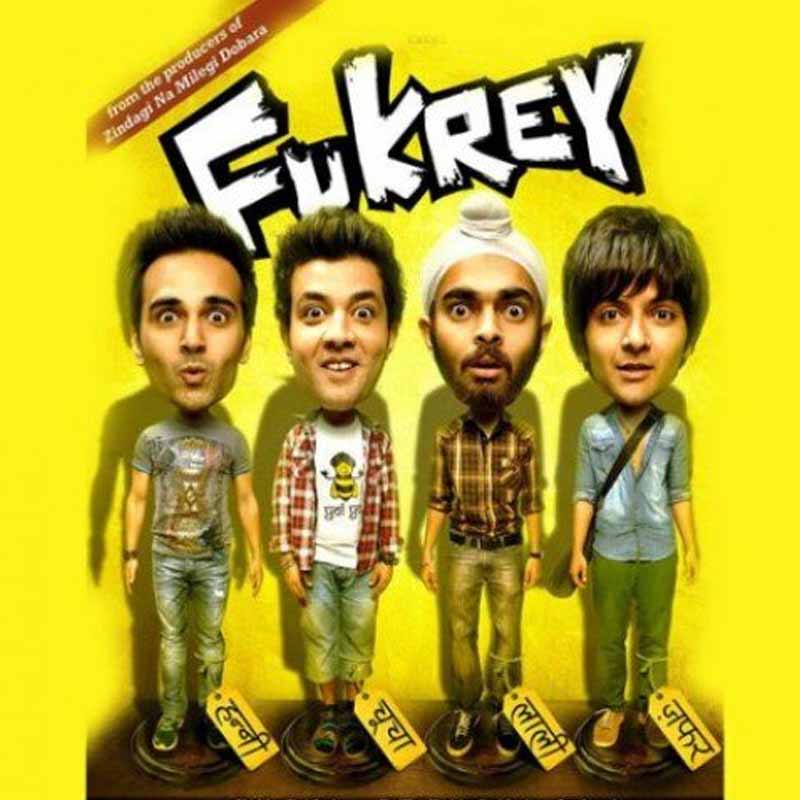
Fukrey – A comedy of errors

Published

on

MUMBAI: Fukrey‘ is a local northern slang – meaning good for nothing. The film is about four such young men. Three of them need a large sum of money to bribe their way into the most happening college in Delhi. This is not because they are keen on good education, but because this college boasts of best of girls on campus, cool parties and freedom to stay away from classes and just have fun.

Producers: Ritesh Sidhwani, Farhan Akhtar.
Director: Mrighdeep Singh Lamba.
Cast: Pulkit Samrat, Manjot Singh, Ali Fazal, Varun Sharma, Vishakha Singh, Pankaj Tripathi, Richa Chadda.

Pulkit Samrat and Varun Sharma are classmates who look grown up because both have failed at least thrice in school. Also, they stick together all day. They have no chance of passing school exams yet dream of getting into college. They decide on doing a recce of their dream campus but it is tough to pass the gates being manned by Pankaj Tripathi. Of course, if one knows how to tackle Tripathi, he is very helpful. The boys make a deal with Tripathi that for a large sum he will get them the exam papers in advance and let them enter the college campus. There they meet guitar strumming Ali Fazal; Fazal has no problem getting into the college, as he has one getting out. He has been roaming around the campus nursing his dream to make a music album. His love angle, Vishakha Singh, teaches in the same college. Tripathi also has one more prospective customer, Manjot Singh, who wants to get into the same college because his girlfriend is here. Since he does not possess the merits, Tripathi offers to get him in against a donation of Rs 2.5 lakh to the college.

Meanwhile, Fazal has a bad news that his father has suffered a stroke and he urgently needs to raise a lakh of rupees for his treatment. The four lads have met and now have a common aim, to raise money. But, they have a very resourceful mentor in Tripathi. He takes them to Richa Chadda, known as Bholi Punjaban who, contrary to her name, is a ferocious woman whose vocabulary is mainly filled with abuses; she deals in drugs, false email racket, pimping and the works.

Advertisement

Samrat and Sharma have a dream to sell to Chadda. Sharma has some peculiar dreams where Samrat is being mauled by a god or an animal which he narrates to him. Samrat interprets this dream to work out a lottery number which they always win. Chadda is convinced to invest the seed money in the dream lottery but she does so only against the papers of Manjot‘s father‘s halwai shop. Under pressure, Sharma fails to get any sleep and hence no dreams but scared of his friends, he makes up a dream. The money is gone and the four lads are now slaves of Chadda till she recovers her money. Her intention is to keep using the boys to do her illegal bidding. She asks them to sell drugs at a rave party in the neighbourhood and also sends the cops after them. The boys somehow escape but Chadda‘s lien on their heads has mounted to Rs 25 lakh after losing the drugs she gave them to sell. The only way out of the trap is for Sharma to dream again.

There is no story for most part of the film and it carries on mainly on gimmicks of Samrat and Sharma and the encounters of Manjot with a local charasi. The story, such as it is, begins after the entry of Chadda. What follow is crazy comic situations backed with funny one-liners. Chadda excels as a loud female villain. Among the boys, Sharma and Manjot shine with good support from Samrat. Fazal and his love interest Visakha are okay. Tripathi is very effective. Music does not add much to the film. Dialogue is good.

Fukrey has some appeal for Delhi and surrounding areas, but the rest of the country will find limited attraction.

Advertisement
 

Ankur Arora Murder Case – A medical thriller hitting the conscience


Producer: Vikram Bhatt.
Director: Suhail Tatari.
Cast: Kay Kay Menon, Tisca Chopra, Arjun Mathur, Vihakha Singh, Paoli Dam, Sachin Khurana, Manish Chaudhari, Ashish Jain.

Advertisement

Ankur Arora Murder Case is about the might of a powerful wrongdoer being challenged by an honest one without resources. A film in the recent past which comes to mind is Jolly LLB. This film deals with medical negligence and efforts by a powerful doctor and the hospital management to cover up the death caused by negligence.

Ankur, a young boy, complains of stomach pains and is brought to hospital where an intern, Arjun Mathur, diagnoses appendicitis but advises to admitting Ankur for the night until a stomach scan can be done in the morning. Mathur as well as his co-intern and lover, Vishakha Singh, are on the team of Kay Kay Menon, whose skills are legendary. Both the interns are in awe of him and treat him as their idol.

After the scans, Mathur‘s diagnosis proves right and the boy has to undergo a simple surgery to remove his appendix. Menon decides to delay the process by a day in the interest of hospital coffers which Mathur does not find justified. One hour before the operation, Ankur gets hungry. While his mother, Tisca Chopra, is out buying medicines and stuff for him, he is tempted to eat a few biscuits kept next to him; this is against doctor‘s advice to refrain from eating anything eight hours prior to surgery.

Advertisement

The boy tells the nurse about this when asked and the nurse duly informs Menon who decides to do the needful to clean the patient‘s stomach before operation. However, too busy on his mobile, he starts the surgery as soon as he enters the operation theatre (OT); this despite a nagging feeling in his mind that he was forgetting something. Soon as the surgery is over and the boy stitched up, the boy starts vomiting, his windpipes are blocked stopping oxygen supply to his brain and he goes into coma. Menon and his team fail to revive him and the boy is dead in two days.

Menon and his management are all powerful and his team is threatened to keep the matter quiet. The nurse who had warned Menon is sent off to her native place. Mathur, who has been banned from Menon‘s OT team, smells something fishy in the manner of Ankur‘s death. His girlfriend, Vishakha, though present in the OT, refuses to tell him what happened. She leaves him for her career which Menon could ruin if she talked.

Mathur and Chopra decide to take the matter to court. Paoli Dam fights their case. All the witnesses, including Vishakha and the nurse who is traced to Goa and brought to the city as witness, turn hostile. The case is as good as lost. But Vishakha decides to do one last brave act and win her love back. As she goes to Menon‘s office to tender her resignation, he loses his mind and goes off tangent delivering a long rant comparing himself to god and calling the boy‘s death a minor mistake in his career. Vishakha has, of course, recorded this whole scene on her cell phone and it soon makes its way to news channels.

Advertisement

The story is routine and such things don‘t shock people anymore. Performances by Menon, Mathur and Chopra are good. Direction is fair.

There is nothing commercial about Ankur Arora Murder Case.

Advertisement
Click to comment

Leave a Reply

Your email address will not be published. Required fields are marked *

Hindi

GUEST COLUMN: Why film libraries & IPs are the new engines of growth

Unlocking value through catalogue strength and IP synergy

Published

on

MUMBAI:In a media landscape defined by fragmentation, platform proliferation, and ever-evolving audience behavior, the economics of filmmaking are undergoing a fundamental shift. No longer confined to box office performance, a film’s true value is now measured across an extended lifecycle that spans digital platforms, syndication networks, and global markets. As content consumption becomes increasingly non-linear and algorithm-driven, film libraries and intellectual properties (IPs) are emerging as strategic assets, capable of delivering sustained, long-term returns. For Mohan Gopinath, head – bollywood business at Shemaroo Entertainment Ltd., this transformation signals a decisive move from hit-driven models to portfolio-led value creation. In this piece, Gopinath explores how legacy content, when intelligently repurposed and distributed, can unlock recurring revenue streams, why the interplay between catalogue and original IP is critical, and how media companies can build resilient, future-ready entertainment businesses.

For all these years, we thought that a film is successful if it performs well in theatres. There are opening weekend numbers, box office milestones, and distribution footprints that gave a good picture of how the movie has done commercially and also tell us about its cultural impact. However, there are multiple platforms today, always-on content ecosystem, which has caused a shift. Today, the theatrical performance is not the culmination of a film’s journey but merely the beginning of a much longer and more dynamic lifecycle.

Film libraries today are emerging as high-value, constantly evolving assets that deliver sustained returns well beyond initial release cycles. This becomes a point of great advantage for legacy content owners with diverse catalogues, to shape long-term business outcomes.

Advertisement

According to FICCI-EY, the media and entertainment industry of India achieved a valuation of Rs 2.78 trillion in 2025 which is expected to reach Rs 3.3 trillion by 2028 through a compound annual growth rate of approximately 7 per cent and digital media will bring in more than Rs 1 trillion to become the biggest sector which generates about 36 per cent of overall market revenues.

This shift is the expansion of distribution endpoints. We know how satellite television was once the primary secondary window but today, it coexists with YouTube, OTT platforms, Connected TV, and FAST channels. Each of these platforms caters to distinct audience demographics and consumption behaviors, helping content owners to obtain more value from the same asset across multiple formats.

For instance, films that had great reruns, now find continuous engagement across digital platforms. On YouTube, classic Hindi cinema continues to attract significant viewership, reaching audiences across generations and geographies with remarkable consistency. At Shemaroo Entertainment, this is reflected in our film library shaped over decades as part of a long association with Indian entertainment. From classics such as Amar Akbar Anthony to much-loved entertainers like Jab We Met, Welcome, Dhamaal, Phir Hera Pheri, Dhol, Golmaal, and Bhagam Bhag, many of these titles continue finding new audiences while retaining their place in popular memory. Their enduring appeal reflects how culturally resonant stories can continue creating value over time.  Similarly, FAST channels have created curated, always-on environments where catalogue content can continue to thrive through star-led and genre-based programming.

Advertisement

This multi-platform approach has very well transformed films into long-tail IP assets which are capable of generating recurring revenue across advertising, subscription, and syndication models. 

The evolution of audience behavior is equally important. Nowadays, it’s more important to find what’s more relative than what’s recent as viewers are more influenced by mood, memories, and algorithmic suggestions than by release schedules. Even if a movie was released decades ago, it can trend alongside a newly released movie, if surfaced in the right context. Thoughtful packaging, whether through festival-based playlists, actor-driven collections, or genre clusters, allows catalogue content to remain dynamic and continuously discoverable. Shemaroo Entertainment has built extensive film libraries over decades and its focus has mostly been on recontextualizing content for the consumption of newer environments. This process doesn’t just include digitization and restoration, but also re-packaging of films as per platforms.

Syndication itself has evolved into a key growth driver. In perspective, when looking at the domestic market, curated content packages continue to find strong demand across broadcast and digital platforms. Meanwhile, in the international market, especially in markets like Middle East, North America and Southeast Asia, the appetite for Indian content is opening up new monetization avenues. Here, the ability to package and position catalogue content effectively becomes as important as the content itself.

Advertisement

Importantly, the need to re-package catalogue content does not diminish the role of new content. In fact, originals and fresh IP are essential to sustaining the long-term value of a film library because they act as discovery engines that bring audiences into the ecosystem, while catalogue content drives depth, retention, and repeat engagement. 

This interplay between the “new” and the “known” is what defines a robust content strategy today. While new films generate spikes in consumption, catalogue titles offer familiarity and comfort. These are factors that are increasingly valuable in an era of content abundance and decision fatigue. This is also shaping our strategy, drawing value from both a deep catalogue assets and a growing focus on original IPs to strengthen long-term audience engagement and build more predictable revenue streams.

There is growing recognition that long-term value in entertainment will be shaped not only by how intelligently existing content continues to live, travel and find relevance, but also by how consistently new stories are created to renew that ecosystem. In that sense, film libraries and original IP are not parallel bets, but reinforcing engines of growth. For media companies, the opportunity lies in making these two forces work together, because that is increasingly where more resilient and predictable businesses are being shaped.

Advertisement

Note: The views expressed in this article are solely the author’s and do not necessarily reflect our own.

Continue Reading

Advertisement News18
Advertisement
Advertisement
Advertisement
Advertisement Whtasapp
Advertisement Year Enders

Indian Television Dot Com Pvt Ltd

Signup for news and special offers!

Copyright © 2026 Indian Television Dot Com PVT LTD