iWorld
From Bahubali to Billion Views India Aims for a Creative Content Super League

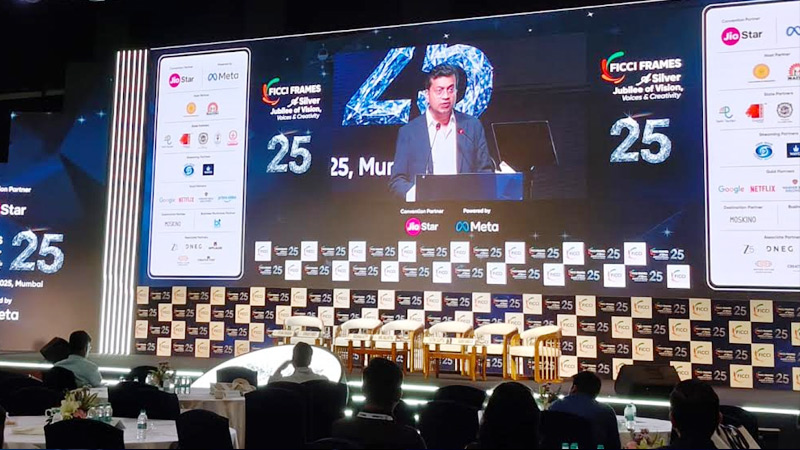
MUMBAI: If cricket can become a family blockbuster, why not Indian stories? That was the rallying cry from Sony Pictures Networks India managing director & CEO Gaurav Banerjee at FICCI Frames 2025. Addressing a packed room of media moguls, policymakers, and creators, he asked a question that hit home: What’s stopping India from birthing a content giant, an IPL of entertainment that’s global in scale yet rooted in our own stories?
Banerjee painted a vivid timeline of India’s entertainment inflexion points. First, the early 2000s witnessed Kaun Banega Crorepati, a game show with a Bollywood superstar as its face, a world-first. Then came the 2008 Indian Premier League, which turned cricket into family entertainment and spawned a robust talent pipeline. And more recently, pan-India phenomena like Satyamev Jayate, Anupama, and films like Bahubali showcased the universal appeal of Indian storytelling. But, he pointed out, the last big leap happened nearly a decade ago leaving a glaring creative gap waiting to be filled.
“The challenge,” he said, “is building an ecosystem where creativity meets scale where every year can give rise to a new Lagaan or a Squid Game created right here in India.” Banerjee argued that the key lies in aggregating human capital. Citing Enrico Moretti’s The New Geography of Jobs, he explained that regions flourish when innovation-driven industries cluster talent, research, and enterprise, essentially a Silicon Valley of creativity.

Drawing a parallel with the IPL, Banerjee highlighted how structured scouting, talent pipelines, and consistent investment can create world-class outputs. “Every season in the IPL introduces at least six new cricketers,” he said. “We need a similar mechanism to unearth and nurture storytellers local, authentic, and ready for global stages.”
The proof, he noted, already exists in pockets. The Malayalam film industry has produced films like Loka Chapter 1, which, despite a budget under Rs 30 crore, has raked in over Rs 300 crore at the box office. “This is not a one-off,” Banerjee enthused. “Films like Avesham, 2080, and Manjula Boys have built an ecosystem of excellence. Loka is the latest chapter in this evolution.”
So how can India scale this success? Banerjee outlined three steps. First, building creative institutions and centres of excellence to scout and nurture talent. Second, forging deep collaboration between academic centres and creative firms akin to Stanford and Silicon Valley to create a continuous dialogue between innovation and execution. Third, reforming regulation to be enabling rather than restrictive. “Creativity is human capital at its purest,” he said. “Yet, current labour and regulatory frameworks are anchored in a colonial past. To unleash India’s creative potential, we must reimagine rules and give imagination room to breathe.”
Banerjee stressed that creativity is no longer peripheral. It fuels jobs, innovation, exports India’s identity, and amplifies soft power. “If India wants to write the next chapter of global leadership,” he said, “we must invest in creativity with the same vision and boldness as we do in new technologies.”
Closing with a clarion call, Banerjee urged policymakers, media leaders, and creators to think globally, experiment boldly, and champion a future where India’s creative economy sits at the heart, not the margins, of the nation’s growth story.
From the IPL’s cricketing pitches to the studios of Kochi and Mumbai, India’s content revolution is poised to go prime time and this time, the audience is the world.






iWorld
Prime Video unveils biggest India originals slate yet
Nearly 55 titles across languages signal deeper push into films, series

MUMBAI: Prime Video is turning up the volume on Indian storytelling, unveiling its largest-ever Originals slate at the ‘Prime Video Presents’ showcase, with close to 55 series and films spanning languages, genres and formats.
The new lineup, which stretches across Hindi, Tamil and Telugu, signals a clear intent: go bigger, go wider, and meet audiences wherever they are watching, whether on streaming screens or in cinemas. Alongside Originals, the platform also announced a fresh theatrical slate under Amazon MGM Studios, marking a deeper step into the big-screen business.
Among the headline acts is The Revolutionaries, a large-scale drama from Nikkhil Advani starring Bhuvan Bam and Rohit Saraf. The slate also features Matka King with Vijay Varma, Raakh starring Ali Fazal and Sonali Bendre, and Lukkhe, which marks rapper King’s acting debut. Adding a genre twist is Vansh – The Kalyug Warriors, positioned as India’s first homegrown Hindi superhero series for streaming.
Familiar favourites are also making a return, with new seasons of Farzi, Panchayat, Call Me Bae, Dupahiya, Dahaad and The Traitors in the pipeline, reinforcing the platform’s bet on established franchises.
Regional storytelling gets a notable push. Highlights include a Telugu adaptation of The Traitors hosted by Teja Sajja, the drama Guvvala Cheruvu Ghat, and Tamil titles such as Exam and returning seasons of Vadhandhi and Inspector Rishi.
The slate also opens new creative partnerships. Hrithik Roshan’s HRX Films steps into streaming with Storm and Mess, while Alia Bhatt’s Eternal Sunshine Productions backs Don’t Be Shy. Production houses including Excel Entertainment, Tiger Baby Films and The Viral Fever further deepen the creative bench.
On the theatrical front, the platform is lining up five films, including Raftaar starring Rajkummar Rao and Keerthy Suresh, VIBE directed by Kunal Kemmu, Dilkashi with music by A. R. Rahman, Nayyi Navelli featuring Yami Gautam, and Kuku Ki Kundli starring Wamiqa Gabbi.
According to Prime Video India director and head of Svod business Shilangi Mukherji, India remains central to the platform’s global growth, ranking among its top markets for new subscribers. She noted that nearly two-thirds of users watch content in more than four languages, underlining a growing appetite for diverse storytelling.
Prime Video India director and head of originals Nikhil Madhok, said the new slate reflects a continued push towards bold, culturally rooted narratives with global appeal.
In short, Prime Video is not just adding titles, it is widening the lens. From small-town dramas to superhero sagas and cinema-ready spectacles, the message is simple: more stories, more voices, and far more ways to watch them.