Broadband
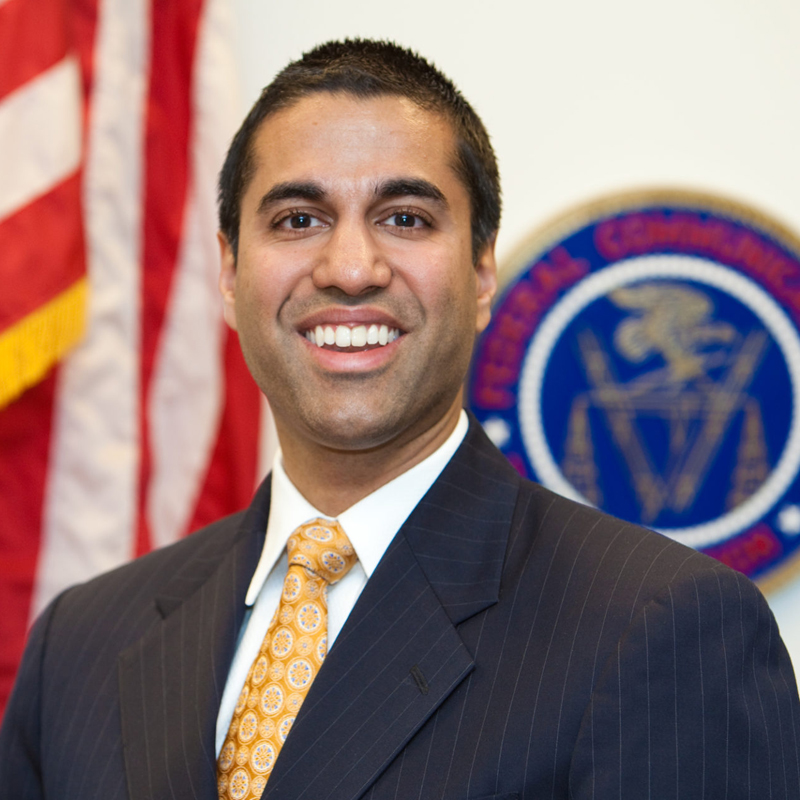
FCC gets Indian origin Ajit Pai as its chairman
MUMBAI: Indians are familiar with Ajit Pai who addressed Ficci Frames as a keynote speaker just three years ago. But Pai is the point man designated by US president Donald Trump as the 34th chairman of the Federal Communications Commission (FCC) who will be drawing up communications policy in one of the most highly networked and communications heavy nations on earth.
Pai, a senior republican on the FCC, was appointed as a commissioner in 2012 by the then President Barack Obama and later confirmed by the senate. He replaces outgoing chairman Tom Wheeler.
“I look forward to working with the new administration, my colleagues at the Commission, members of Congress and the American public to bring the benefits of the digital age to all Americans,” Pai said in a statement.
Ajit Pai had credited his family for his successful rise as communications regulator during his Ficci Frames speech: Said he: “I was born and brought up in the United States, but my family’s roots are here in India. My mother grew up in Bangalore, and my father was raised in Hyderabad. In 1971, they came to the United States with just a radio and ten dollars in their pockets. Now, forty-three years later, here I am, in the country of my forefathers, speaking to you as the first Indian-American to serve on the FCC. The credit for this goes to my parents, who, like many immigrants, sacrificed to give me opportunities not available to them as children. It goes to my grandparents, who instilled in my parents the value of hard work and the vision to dream big.”
According to the FCC website Pai’s rules on communication regulations are as follows:
* Consumers benefit most from competition, not preemptive regulation. Free markets have delivered more value to American consumers than highly regulated ones.
* No regulatory system should indulge arbitrage; regulators should be skeptical of pleas to regulate rivals, dispense favors, or otherwise afford special treatment.
* Particularly given how rapidly the communications sector is changing, the FCC should do everything it can to ensure that its rules reflect the realities of the current marketplace and basic principles of economics.
* As a creature of Congress, the FCC must respect the law as set forth by the legislature.
* The FCC is at its best when it proceeds on the basis of consensus; good communications policy knows no partisan affiliation.
Pai as the commissioner had proposed a:
* Comprehensive plan to promote broadband deployment to all Americans. The federal government must make it easier to for broadband providers to retire increasingly obsolete copper lines in favor of next-generation technologies like fiber.”
• It must enable rural residents to have the same choice for stand-alone broadband typically found in cities.
• It must create a roadmap for state and local governments so that companies that want to compete in the broadband market don’t have to jump through unnecessary regulatory hoops in order to lay fiber to consumers.
• It must promote common-sense policies like “Dig Once” and reform pole attachment rules to reduce the costs of building digital networks.
• It must streamline the process for deploying wireless infrastructure, from big towers to small cells.
• It must free up more licensed spectrum for use by wireless carriers and more unlicensed spectrum for things like Wi-Fi.
• And it must preserve Internet freedom here and abroad, so that the online world can flourish free from heavy-handed government intervention.
Additionally, Pai ai was the first member of the FCC in over two decades to call for revitalizing the AM radio band; the basic reforms he proposed were adopted in 2015. He also urged the FCC to create a task force to study the “Internet Protocol Transition” and report on obsolete rules that could be repealed; that task force was created.
He is likely to undo the net neutrality regime that the FCC had been pursuing under outgoing chairman Wheeler.

Broadband
Tejas Networks names Arnob Roy as MD and CEO, overhauls top leadership team
The Bengaluru-based telecom gear maker reshuffles its entire top team even as quarterly revenue collapses by 83 per cent
BENGALURU: Tejas Networks is changing the guard at the top, and doing so at speed. The Bengaluru-headquartered telecom equipment maker has elevated Arnob Roy as managing director and chief executive officer, effective April 15, 2026, for a term running through to August 3, 2028, and in the same breath announced new appointments across operations and finance. The timing is pointed: the company is navigating one of the roughest patches in its recent history.
Roy steps up from his role as executive director and chief operating officer, a position he has held since March 2019. He brings more than three decades of experience in the high-technology sector across research and development, operations, and sales. His predecessor, Anand Athreya, resigned last year citing personal reasons and was relieved on June 20, 2025, leaving a gap at the top that has now been formally filled.
The numbers Roy inherits are sobering. Tejas posted a net loss of Rs 211.3 crore in the fourth quarter of fiscal year 2026, a near-194 per cent widening year on year from Rs 71.8 crore in the same period a year earlier. Revenue for the quarter collapsed 82.6 per cent year on year to Rs 333 crore, down from Rs 1,907 crore. EBITDA swung to a loss of Rs 118.2 crore against a profit of Rs 121.5 crore a year ago. The culprit is not hard to identify: Tejas has derived the bulk of its revenue from BSNL’s fourth-generation network project, delivered as part of a Tata Consultancy Services-driven consortium, and that roll-out is now winding down.
Roy, speaking during a post-earnings conference call with analysts, was candid about where the company has been. “The BSNL 4G network went live across 100,000 sites. We deployed our largest indigenous router networks in the country through the BSNL MAN network, as well as in the BharatNet Phase 3 network,” he said, adding that Tejas had also successfully rolled out its 400G and 800G DWDM equipment in domestic and international markets, and continued the deployment of what it describes as the world’s largest satellite IoT network through its vehicle tracking system solution.
The pivot to new revenue streams is already under way. Tejas has partnered with Japan’s Rakuten Symphony and NEC Corporation to push deeper into international markets, with several Open Radio Access Network trials ongoing, one of which concluded recently. The company is also diversifying across equipment categories and geographies to sustain momentum as the BSNL chapter closes.
To prosecute that strategy, Roy needs a full team around him. Preetham Uthaiah has been appointed chief operating officer, moving up from his current role as vice president of product management for wireless products at Tejas Networks. Uthaiah brings nearly 30 years of global experience spanning engineering, product management, and business development across India and the United States. Before joining Tejas Networks, he served as executive vice president of product management, marketing, and strategy at Saankhya Labs, and held senior roles at Tech Mahindra on both sides of the Atlantic. He holds an MBA from Arizona State University and a degree in electronics and communications from Karnatak University.
On the finance front, AVS Prasad has been approved as chief financial officer, effective May 16, 2026, succeeding Sumit Dhingra, who has resigned. Prasad, currently serving as finance controller at Tejas Networks, brings over 27 years of experience within the Tata Group across telecom, aerostructures, and defence. A company secretary and cost and management accountant by training, he has spent more than 15 years in senior finance roles including CFO and financial controller positions, with expertise spanning corporate finance, treasury management, regulatory compliance, internal audit, and governance.
New chief executive, new chief operating officer, new chief financial officer — all installed in a single move, at a moment when the company’s largest revenue source is drying up and the next chapter remains unwritten. Tejas Networks has placed its bets. Now it has to deliver.