English Entertainment
English Entertainment TV channels: At inflection point?


MUMBAI: In George Bernard Shaw’s Pygmalion, Professor Higgins tells his acquaintance Colonel Pickering that he can make the colloquial sounding flower girl Eliza Dolittle speak like a duchess by teaching her how to speak proper English.
Times Network CEO MK Anand is playing the role of Professor Higgins these days as far as the English language is concerned. He wants advertisers, those working in the 30-odd English language channels, agencies to look at the genre differently. He believes that it has viewers in smaller towns, and even in the heartlands. That it is not just a six metro phenomenon; it is touching the masses. Hence, it deserves that much more respect. And that the genre has only one way to go – up.
Says Anand: “The entire idea of English being niche has been propagated by advertisers at some level. They have talked to us and have coached us and probably mesmerised and hypnotised us and we also started believing it. It’s like a self fulfilling prophecy which has led us to consider it is as so called niche. I don’t think we are niche at all. Someone started it with by saying that Hindi is predominant prominent everywhere especially in rural. Then people thought that English is only focused on the six metros, which is no longer true.”

Indeed English language broadcasters are and have been focusing on pushing their services in non-metros. According to cable TV tracker Chrome Data, EECs used to get 80 per cent of their viewers from the six metros; 20 per cent from non-metros not so long ago. With digital addressable systems and set top boxes spreading in phase II and phase III areas of India, the pendulum has swung in the direction of the non-metros. Today, 60 per cent of the viewership is from the six metros; while 40 per cent is from non-metros.
The 30 channels mentioned above account for a genre viewership share of just 0.5 per cent, according to the Ficci-KPMG 2016 report; as against Hindi GEC’s giant share of 58 per cent. According to another study, the average monthly reach of English language is around 208 million domestically. And the ad revenue all of English Entertainment TV channels generated last year was Rs 400 crore.
What bodes well for this genre? Well, for one, the fact that understanding and speaking English is very aspirational in smaller towns and in rural areas in the new India that is opening up economically to the world. Knowledge of English puts you at an immediate advantage over non-English speakers.
And the cult of Hollywood is beginning to spread nationally with American films being distributed theatrically in more screens with different language dubs over the past few years. These movies have started challenging Bollywood films in India in terms of theatrical business. Films like Fast and Furious 7, Avengers: Age Of Ultron, Jurassic World, Batman vs. Superman – Dawn Of Justice, etc. have opened higher than many big ticket Hindi releases. The seventh edition of the Fast and Furious franchise racked up Rs 120 crore at the India box office.
“Younger audiences are consuming English movies and entertainment more than Bollywood movies. At least, in some areas nationally. Bollywood is no longer the predominant attraction there,” says media veteran Cyrus Oshidar.
What’s additionally helping English TV channels get a hold on newer audiences in non-metros are the language subtitles. A study revealed that 79 per cent of viewers said that they find subtitles on English movie channels extremely useful. Explains AXN and Sony Pix business head Saurabh Yagnik: “Subtitles not only help viewers to follow the content better buts also boosts their language. Many players have also started dubbing shows for this reason.”
Even as the audience for Hollywood movies on English channels has gone up, the viewership for English TV shows is not keeping pace and has gone down. Shows such as Game of Thrones attract only niche audiences.
According to Helios Media CEO Divya Radhakrishnan, that’s because the content, the format of American TV shows and their language don’t go down well Indian TV viewers in the interiors, because of the one TV household phenomenon there.
Adds media analyst and IIM Calcutta professor Chandradeep (CD) Mitra: “If the content is heavy and serious, people might not understand it. The content should be easy to follow and should be appealing with simple dialogues.”
Finally, there is the issue of piracy. Audiences in metros are unwilling to wait for the delayed release of prize-winning TV series on Indian TV as compared to the first airing on American or British TV. “Piracy is a major worry for TV shows and with internet broadband and data costs coming down, more and more shows are being downloaded from torrent sites and watched on computers or on mobile devices,” says a media watcher.
However, action channels are an exception as they continue to lure the young audiences, reveals Mitra.
Overall English Entertainment channels have been hit by rising content costs which are being demanded by international studios and distributors. A source points out that content acquisition costs for English entertainment have increased by 150 per cent as compared to three years’ ago. An estimate is that the cost per hour for an international TV series comes close to Rs 4.5 lakh to Rs 6 lakh, irrespective of whether it is a hit overseas or not.
English GECs attract premium brands who do large inventory deals as advertisers.. TV spot rates on an average are around Rs 4,000 for 10 seconds during weekdays while they could go up to Rs 40,000 for the weekend marathons.
But advertising spends on the English entertainment genre is growing by 10-15 per cent annually, which is what makes it attractive. Observers expect new entrants to come in as the potential is only going to grow with increasing digitization.
Says Vibrant Advertising VP Kartik Lakshminarayan: “I think it will increase in one year’s time with the push the genre gets from digital and social media.”
“It is a vast market and the reach will get broader and broader with time,” adds Oshidhar.
“Digitization is a natural tonic for them. The channels will get a better potential to distribute and the major part of the revenue is going to come out of distribution over time. By the end of this year, Indian broadcast and new media will obtain the wave for English entertainment channels to grow so much that it will only explode from there,” concludes Anand.
What is the reach of the English entertainment genre? Take a look at the following numbers to get an understanding.
|
* It is but natural that the English entertainment channels have a amazing reach in India’s commercial capital Mumbai. AXN has a reach of 60 per cent, Zee Cafe attains 61 per cent, Colors Infinity, Comedy Central have 63 per cent. Star World reaches 54 percent and FX reaches 53 per cent.. * Star World has the maximum reach of 46 per cent households in Bangalore followed by AXN with 46 percent and Comedy Central with 45 per cent. Colors Infinity reaches out to 28 per cent while FX accounts for 22 per cent reach. * In India’s capital, Star World has a 44 per cent reach making it the undisputed champ. Comedy Central has a grip of 34 percent, while FX, Colors Infinity, and AXN manage a score 33 per cent, 32 per cent and 30 per cent respectively. * Down east in Kolkata, Zee Cafe and Colors Infinity reach 35 per cent of the households, whereas Star World and Comedy Central are in the 33 per cent range. FX and AXN have 31 per cent and 30 per cent reach respectively. * The recently launched Colors Infinity has a major stake in the Chennai region with 51 per cent reach whereas Star World’s figure is at 48 per cent. AXN, Comedy Central, Zee Café, FX have a reach of 36 per cent, 33 per cent, 29 and 19 per cent respectively. * Coming to the non-metros, AXN and Star World are the two leaders with a 47 per cent reach each. Comedy central has a hold of 33 per cent while old timer Zee Café Colors and FX reach 27 per cent of huseholds each. Colors Infinity is the straggler at approximately 24 per cent. |





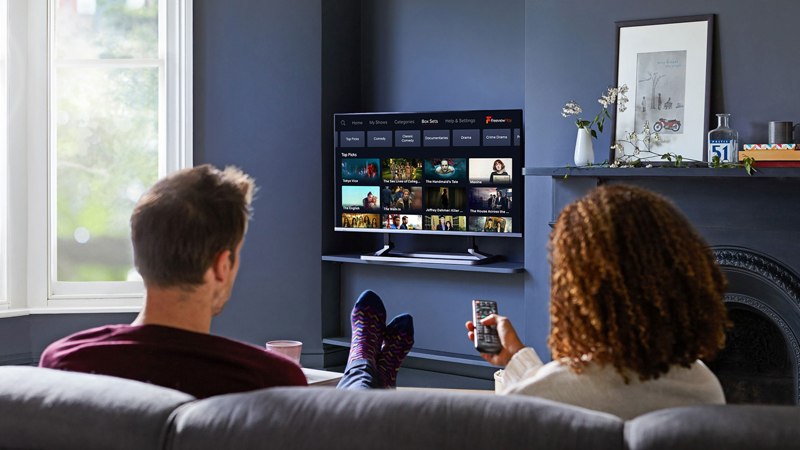
UK: The aerial is losing its grip. As broadband becomes the default way Britons watch television, the UK is edging towards a decisive, and divisive, question: should Freeview be switched off by 2034? The issue, highlighted in reporting by The Guardian, has exposed deep fault lines over access, affordability and the future of public service broadcasting.
For nearly 25 years, Freeview has delivered free-to-air television from the BBC, ITV, Channel 4 and Channel 5 to almost every corner of the country. Even now, it remains the UK’s largest TV platform, used in more than 16m homes and on around 10m main household sets. Yet the same broadcasters that built it are now pressing for its closure within eight years.
Their case rests on a structural shift in viewing. Smart TVs, superfast broadband and the Netflix-led streaming boom have pulled audiences online. Advertising economics have followed. By 2034, the number of homes using Freeview as their main TV set is forecast to fall from a peak of almost 12m in 2012 to fewer than 2m, making digital terrestrial television, or DTT, increasingly costly to sustain.
But critics say the rush to switch off risks abandoning those least able, or least willing, to move online.
“I don’t want to be choosing apps and making new accounts,” says Lynette, 80, from Kent. “It is time-consuming and irritating trying to work out where I want to be, to remember the sequence of clicks, with hieroglyphics instead of words. If I make a mistake I have to start again.”
Lynette is among nearly 100,000 people who have signed a “save Freeview” petition launched by campaign group Silver Voices. She fears the government is about to “take [Freeview] away from me and others who either don’t like, can’t afford, or can’t use online versions”.
Official figures underline the fault lines. A report commissioned by the Department for Culture, Media and Sport estimates that by 2035, 1.8m homes will still depend on Freeview. Ofcom’s analysis shows those households are more likely to be disabled, older, living alone, female, and based in the north of England, Wales, Scotland and Northern Ireland.
Freeview is owned by the public service broadcasters through Everyone TV, which also operates Freesat and the newer streaming platform Freely. After two years of review, DCMS is expected to set out its position soon, drawing on three options proposed by Ofcom: a costly upgrade of Freeview’s ageing technology; maintaining a bare-bones service with only core PSB channels; or a full switch-off during the 2030s.
The broadcasters have rallied behind the third option. They argue that 2034 is the logical cut-off, when transmission contracts with network operator Arqiva expire. By then, they say, the cost of broadcasting to a dwindling audience will far outweigh the returns from TV advertising.
Ofcom agrees a crunch point is approaching. In July, the regulator warned of a “tipping point” within the next few years, after which it will no longer be commercially viable for broadcasters to carry the costs of DTT.
Others see risks beyond economics. Questions remain over whether internet TV can reliably deliver emergency broadcasts, such as the daily Covid updates, in the way that universally available DTT can. The UK radio industry has also warned that an internet-only future for TV could push up distribution costs and force some radio stations off air if PSBs no longer share Arqiva’s mast network.
“It is a political hot potato,” says Dennis Reed, founder of Silver Voices, who says he has “dissociated” his organisation from the government’s stakeholder forum, which he believes is “heavily biased” towards streaming.
The Future TV Taskforce, representing the PSBs, counters that moving online could “close the digital divide once and for all”. “We want to be able to plan to ensure that no one is left behind,” a spokesperson says, adding that rising DTT costs could otherwise mean cuts to programme budgets.
The numbers show the scale of the challenge. Of the 1.8m Freeview-dependent homes projected for 2035, around 1.1m are expected to have broadband but not use it for TV. The remaining 700,000 are forecast to lack a broadband connection altogether.
Veterans of the analogue switch-off, completed in 2012 after 76 years, recall similar fears of “TV blackout chaos”. Around 6 per cent of households were labelled “digital refuseniks”, yet a targeted help scheme and a national campaign, fronted by a robot called Digit Al voiced by Matt Lucas, delivered a largely smooth transition.
This time, the BBC is less keen to foot the bill. Tim Davie, the outgoing director general, has said the corporation should not fund a comparable support programme for a Freeview switch-off.
Research for Sky by Oliver & Ohlbaum suggests that with early awareness campaigns and digital inclusion measures, only about 330,000 households would ultimately need hands-on help ahead of a 2034 shutdown.
Meanwhile, viewing habits continue to fragment. Audience body Barb says 7 per cent of UK households no longer own a TV set, choosing to watch on other devices. In December, YouTube overtook the BBC’s combined channels in total UK viewing across TVs, smartphones and tablets, albeit measured at a minimum of three minutes.
That shift may accelerate. YouTube has recently blocked Barb and its partner Kantar from accessing viewing session data, limiting transparency just as online platforms consolidate power.
“When the government chose British Satellite Broadcasting as the ‘winner’ in satellite TV it was Rupert Murdoch’s Sky instead that came out on top,” says a senior TV executive quoted by The Guardian. “There already is such an outsider ready to be the winner in the transition to internet TV; it is YouTube.”
Freeview’s future now hangs on a familiar British dilemma: modernise fast and risk exclusion, or protect universality and pay the price. Either way, the aerial’s days as king of the living room look numbered.






