News Broadcasting
Election 2014: The rise of social media

MUMBAI: India is witnessing an election with several firsts to its credit. Not only is it the first time that a million youth are voting, it is also the first time the campaign spends of political parties are second only to the USA, the first time channels are jostling to show which one is more unique and it is also the very first time that social media is so actively involved in elections.
IBN network managing editor Vinay Tewari puts it as: “Today for any big event, social media communication is big. No news channel can survive without social media.” The 2009 Lok Sabha elections did not see as much mobile and social media penetration. So much so, the FICCI FRAMES annual report did not have a ‘new media’ section till 2011.
According to the report, the total number of internet users in India is 214 million, out of which 130 million access it through their mobile phones. This is just 17 per cent of the total population of the country!
“It took a decade for the country to grow from a 10 million to 100 million internet user base and only three years to double (2011 to 2013) that number to 100 million.” says the report.
According to India Today Group COO Digital Salil Kumar, “The age group of 18 to 24 years and then those above 24 years are the most vocal in the metros but maximum growth is being witnessed from tier two and three towns.”
 |
The FICCI FRAMES 2014 report says that by the end of 2013 there were nearly 72 million rural Indians who had accessed internet at least once in their lives and 49 million were active internet users. The primary reason that holds them back is unavailability of content in their local languages, which is something channels and mediums are trying to slowly bridge.
Naturally, channels are pulling out all stops to get viewers hooked onto the second screen. CNN-IBN has a tie up with Microsoft and Google; ABP News and Aaj Tak are using their intense social media following; Times Now and CNBC-TV18 have tie ups with Twitter; while NDTV depends on its own proprietary material such as second screen and its app which has six million downloads.
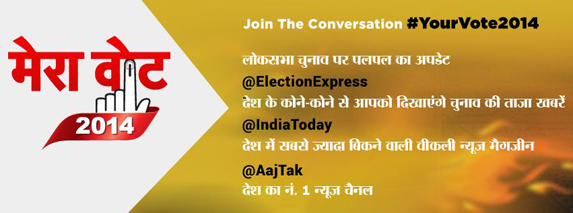
Aaj Tak had come up with an innovative campaign last year called E-Election (E-Chunav) where users were asked to virtually vote for their state parties in Delhi, Madhya Pradesh, Rajasthan and Chattisgarh, in order to gauge the mood of netizens. “With a dedicated team in place, we have been leveraging the medium to disseminate news, listen to feedback, hear views of the community and share them back with audiences on TV, including the panelists on programmes,” says Kumar.
 |
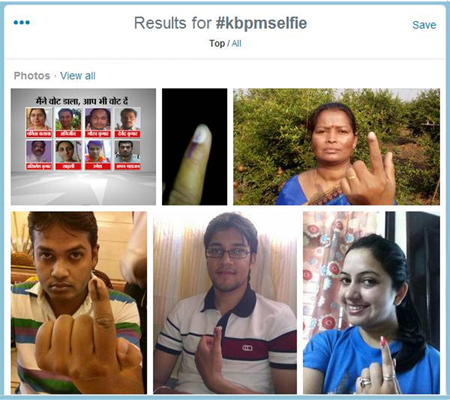
ABP News started the trend #KBPMSelfie that encouraged voters to send selfies of their inked fingers through Twitter, Facebook and mail, leveraging its popular show Kaun Banega Pradhan Mantri (KBPM). It claimed to have received more than one lakh pictures. "We use social media actively throughout the year and we only see this activity increasing as news consumption on this platform is growing," says MCCS marketing manager Vikas Singh, the company that runs ABP News.
An important medium for feedback, social media can no longer afford to be clubbed together with TV. In fact, intensification on social media is not just for the elections but also post elections to retain people. While Aaj Tak wants to improve its engagement with viewers as well as build brand loyalty among them, ABP News' Singh maintains, "From a channel perspective, it helps us communicate much better with our audience. Earlier if it used to be a one way communication, social media now helps it to become a two way channel. News travels faster and a lot of consumption of news happens through referrals, sharing and comments."
According to Tewari, “The current focus is only elections. Post that, the interest in politics may decline but creating stickiness is something everyone is doing.”
Word of mouth has become the biggest marketing tool today. The fact that news travels and gets consumed faster through social media means that it is effectively used for content dissemination and to provide breaking news. ‘Viral’ and ‘trends’ are the new operative words.
Twitter claims that the buzz around the 2014 election on its platform in the last year has increased 600 per cent while the mention of political parties and candidates since the beginning of 2014 has gone up 10 times.
 |
Facebook has come up with an ‘I’m a Voter’ campaign urging voters to click the button and tell everyone about their moment of pride.
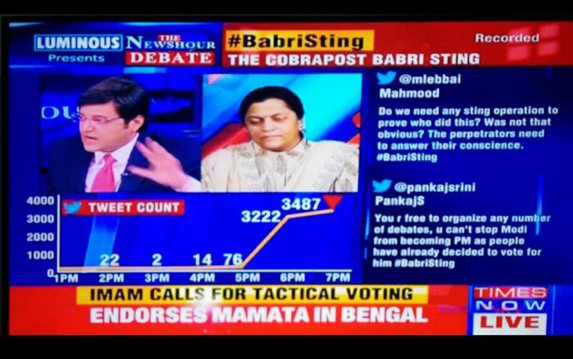
This also brings us to the question as to how much of this information can actually be termed dependable? Times Now is doing live sentiment analysis of Twitter feeds while Network 18’s news channels are analysing election data through Microsoft’s technology. However, NDTV group CEO Vikram Chandra feels that these data are not very conclusive. “Though social media is an important factor, it is not necessarily the single factor that will dominate voting decisions. You have to also keep in mind that only a particular segment of the population has access to the internet or twitter. So mood gauging is fine but I am a bit wary of how far you can take it,” he says.
With ABP News focusing on Facebook (3.9 million), Twitter (5.05 lakh) and G+ respectively while Aaj Tak on Facebook (6.5 million), Twitter (30,000), G+, YouTube, Flickr and Pinterest, CNN-IBN and IBN7 on their own websites first and NDTV depending on the second screen with its own application having 3.2 million followers on Facebook and 1.92 million on Twitter, how much of this information can be relied upon becomes a pertinent question.
 |
“In the last election, social media was considered a medium of a few. Internet penetration was not so deep. In the current environment, it is considered a major influencer and a lot of recourses have also been deployed by all political parties to influence the voter,” points out Kumar. Online data says that in 2009, the number of Facebook users was 1.6 million which has now crossed 100 million, while Twitter which had about 0.6 million subscribers, hasn’t really caught up and currently has approximately 40 million visitors. However, it seems to now be making the most buzz.
“Voting for Lok Sabha #Election2014 in India begins today in what has truly been the country’s first Twitter election” said a Twitter statement on the first day of elections. Even then, the social media user penetration in the country stands at 10.5 per cent of the total population, which is expected to grow to 17.2 per cent by 2017. So, although channels are vehemently focusing on communication through digital media, it still remains a small but actively growing part of the population.
Quite possible that by then the meaning, use or method of ‘social media’ might change. However, channels are keenly tracking the number of followers, likes, people talking about it and the growth level. As India’s mobile and internet penetration sharpens and connections become better and cheaper, the social media landscape for news will totally change.