DTH
DTH operators go big on hybrid boxes this festive season

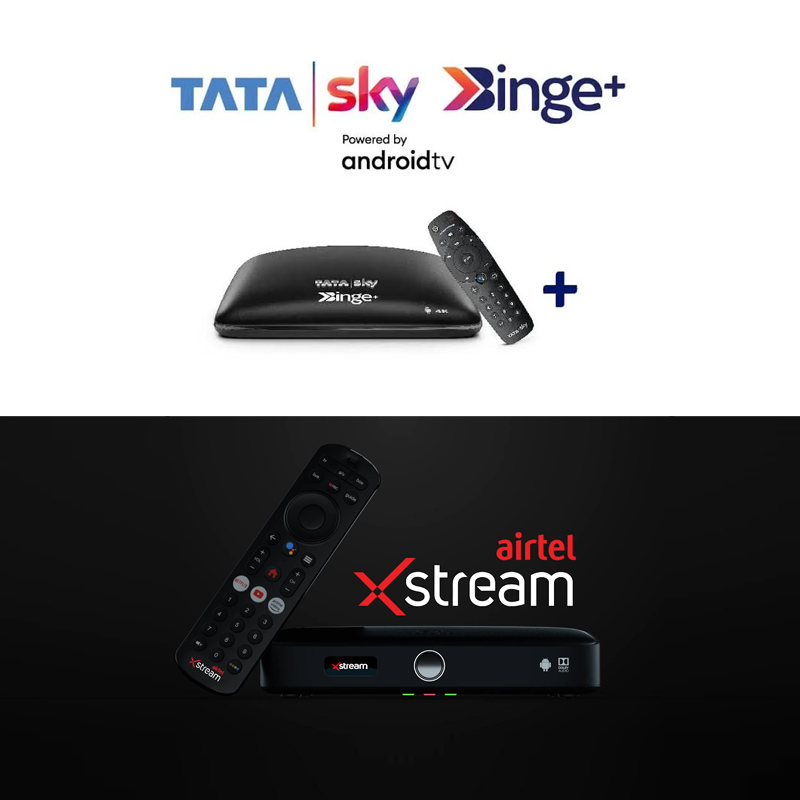
KOLKATA: Leading direct-to-home (DTH) operators are endorsing their hybrid set-top boxes during the festive season. While it’s nothing new for them to piggyback on festivals to attract new subscribers, but this time rather than promoting discounted packages or value-added services, the operators are trying to bring in new perspectives about their products in users’ mind.
Take Airtel India for instance. In its Ab Jo Dekho Bada Dekho campaign, the DTH service provider is running a TVC to promote its Xstream box. The video captures two young consumers discussing “entertainment ke bade duniya” (the larger world of entertainment). The core message of the video is that it is now easy to switch back and forth easily between linear TV and online premium content using Airtel’s new box.

The Sunil Mittal-led company launched its converged platform last year. With a robust wired broadband base, the company has been upbeat about its bundled offering.
“Homes business segment witnessed revenue growth of 7.3 per cent YoY. We added over 129,000 customers during the quarter to reach a total base of 2.58 million. We re-calibrated our offering and launched Xstream bundles with content and unlimited internet to accelerate penetration. The company signed on many more LCO partnerships in non-wired cities, extending the model to 48 cities,” Airtel stated in its Q2 earnings release.
The market leader in the DTH segment, Tata Sky, has also launched a TV campaign for Tata Sky Binge+. The latest ad highlights how the box meets different consumer needs across age groups. Moreover, it has also taken the influencer marketing route on its social media platforms featuring stars like Sayani Gupta and Rasika Dugal.
However, the cost could be a barrier for these boxes in winning over the masses. In this regard, Tata Sky recently fine-tuned the pricing of its smart set top box Tata Sky Binge+, making it available at a competitive price of Rs 2,999 for new subscribers and Rs 2,499 for existing subscribers opting for an upgrade or a secondary multi-TV connection. On the other hand, Airtel Xstream Basic is available at Rs 2499.
At the beginning of the Covid2019 crisis, the overall pay-TV ecosystem lost subscribers – be they cable operators or DTH players. Even in the first quarter of 2020, DTH subscribers grew marginally by 2.8 lakh. While on one hand, the leading players claimed that their new connection addition rate is back to pre-Covid period, the traditional players have to offer various propositions for consumer retention, especially given the massive OTT uptake during the last six months. Tata Sky, Airtel launching new campaigns for hybrid set top boxes could be a bid to retain their existing customer base in the face of the OTT challenge and also bolster their new subscriber count.
“Hybrid boxes are the future for these players. Youth is moving to digital very fast. In terms of payment mechanism also, it is more expensive for a consumer to pay separately on TV, then for data and OTT platforms; effectively it turns out to be an expense of almost Rs 20,000 per year. The advantage of hybrid boxes is they give all at a very affordable price and conveniently. If you have a mechanism for bundling all those together, it’s a win-win for consumers, DTH players, and OTT platforms and beneficial for the entire ecosystem,” said Elara Capital VP – research analyst (Media) Karan Taurani.
Although it is just the beginning for this segment, with several existing challenges, Taurani also added that there will be a high rate of conversion in future from pure play TV to these boxes. Moreover, the additional trigger will be smart TV growth, which is also going up significantly in recent times.
Currently, the DTH industry has an active subscriber base of 72.44 million paying customers as of 31 March. Tata Sky, with a market share of 32.33 per cent, was leading the segment while Airtel Digital TV had 23.65 per cent of the pie.
(Indiantelevision.com reached out to them for more clarity but they declined to respond.)





DTH
Prasar Bharati’s WAVES earns Rs 2.9 crore in first year
Platform scales content, users but monetisation gaps limit revenue growth.
MUMBAI: Big waves, small ripples at least for now. When Prasar Bharati launched its OTT platform WAVES at the 55th International Film Festival of India in November 2024, it pitched a bold vision: a homegrown rival to global and domestic streaming giants, blending video, audio, gaming and commerce into a single digital ecosystem. Five months into FY2024–25, however, the platform’s revenue stands at just Rs 2.90 crore, a figure that underscores the gap between ambition and monetisation.
On paper, WAVES looks anything but modest. The platform has ingested 13,608 titles, totalling 9,495 hours of content, with over 13,000 titles already live. It has streamed more than 575 live events from the Mahakumbh Amrit Snan and the 76th Republic Day parade to the Hockey India League, Kabaddi World Cup and Mann Ki Baat while offering 74 live TV channels and 12 radio channels. With over 10 lakh registered users and more than 200 content partners onboarded, the scale resembles that of a fully operational streaming service rather than a pilot project.
The architecture supporting this scale is equally robust. Built under Prasar Bharati’s Central Archives vertical, WAVES runs on a cloud-based infrastructure with DRM, encryption and an integrated analytics dashboard. It includes dedicated units for content ingestion, quality control, publishing, graphics, marketing and billing, and is distributed across platforms such as OTTplay, Tata Play and BSNL. The offering extends beyond video to include audio-on-demand, e-games and even e-commerce via ONDC integration.
Yet, the numbers reveal a core disconnect. Despite its scale, WAVES generated just Rs 2.90 crore in a market where India’s OTT industry crossed Rs 23,000 crore in 2024. A key bottleneck lies in monetisation infrastructure: subscriptions cannot currently be purchased within the app and must be completed via an external website. In a mobile-first country where over 95 per cent of OTT consumption happens on smartphones, this extra step creates friction that most users are unlikely to overcome.
Ironically, content is not the problem, it is the platform’s biggest strength. Prasar Bharati holds one of the world’s richest broadcast archives, including 45,154 hours of digitised Akashvani programming and 35,723 hours from Doordarshan. For WAVES alone, over 3,800 hours of archival content have been made OTT-ready, including classics such as Ramayan and Shaktimaan, alongside rare cultural recordings and historical broadcasts.
There are early signs that this library holds commercial potential. Revenue from archival content licensing rose sharply to Rs 3.38 crore in FY24, up from Rs 67 lakh the previous year. Meanwhile, free digital platforms continue to drive massive reach, the PB Archives Youtube channel clocked 119.78 million views and added 4,02,000 subscribers in FY2024–25, crossing 1.7 million in total, while DD News has over 5.84 million subscribers.
That, however, presents a strategic dilemma. While free distribution builds scale, it also conditions audiences to expect content at zero cost making it harder to transition to paid models. WAVES, designed as a hybrid AVOD-SVOD platform with advertising and subscription layers, is yet to fully crack this balance.
The broader challenge is not technological but strategic. In an ecosystem dominated by platforms offering seamless payments, aggressive pricing and high-budget originals, WAVES is still bridging the gap between being a content repository and a commercially viable product.
For now, the platform reflects both promise and paradox. It has the scale, the content and the infrastructure but until monetisation catches up, WAVES remains less a revenue engine and more a digital showcase of what India’s public broadcaster could become.






