iWorld
DocuBay announces ‘12 Digit Masterstroke’: An untold insight into India’s Aadhaar revolution

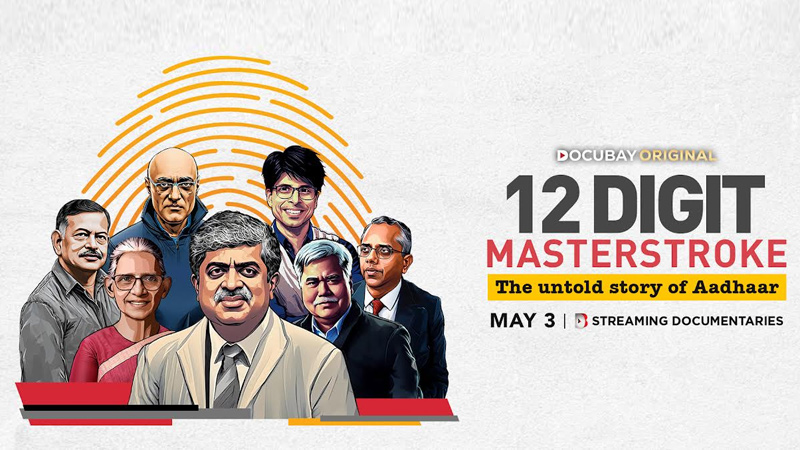
Mumbai: DocuBay, the global streaming service from IN10 Media Network, has announced the release of its latest original, ‘12 Digit Masterstroke – The Untold Story of Aadhaar’ that unravels a behind-the-scenes story of the creation of the world’s largest social identity program, culminating into what is today known as “Aadhaar Card”, crafting a unique identity for over 1.4 billion Indians.
Motivated to highlight topics of national and global importance, DocuBay depicts the untold story of an unlikely team of public and private sector professionals who came together at UIDAI (Unique Identification Authority of India) to design & implement India’s ground-breaking Aadhaar card system. The documentary explores logistical, technological, financial & bureaucratic challenges faced by the team, spearheaded by tech wizard Nandan Nilekani, aiming to achieve something that no one had attempted before in India. Team Aadhaar worked under two governments led by former Prime Minister Manmohan Singh and current Prime Minister Narendra Modi.
“While there is a lot of awareness about the remarkable initiatives that have benefited over a billion beneficiaries of various government schemes, through the Aadhaar project, not many people are aware of the gigantic efforts which were required from a team of technocrats led by Nandan Nilekani that executed the project to fruition,” said DocuBay COO Girish Dwibhashyam. “We are thrilled and grateful to have captured this historic story into our DocuBay Orignal film.”

The documentary, narrated by entrepreneur Ankur Warikoo, features UIDAI former CEO Ram Sewak Sharma, an IAS officer, who articulates technology in a ‘Dabang’ way. Ganga Kapavarapu, a tech buff who brought a financial focus to the program. Srikanth Nadhamuni, the ‘tech guru’, introduced a powerful technological armoury for the creation of Aadhar. Shankar Maruwada, ‘Sir Panch’, played a key role in marketing Aadhaar with a small team of four. Pramod Verma the ‘Chief Royal Architect’ of Aadhar sketched the building blocks for the program. Lastly, Ashok Pal Singh modernised the Indian postal system through digitalisation and their stories of overcoming challenges.
“How do you encapsulate a five-year rollercoaster journey into 50 minutes,” said Wide Angle Films founder and CEO Sujata Kulshreshtha, on the challenges faced during research that underwent to produce the film. She added, “We had to overcome the challenges like lack of archival material from the period of execution and to get access to the key members of the team. Our team did in-depth research, even before we formulated the narrative as the documentary brings this incredible ‘made-in-India’ story to viewers.”
Today in India, with the introduction of UIDAI’s Aadhaar system, transformation has been enabled across 600,000 plus villages and 400 plus cities in India as the unique biometric secure number has become the bedrock for multiple government schemes. From enabling financial inclusion to powering direct benefit transfer schemes, Aadhaar has reshaped lives, earning international recognition as a model for digital identity systems.
‘12 Digit Masterstroke’, produced by Wide Angle Films, is now exclusively available on DocuBay, inviting audiences worldwide to witness the extraordinary story behind India’s Aadhaar revolution.







iWorld
Snapchat parent Snap cuts 16 per cent of workforce in AI-driven restructuring
The Snapchat parent is axing around 1,000 jobs and closing 300 open roles to save $500m, as artificial intelligence makes smaller teams the new normal

CALIFORNIA: Snap is snapping. The Snapchat parent has confirmed plans to cut around 1,000 employees, roughly 16 per cent of its full-time workforce, as it bets that artificial intelligence can do what headcount once required. Shares jumped more than 10 per cent in premarket trading on the news, a brisk vote of confidence from a market that has watched the stock shed about 31 per cent this year.
The restructuring, which also closes more than 300 open roles, follows pressure from activist investor Irenic Capital Management, which holds an economic interest of about 2.5 per cent in the company and has been loudly pushing Snap to tighten its portfolio and lift performance. The firm got what it asked for, and then some.
Chief executive Evan Spiegel told employees the cuts would reduce annualised expenses by more than $500m by the second half of the year. The company expects to incur charges of between $95m and $130m related to the layoffs, mostly severance, with the bulk landing in the second quarter. Staff in Snap’s North America team were asked to work from home on the day of the announcement.
The financial backdrop is not without bright spots. Snap expects first-quarter revenue to rise around 12 per cent to approximately $1.53 billion, broadly in line with analyst estimates. Adjusted core profit for the January to March quarter is forecast at about $233m, comfortably ahead of Wall Street’s expectation of $186.8m.
The harder question surrounds Specs, Snap’s augmented reality smart glasses subsidiary, which Irenic has urged the company to spin off or shut down entirely. The unit has absorbed more than $3.5 billion in investment and burns through approximately $500m in cash annually. Snap is pressing ahead regardless, with a consumer product expected later this year, even as Meta leads the market in the segment.
Spiegel is betting that leaner teams, smarter machines and a consumer AR play can restore Snap’s credibility with investors who have run out of patience. The redundancy notices have gone out. The harder restructuring, the one that requires a hit product rather than a headcount reduction, is still very much pending.







