News Broadcasting
Disney to pull the plug on southeast Asia/HK networks


New Delhi: In what may come as a huge surprise for viewers in southeast Asia and Hong Kong, Disney is mulling over closing as many as 18 channels in the region from October this year. The end-of-an-era move could have a major impact on the entire video entertainment supply chain in the region.
Disney staffers were told about the decision at a town hall out of Singapore on Tuesday, according to sources close to the development. The efforts are aimed at enabling the organisation “to align its resources more efficiently and effectively to current and future business needs.” However, an official statement is yet to be released.
The move is believed to be part of The Walt Disney Company’s global efforts towards a direct-to-consumer-first model and further stimulating the growth of its streaming services.

A senior mediaperson said India is unlikely to be affected by the move, which, while unfortunate, is not entirely unexpected. Last year, the M&E colossus restructured its global operations; this involved separating its India and Asia Pacific businesses after APAC president and Star & Disney India chairman Uday Shankar’s departure, and hiring new talent to spearhead its SVoD push in the southeast region.
With Disney pulling the plug, as many as 18 channels could disappear from the airwaves, which includes Fox, Fox Crime, Fox Life, and FX, movie channels including Fox Action Movies, Fox Family Movies, Fox Movies, and Star Movies China and some sports channels — Fox Sports, Fox Sports 2, Fox Sports 3, Star Sports 1, Star Sports 2. Popular kids channels including Disney Channel and Disney Junior, music channel Channel V and actual services Nat Geo People; and SCM Legend could also go off air in the region. This leaves a question mark over how the other pay-TV platforms will fill the void.
The multimedia giant is quickly gaining in the streaming space. Since its launch over a year ago, Disney+ has transformed itself into a streaming leader, with membership numbers flying past long-term forecasts.
So far, Disney has rolled out Disney+ in Singapore along with a separate Hotstar app, and hybrid service Disney+ Hotstar in Indonesia. Launches in other parts of southeast Asia and Hong Kong are likely this year. Disney+ has 2.6 lakh paying subscribers in Singapore as of April 2021 and 4.5 million in Indonesia, according to estimates presented by regional industry analysts Media Partners Asia.







News Broadcasting
UDF poised to return to power in Kerala, says Manorama-CVoter survey
Massive opinion poll projects shift in Kerala politics ahead of 2026 Assembly elections.
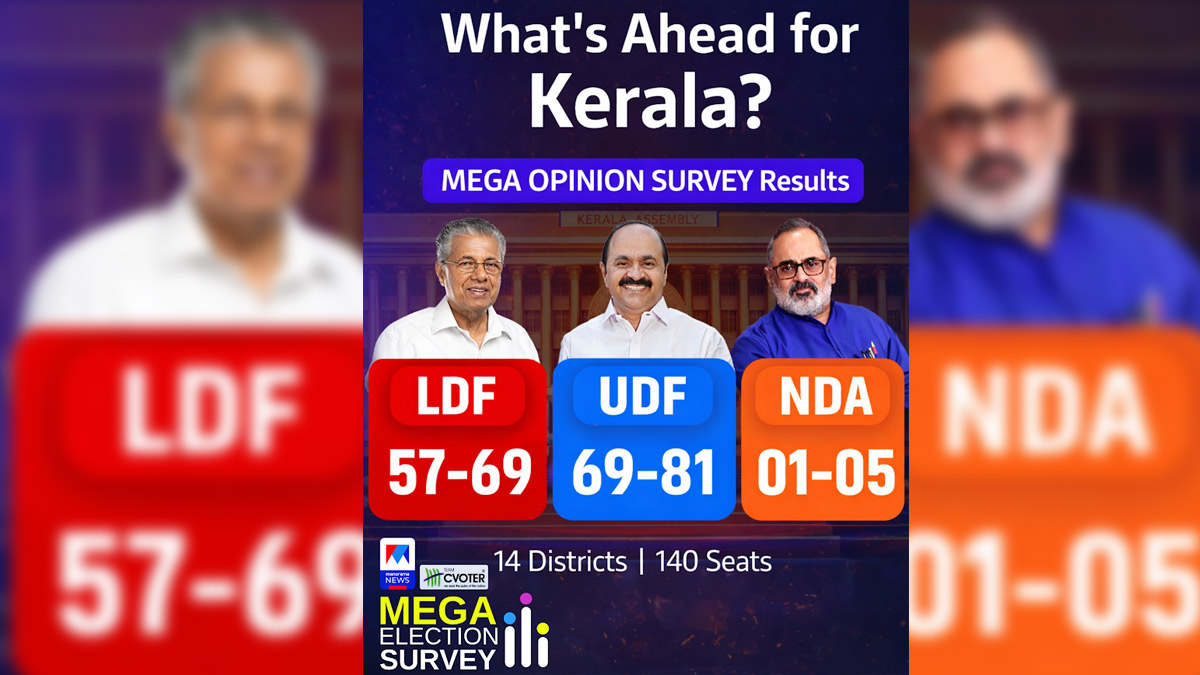
MUMBAI: The winds of change appear to be blowing through Kerala’s political landscape and this time, they seem to favour the United Democratic Front. A comprehensive mega opinion survey conducted by Manorama News in partnership with CVoter projects a potential comeback for the UDF in the upcoming Kerala Legislative Assembly Elections 2026. The survey, covering all 140 constituencies with a massive sample size of nearly 90,000 respondents, predicts the UDF could win between 69 and 81 seats.
The ruling Left Democratic Front (LDF) is expected to secure 57 to 69 seats, a significant drop from the 99 seats it won in the 2021 elections. This would mean the LDF losing 30 to 42 of its sitting seats. Meanwhile, the National Democratic Alliance (NDA), which drew a blank in 2021, is projected to open its account with 1 to 5 seats.
Region-wise, the UDF is expected to make strong gains in Malabar, winning 25 to 34 out of 48 seats, and in Central Kerala, where it could bag 29 to 33 out of 53 seats. In South Kerala, the LDF is likely to retain an edge with 21 to 25 seats, while the UDF may improve to 12 to 16 seats. The NDA could pick up 1 to 3 seats in the southern region.
The survey was conducted between 14 and 26 March 2026, with additional tracker and snap polls carried out from December 2025 to March 2026. A total of 89,693 respondents participated, ensuring representation across all demographics and social segments.
Manorama News has a strong track record of accuracy, with its previous projections closely matching the actual results of the 2019 and 2024 Lok Sabha elections as well as the 2021 Kerala Assembly polls.
In Kerala’s famously fierce political battles, this survey suggests the pendulum may be swinging back. Whether the final verdict matches these numbers or throws up another surprise, one thing is clear, the 2026 Assembly elections are shaping up to be one of the most keenly watched contests in the state’s history.






