I&B Ministry
Copyright infringement or inspiration — it’s still a war


MUMBAI: Whenever a good movie crosses over into India, the first thought that pops up in one’s mind is — Whether it is copied or is it inspired?
The war between infringement and inspiration is not only reaching the courts of law but spicing up discussions too. Well, copying in a unique way is inspiration, but copy an original idea or a format or a script is absolute infringement, say legal experts.
The Sixth Annual Media, Advertising and Entertainment Legal Summit 2017’s session on ‘The converged mediascape and a creative India – It’s copyright cries’ had a spicy kickstart with the panelists — Government of India joint secretary – department of justice, ministry of law and justice, Raghavender GR, Luthra & Luthra Law office partner Deepak THM, Dhir & Dhir Associates partner Siva K Gopinatham, Law Chambers of J Sai Deepak founder J Sai Deepak and Ogilvy and Mather VP and head – legal Kanan Rele.

The panel was moderated by Raymond director – legal Zameer Nathani.
Discussing the key topic ‘Infringement of copyright – copyright or mere inspiration,’ Deepak THM said, “It may not be an infringement of cinematograph film but there can be an infringement of script. To compare, certain tests needs to be applied. Substantial similarity test copyright infringement, copyright to characters and copyright to script are some tests to be done before claiming infringement.”
He added: “India’s one of the biggest blockbuster scripts, Bombay, is based on the play Cohens and Kellys. In the play, the Jewish girl and Irish boy fall in love and secretly marry. ‘Bombay’ is the film on the wrath of communal riots when a Hindu boy gets married to a Muslim girl. But, the movie was not infringed, some portions of the play were inspired and seen in the script, but the script’s elements along with the concept was depicted in a unique pattern.”
Gopinatham added that copying in a unique way was inspiration, but “in an original way” was absolute infringement.
Nathani put some light on copyright and royalty. He said, “The idea of introducing royalty cost was to understand the mathematics that if an additional figure is included in the production cost, then how to bear it, and who should bear it. Fundamentally, the exploiter is supposed to bear the royalty fee. For example, a movie was sold to Star (channel). So, every time, a song from the movie is broadcast on Star, the revenue generated from the advertisers will take out a portion for the lyricist. The portion will be decided by copyright society which is not yet decided.”
Seeing the present era, Nathani added that Facebook is engaging top 10 newspaper agencies to authenticate the news for article infringement and to stop fake news.
Raghavender spoke about 2012 amendment which was in line with WCT and WPP. He said, “WIPO Copyright Treaty (WCT), introduced in 1996, is a special agreement under the Berne Convention that deals with the protection of works and the rights of their authors in the digital environment. But, there is divergence in convergence because the Digital Millennium Copyright Act 1998 is slightly different from the way we have done it because of the copy control provisions that are there and access control techniques used. Flexibilities, however, are included in WPP and WCT provision.”
He added: “The concept of flexibility expanded the tricks to protect the interest of the technological, administrative, financial, socio-cultural conditions of the developing countries under Article 6 and 66 Paragraph 1.”
Kanan, talking about the misery faced by her company owing to the Copyright Amendment Act, said, “I am from the advertising industry, and we are facing two issues due to this amendment. Our employees directly work for us but they are also entitled to royalty. But, there is no society-firm from where these royalties can be collected. The second issue we faced is that Section 18 gives protection to authors that they are not supposed to waive the rights to receive royalty. So, if an author wants to collect money for example an X amount as his lifetime royalty, he has no right under the Copyright Amendment Act to receive that.”
On consolidated royalty, Raghavender added, “There is a continuous exploitation based on revenue of author-writers in terms of consolidated royalty. And also, s/he is needed to be a member of IPRS as far as royalty rights are concerned.”
Raghvender briefly explained the reasons of delay in statutory licensing for broadcasting. He said, “Section 31D under the Copyright Amendment Act was introduced for the radio industry, which was later extended to television broadcasters. The purpose of having the statutory licensing provision was to entitling the radio broadcasters to play sound recordings seamlessly, without going through the extortion of negotiations for broadcast by paying a prefixed consideration for such usage.”
“Earlier, a radio broadcaster had to take three voluntary licenses before exploiting a song either for promotion or for commercial purpose. But, after the denial by the radios for paying high copyright amount demanded by the owner, voluntary licence was denied as per the Berne Convention provisions and statutory license were made. Under statutory licence, the rates of royalty for radio broadcasters shall be different from television broadcasting, and the government shall decide the rate which will be later fixed by the Copyright Board separately for radio broadcasting and television broadcasting. It is restricted to television and radio, and does not apply on webcasting.”
Kanan shared the key takeaway from the Delhi High Court case of Suneet Varma Design vs Jas Kirat Singh Narula. It was a 2006 case of copyright infringement on Yashraj’s film “Bunty Aur Babli,” using a creation from the designer Suneet’s 2003 collection to dress up an actress in the film — Rani Mukerji. Narula said that he had not designed but purchased the same from a retail shop named Baby Bell in a shopping mall in Mumbai. Based on the provisions of Section 51-52 of the Indian Copyright Act, 1957, the case was dismissed.
Kanan said, “There are certain guidelines that filmmakers, photographers, etc. need to be given certain liberties as far as creative expression is concerned. Because, it is very difficult to take approval for each and every product or material that is used in the artistic representation of the film.”
On India’s position at WIPO Broadcasting Treaties, Raghavender said, “At present, the planning committee at WIPO is discussing the numbers, and it has been a point of discussion since the last 15 years. Since then, the WCT and WPP provisions came, the understanding among the stakeholders has increased to 191 in rival states, raised last week by WIPO panel and the reason behind the difference is technology.”
He added: “In 2005, WIPO rushed with their final round with consensus of rival states on diplomatic content. On one clause of transferring the rights, with the lack of consensus, it took 11 years to revive.”
“India has denied having implicit webcasting treaty,” he said.
“In the 20th association, the knowledge data market value, the international norms will be done in the standing committee on copyrights and royalty rights where countries give proposals which become an agenda, and discuss whether there should be a treaty or not. On the basis of all the proposals, a final document is prepared. In the committee, textual negotiations are also discussed. The inclusion of comma and column in language took two days to finalise whether India opposed the proposal, but later, it was sorted out.”
J. Sai Deepak said: “The Copyright Board should be merged with the Intellectual Property Appellate Board (IPAB), which is a good step, but unfortunately the existing provisions of Copyright Board (Section 11) does not support this, it needs amendments.” IPAB seeks to amend the Copyright Act so as to transfer the functions of the Copyright Board to IPAB, which as of now deals only with matters relating to trademarks, patents and geographical indications.”
ALSO READ:
Copyright Board may become part of Intellectual Property Appellate Board
Star-Vijay Copyright case hearing next week, TRAI to file counter
Star – TRAI copyright case: In dramatic turn, Madras HC judges withdraw






I&B Ministry
IT Rules tweaks are clarificatory, not expansion of powers: MeitY
Govt signals flexibility as platforms push for clarity on user content rules
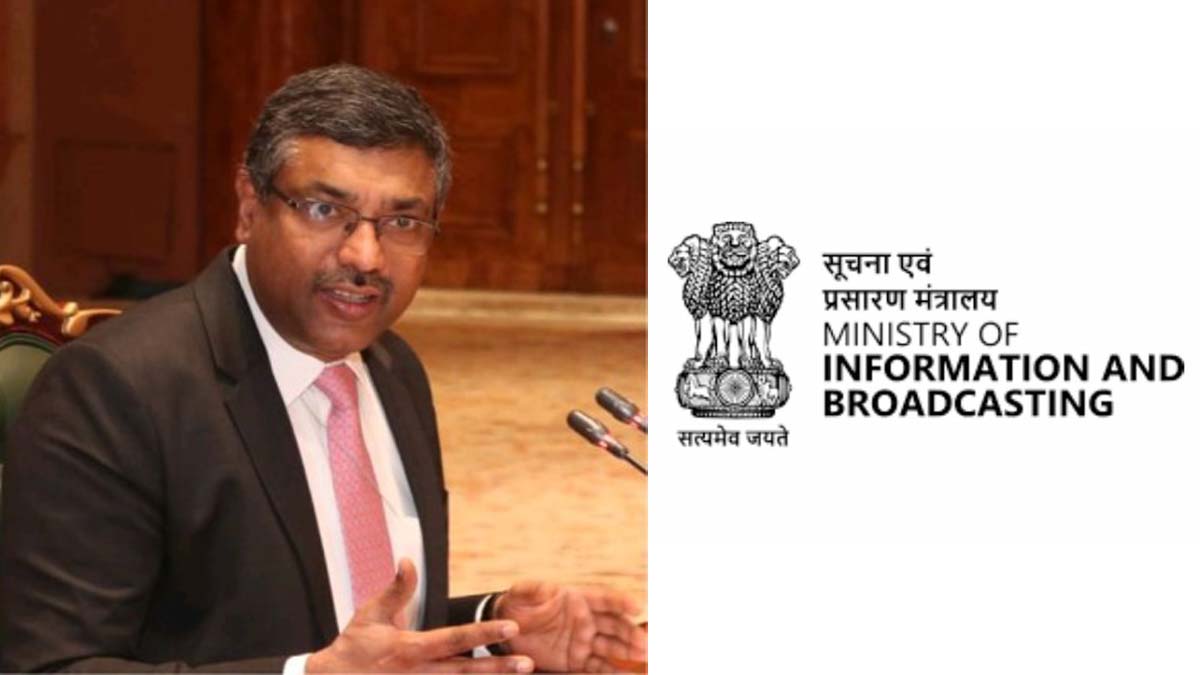
NEW DELHI: The Centre has sought to dial down concerns over its proposed amendments to the IT Rules, with Ministry of Electronics and Information Technology secretary S Krishnan asserting that the changes are intended as clarifications rather than an expansion of regulatory powers.
Pushing back against criticism from platforms and civil society, S Krishnan said the amendments “do not in any way actually give us wider powers” and are meant to remove ambiguity in how existing provisions are applied. He added that the trigger came largely from within the ecosystem, with intermediaries themselves seeking clearer guidance on compliance, takedowns and record preservation.
At the heart of the debate is the growing friction between platforms and policymakers over responsibility for user-generated content. Intermediaries have argued that they should not be treated on par with publishers, particularly when content is created and uploaded by users. Krishnan acknowledged this concern, noting that “a sharper distinction” between user content and publisher content is needed and is currently under examination.
The issue becomes more complex in enforcement scenarios. While registered publishers can be directly asked to modify or remove content, intermediaries often lack control over the original creator. “In such cases, the intermediary cannot direct those changes,” Krishnan explained, underlining the need for procedural nuance.
Another key proposal under discussion is to bring user-generated news and current affairs content within a more unified regulatory ambit, potentially under the Ministry of Information and Broadcasting. The move follows suggestions that a single authority should handle such content, regardless of whether it originates from a publisher or an individual user.
Even as the government frames the amendments as a tidy-up exercise, fault lines remain. Industry players have flagged concerns over compliance burdens, especially for smaller businesses, and questioned whether advisories could effectively become binding without explicit legislative backing. Krishnan said the government is mindful of these risks and is exploring ways to ease obligations, including possible relaxations under certain provisions.
The ministry is also considering consolidating multiple advisories and guidelines into a more structured framework, a step widely seen as addressing long-standing confusion over what platforms are expected to follow.
On takedowns, the government has reiterated that due process will remain unchanged. Krishnan stressed that actions will continue to be governed by established procedures, with reasons recorded and review mechanisms in place. He also pointed to the surge in deepfakes and synthetic media as a factor behind rising content disputes, calling it a “scale challenge” for regulators.
Interestingly, Krishnan also framed social media platforms as commercial entities rather than pure vehicles of free expression, hinting at a broader shift in regulatory thinking as platform economics come into sharper focus.
With stakeholders seeking more time and, in some cases, a rollback of the proposals, the government has kept the consultation process open-ended. Krishnan said further revisions remain on the table, signalling a willingness to adapt the draft based on feedback.
For now, the message from MeitY is clear: the rules may not be tightening in intent, but the effort to define them more clearly is well underway.






