News Headline
Connected TV: A growing market in India

Mumbai: Connected TV has an audience base of 45 million in India, according to Madison Advertising Report 2022.
The segment contributes eight to ten per cent of the digital audience currently. In the last five years, it has grown nine times and is expected to grow by another four times to reach an audience base of 120 million by 2025. It is expected that connected TV audience base contribution will surge by 15 per cent in future.
The audience base of CTV is growing mostly due to the increase in demand for smart TVs. In 2021, CTV shipments accounted for 84 per cent of overall TV shipments as compared to 64 per cent in 2020.

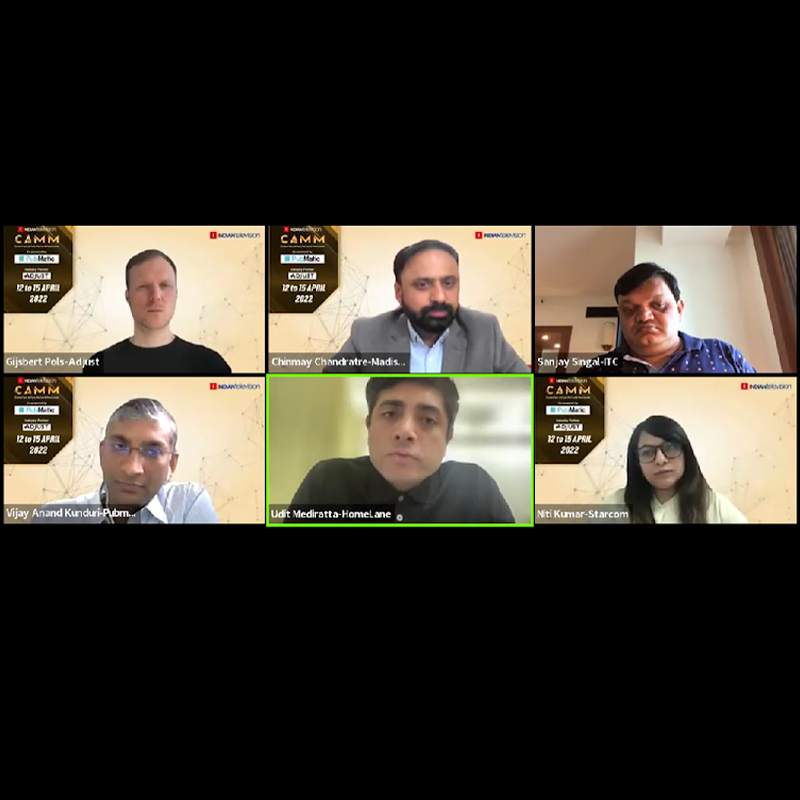
These data points were presented by Madison World’s general manager Chinmay Chandratre who moderated a panel discussion at Indiantelevision Dot Com’s four-day event ‘Content-Tech, Ad-Tech, Mar-Tech and More (CAMM) Summit’ co-powered by Pubmatic and Industry Partner Adjust held on Tuesday.
The discussion was joined by legacy and new-age brand marketers, media planners and technology providers such as Adjust lead product strategist Gijsbert Pols; Starcom chief operations officer Niti Kumar; ITC Limited chief operating officer – dairy and beverages Sanjay Singhal; HomeLane chief marketing officer Udit Mediratta and Pubmatic’s regional vice president (OTT and CTV) Vijay Anand Kunduri.
Watch the full session.
The discussion kicked off by understanding how a legacy brand like ITC looked at the opportunity of CTV. “Typically, the way you build huge categories like biscuits and snacks is through mass advertising,” explained ITC’s Sanjay Singhal.
“As consumer tastes have evolved, we have found that there is a need to slice and dice consumer segments whose needs cannot be met by traditional products and communication on mass media platforms. There is a need for targeting cohorts of consumers that TV cannot do efficiently,” said Singhal.
“There is only so much that may be communicated in a 30-seconder ad on TV,” he added.
Singhal, “When there is a need to explain certain benefits of products to the consumer, a more engaging medium with a higher frequency build-up is required.”
No doubt ITC is a large spender on TV but a large proportion of ad spends are moving to new age mediums for their brands that are targeting younger audiences, alluded Singhal.
He added, “It’s not just our brands such as ‘Bingo’ and ‘Yippee’ which are youth-oriented that are moving towards digital but also our atta brand ‘Ashirvaad’. That’s the power of high frequency.”
While legacy brands are leveraging a mix of traditional TV and CTV, new-age brands such as HomeLane are comfortable advertising only on digital and CTV platforms.
As Udit Mediratta puts it, “As a digital-first brand, our target audience is largely millennials who are ‘cord-cutters’ and hence CTV is the new TV for us. There are inherent strengths in CTV whose visuals and formats are similar to traditional TV while at the same time it is also targeted and measurable. The only disadvantage at this point is scale because there are only 20 million CTV households. However, this base is expected to increase by four times in the next three to four years.”
From a media planning perspective, CTV allows brands to reach incremental audiences, states Starcom’s Niti Kumar. “When you look at CTV and what it brings to the table, it is the largeness of TV in terms of screen size and format coupled with the biggest advantage of digital i.e., targeting/precision. CTV should be included in media plans based on two criteria – where’s the consumer and the brands’ business outcomes.”
“In terms of inventory that is available and targeting, CTV in India is still in its nascent stage as compared to what a YouTube or Disney+ Hotstar can provide. There’s a lot of development that is needed in the technology but it can be layered onto media plans from an incremental reach perspective,” she adds.
The rise of CTV also implies that publishers must be more conscious of hygiene factors while displaying an ad that negatively impacts the user experience. “What we’ve seen is a movement from the small screen to the big screen,” observed Pubmatic’s Vijay Anand Kunduri.
“In most of the Indian market, digital penetration is largely due to mobile but in the last 24 months, we’ve seen the transition from ‘me’ to ‘we’ viewing largely in front of CTV. On the broadcaster side, the trend where the content was first being created for linear and then streamed on OTT as catch-up has reversed. Now, content is being streamed on OTT-first followed by linear telecast,” Kunduri added.
“Parallel to CTV there’s also the emergence of free ad-supported TV (FAST) or advertising video-on-demand (AVOD) and publishers must take into account that when their ad is playing on CTV it should not face technical issues such as buffering, back-to-back ad reels and showing competitor product ads consecutively as this creates a bad user experience,” he added.
Adjusts’ Gijsbert Pols mentioned that in terms of measurability, CTV measurement on digital platforms is just like Facebook and YouTube, however, there is an important caveat that marketers and planners must be aware of.
He said, “Across the world, performance marketers are entering the TV space via CTV because it has become measurable. I don’t think we are far away from a fully digitalised way of measuring performance and branding as the technology and data are there. The problem is implementation which is a tough cookie to crack.”
“While you can measure CTV in the same way you measure other digital channels, it does require you to adjust key performance indicators (KPIs). CTV is more upper-funnel as there are no clicks. For the last decade, digital marketers have been used to measure digital looking at last touch data, however, CTV requires you to adopt a multi-touch approach when it comes to measurement,” he concluded.







NEW DELHI: Hamdard Laboratories gathered a cross-section of India’s achievers in New Delhi on Friday, handing out the Hakeem Abdul Hameed Excellence Awards to figures who have left their mark across healthcare, education, sport, public service and the arts.
The ceremony, attended by minister of state for defence Sanjay Seth and senior officials from the ministry of Ayush, celebrated individuals whose work blends professional success with a sense of public purpose. It was as much a roll call of achievement as it was a reminder that influence is not measured only in profits or podiums, but in people reached and lives improved.
Among the headline awardees was Alakh Pandey, founder and chief executive of PhysicsWallah, recognised for turning affordable digital learning into a mass movement. On the sporting front, Arjuna Awardee and kabaddi player Sakshi Puniya was honoured for her contribution to the game and for pushing women’s participation onto bigger stages.
The cultural spotlight fell on veteran lyricist and poet Santosh Anand, whose songs have echoed across generations of Hindi cinema. At 97, Anand accepted the honour with characteristic humility, reflecting on a life shaped by perseverance and hope.
Healthcare honours spanned both modern and traditional systems. Manoj N. Nesari was recognised for strengthening Ayurveda’s place in national and global health frameworks. Padma shri Mohammed Abdul Waheed was honoured for his research-backed work in Unani medicine, while padma shri Mohsin Wali received recognition for his long-standing contribution to patient-centred care.
Education and social development also featured prominently. Padma shri Zahir Ishaq Kazi was honoured for decades of work in education, while former Meghalaya superintendent of Police T. C. Chacko was recognised for public service. Goonj founder Anshu Gupta received an award for his dignity-centred rural development initiatives, and the Hunar Shakti Foundation was honoured for empowering women and young girls through skill development.
The Lifetime Achievement Award went to former IAS officer Shailaja Chandra for her long career in public healthcare and governance, particularly in the traditional systems under Ayush.
Speaking at the event, Hamdard chairman Abdul Majeed said the awards were a tribute to those who combine excellence with empathy. “These awardees reflect Hakeem Sahib’s belief that healthcare, education and public service must ultimately serve humanity,” he said.
Minister Seth struck a forward-looking note, saying India’s young population gives the country a unique opportunity to become a global destination for learning, health and wellness by 2047.
The ceremony also featured the trailer launch of Unani Ki Kahaani, an upcoming documentary starring actor Jim Sarbh, set to premiere on Discovery on 11 February.
Instituted in memory of Unani scholar and educationist Hakeem Abdul Hameed, the awards have grown into a national platform that celebrates those building a more inclusive and resilient India. For one evening at least, the spotlight was not just on success, but on service with substance.







