I&B Ministry
Complete Works of Mahatma Gandhi e-version prepared by Publications Division

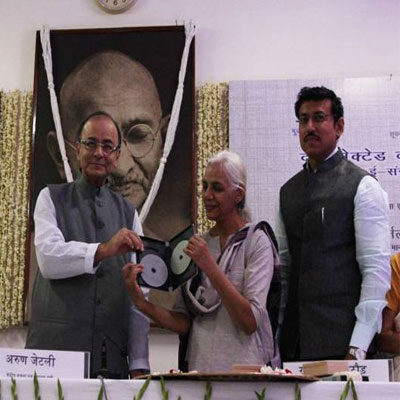
NEW DELHI: The electronic version of the Collected Works of Mahatma Gandhi (CWMG), a monumental document of Gandhi’s words as he spoke and wrote day after day beginning from 1884 till 30 January, 1948 was released today by Information and Broadcasting Minister Arun Jaitley at Gandhi Peace Foundation.
The e-version was also uplinked on the Gandhi Heritage Portal, a comprehensive repository of authentic Gandhiana. The portal hosts e-CWMG in a searchable PDF format to ensure easy and free accessibility of the CWMG for people across the world.
Jaitley announced that the Hindi version of the monumental work CWMG (Sampoorna Gandhi Vangmaya) would be digitised soon. Minister of State (I&B) Rajyavardhan Rathore, Secretary (I&B) Sunil Arora and members of the Expert Committee were present on the occasion.
Speaking on the occasion, Jaitley said the intrinsic and heritage value of the e-CWMG Project had the collaboration and partnership of institutions that have been founded and nurtured by Gandhiji himself. Jaitley said that this digitised version of the CWMG would be instrumental in preserving the valuable national heritage and disseminating it for all humankind.
Arora said in order to preserve the invaluable heritage of Gandhi and make it available to future generations for all times to come, the Publications Division had taken up the task of preparing the e-version of the 100 volumes of GWMW in 2011. He added that in order to maintain the authenticity of this important work, it was decided to have a facsimile-based version in electronic form for preservation. It was also decided to make it into a searchable master copy in PDF format so that people could benefit of Gandhi’s life and thought in a simple and easy manner.
The CWMG, published by the Publications Division, is a monumental document of Gandhi’s words, which he spoke and wrote in the period 1884 to 1948. In this series, his writings, scattered all over the world, have been collected and constructed ethically and with stringent academic discipline and loyalty.
The CWMG took about 38 years in the making (1956-1994). They are a series of one hundred volumes, running into over 55,000 pages, intricately connected across the series, as an integrated whole. The CWMG-original-KS-edition volumes were published in the years 1956 to 1994.The Electronic Master Copy (Volumes 1 to 100) recently prepared is in the form of a searchable PDF beta version, matched with the original-KS-edition fully verified with the original source-documents. It retains the original architecture – volume structure, font structure, line structure, page structure – including its visual look – fully and loyally.
The task of preparing the Electronic Master Copy of the CWMG-original-KS-edition has been accomplished by the Gujarat Vidyapith, Ahmedabad, India on behalf of DPD. Execution of the task involved an intensely focused, organic, and stringently supervised effort over a period of four years. A Committee of three experts constituted for the purpose of supervising this work had the following eminent Gandhian scholars: Gujarat Vidyapeeth former VC Prof. Sudarshan Iyengar, Sabarmati Ashram Preservation & Memorial Trust director Prof. Tridip Suhrud and renowned Gandhian Schola Dinaben Patel.