News Broadcasting
Comment: DNPA formation raises key questions & upsets independent publishers


“When it comes to rain making, not all followers are equally valuable. Some people have a lot more influence than others,” said Areva Martin, author and autism expert, in `Make It Rain!: How to Use the Media to Revolutionize Your Business & Brand’.
A hurriedly called press conference, which was delayed because of last-minute deliberations in the India Today office on the outskirts of New Delhi on 21 September 2018, made public a development that resulted in more gasps on social media and WhatsApp groups than surprise from the attendant journalists at the conference to cover the event.
And since then, the announcement of the formation of a Digital News Publishers Association (DNPA) has continued to keep various WhatsApp groups and social media users busy discussing the pros and cons of the newest entrant in the field of media industry advocacy in India. Especially because DNPA claims to be one more voice of the stakeholders amidst a plethora of already-existing industry bodies and sectoral alliances in the approximate Rs 1.5 trillion Indian media and entertainment sector.

According to the most updated data from the India Brand Equity Foundation (IBEF), an organisation established by India’s Ministry of Commerce and Industry, the Indian digital advertising industry is expected to grow at a CAGR of 32 per cent to reach Rs 18,986 crore or $ 2.93 billion by 2020, backed by affordable data and rising smartphone penetration. FICCI-E&Y 2018 report on India’s media and entertainment sector stated 84 per cent of India's total digital population consumed news digitally in April 2017.
Juxtaposed against the present political set-up in the country, the aforementioned data gets perspective, which was visible in the press release issued. “Ten of India’s biggest media companies who collectively serve 70 per cent of India’s online audience have today announced a new collective, Digital News Publishers Association,” the official statement read. Upfront it has been made clear that the 10 founding members of the new organisation hold sway over online audience. What was left unsaid was that such high coverage of online population also makes them important influencers.
The official statement also leaves another clue behind its formation: “The organisation is committed to…self-regulation and to promoting the business and editorial interests of all members.” The 10 founding members are Dainik Bhaskar, India Today Group, NDTV, Hindustan Times, Indian Express, Times of India, Amar Ujala, Dainik Jagran, Eenadu and Malayala Manorama — all traditional media houses with digital extensions to keep pace with the march of technology. Many of these organisations also own several other media ventures like TV and FM radio channels.
With the India government, still grappling with ways to rein in rampant fake news being spread more via social media platforms and dodgy websites, has also come up with a framework for regulations — self or government mandated — for digital and online publishers of content, formation of DNPA, consisting of legacy media houses, raises important questions and has the potential of opening up of a can of worms leading to further making the country a regulatory challenge. Add to the fact that the government has mandated a committee to explore regulations for all genres of online content and that, reportedly, the committee is finding it difficult to suggest solutions that are a win-win for both stakeholders and the government making the regulatory landscape very tricky.
Now, DNPA’s formations raises three crucial questions.
Question No. 1: Why form another industry advocacy group when several such bodies already exist?
For the overall development of the digital news segment and the publishers, is the official explanation. Does that mean organisations like the Indian Broadcasting Foundation, News Broadcasters Association (both these bodies have self-regulatory set-up for its members), Internet & Mobile Association of India (IMAI), Broadband India Forum (BIF), Editors’ Guild of India, Producers Guild of India, which consists of digital players too, and a host of smaller versions of these organisations are unable to deliver for the founding members of DNPA?
It’s imperative to remember a majority of the DNPA’s 10 present members are also members of various other bodies too like the IBF, NBA and IMAI. NBA itself was formed several years back when the TV news players thought the IBF was not representing their viewpoints properly.
An independent observer quipped after DNPA came into existence: “If the industry body is serious about its avowed goals, the members should stop giving free content to the likes of Facebook and Twitter.”
Question No. 2: Though DNPA has admitted it’s open to other digital companies as members, why weren’t the independent and other comparatively smaller publishers of digital news initially contacted?
Technology certainly has made innovations and entrepreneurship in digital publishing more competitive. And, this initial cold-shouldering of smaller competitors has made them question the claimed goals of the Big 10, as the DNPA founders are being labelled as.
“Yet another big daddies club. Formed by big media companies discreetly, without the ones who spent blood & sweat to create independent internet news publishing platforms without a muscle. Despicable. I would call upon all the independent digital news publishing platforms with sizable reach to express their protest and tweet about it to I&B Minister. This [Digital News Publishers] Association should not be recognised,” rued Alok Verma in a two-part tweet last Friday. A veteran journalist who has worked in senior positions in both the print and electronic news media segments earlier, Verma is founder and chief editor of NYOOOZ.com, an online video-first platform delivering news from over 62 small and medium scale cities.
Question No. 3: Will DNPA’s birth lead to the formation of another organisation comprising the independent digital news players?
This is a very possible scenario and, if such an advocacy group or alliance does come into effect, it should get off the block like Usain Bolt. If it manages the inherent content and business contradictions of its members efficiently, it also has the potential to be a strong industry voice having good fire (and leveraging) power. But it’s a big IF.
However, some of the `bigger’ independent digital publishers of news have not articulated their views — at least publicly. Owners and managers of The Wire, BloombergQuint, VICE India, Scroll.in, HuffPost India, The Print, etc. who otherwise opine on almost all industry and regulatory issues, apart from being very active on social media, have been quiet. Industry gossip says — though to be taken with a pinch of salt — feelers sent by some independent players to the likes of The Print, The Wire, BOOM, which is a part of Ping Digital Network, have elicited lukewarm response on the issue of an independent digital publishers alliance so that DNPA and its legacy members cannot start influencing the regulatory environment.
With general elections in India lurking around the corner, the hordes of independent digital news venture gain importance as providers of news and being influencers of the hoi-polloi that may not be so exposed to the national media.
Trying to summarise the DNPA development and its possible fallouts, Pankaj Pachauri founder and editor of mobile app based and online GoNews rued the fact that legacy players kept the DNPA formation hush-hush despite some of them being members of NBA too, just like his venture. Incidentally, NBA’s annual meeting was held earlier last week.
“Why did India become a powerhouse in technology and software? Because at a time when the sector was in its infancy and growing, there was just one organisation, Nasscom, that championed the sector’s cause with policy-makers and did it effectively. In the media industry, especially so in the fledgeling digital space, all the players must remember that unless we present a united front, regulators can try hemming us in with restrictive legislations,” said Pachauri, who was also a media advisor to former Indian PM Manmohan Singh.






News Broadcasting
UDF poised to return to power in Kerala, says Manorama-CVoter survey
Massive opinion poll projects shift in Kerala politics ahead of 2026 Assembly elections.
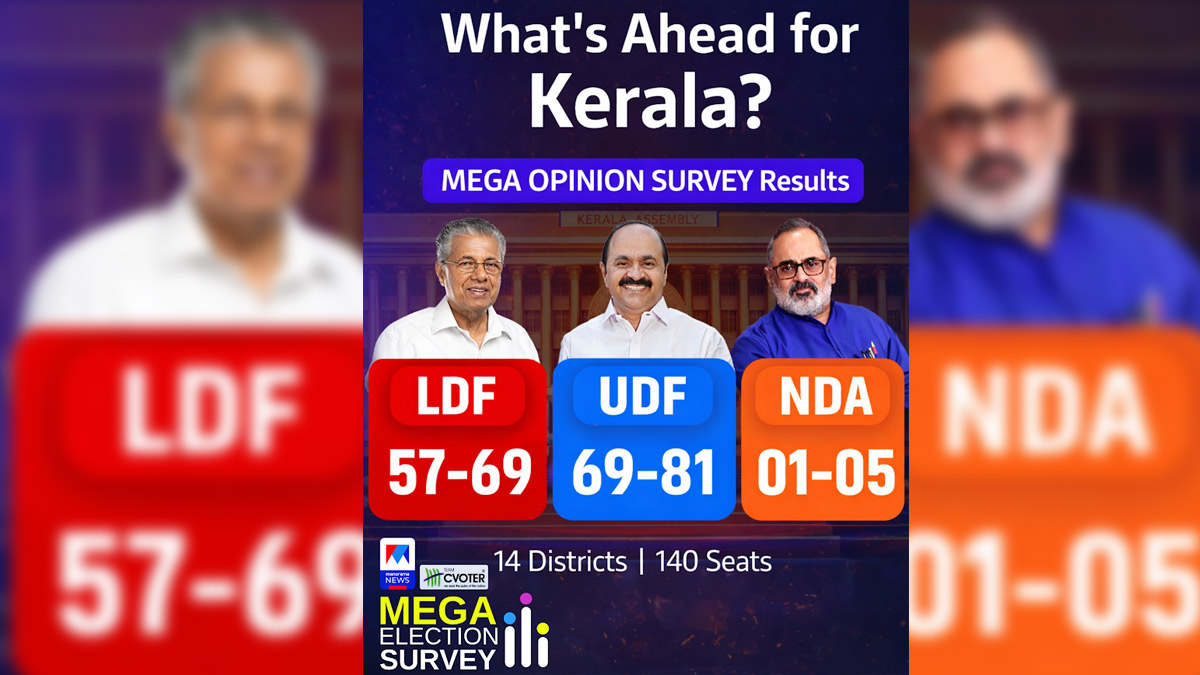
MUMBAI: The winds of change appear to be blowing through Kerala’s political landscape and this time, they seem to favour the United Democratic Front. A comprehensive mega opinion survey conducted by Manorama News in partnership with CVoter projects a potential comeback for the UDF in the upcoming Kerala Legislative Assembly Elections 2026. The survey, covering all 140 constituencies with a massive sample size of nearly 90,000 respondents, predicts the UDF could win between 69 and 81 seats.
The ruling Left Democratic Front (LDF) is expected to secure 57 to 69 seats, a significant drop from the 99 seats it won in the 2021 elections. This would mean the LDF losing 30 to 42 of its sitting seats. Meanwhile, the National Democratic Alliance (NDA), which drew a blank in 2021, is projected to open its account with 1 to 5 seats.
Region-wise, the UDF is expected to make strong gains in Malabar, winning 25 to 34 out of 48 seats, and in Central Kerala, where it could bag 29 to 33 out of 53 seats. In South Kerala, the LDF is likely to retain an edge with 21 to 25 seats, while the UDF may improve to 12 to 16 seats. The NDA could pick up 1 to 3 seats in the southern region.
The survey was conducted between 14 and 26 March 2026, with additional tracker and snap polls carried out from December 2025 to March 2026. A total of 89,693 respondents participated, ensuring representation across all demographics and social segments.
Manorama News has a strong track record of accuracy, with its previous projections closely matching the actual results of the 2019 and 2024 Lok Sabha elections as well as the 2021 Kerala Assembly polls.
In Kerala’s famously fierce political battles, this survey suggests the pendulum may be swinging back. Whether the final verdict matches these numbers or throws up another surprise, one thing is clear, the 2026 Assembly elections are shaping up to be one of the most keenly watched contests in the state’s history.






