Hollywood
Catch Kim Cattrall in Lionsgate’s comedy “About My Father”
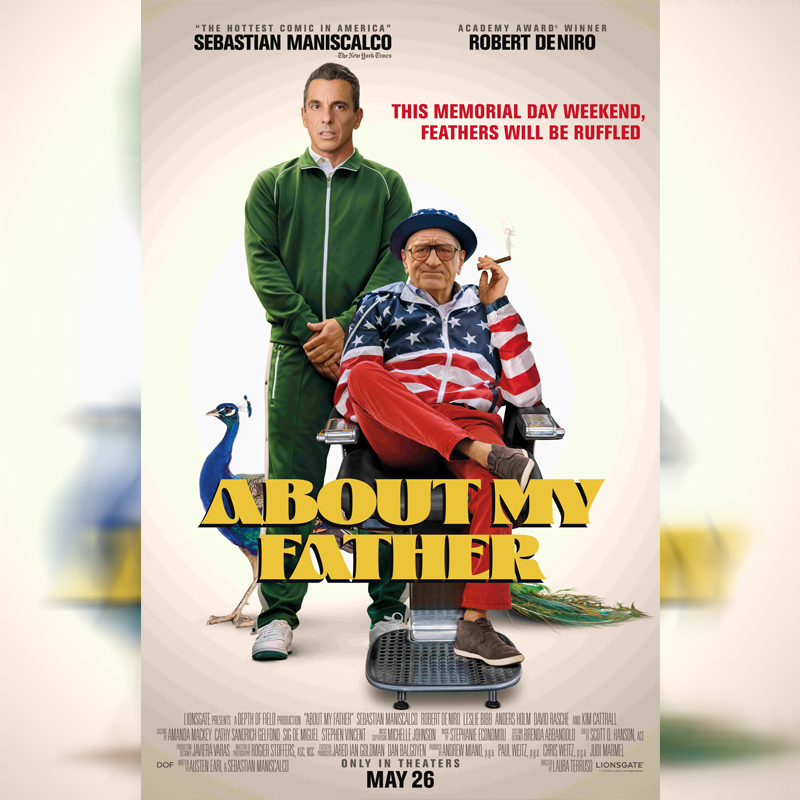
Mumbai: Fashion icon Kim Cattrall is set to light your screens ablaze in Lionsgate’s upcoming comedy feature About My Father. Making her comeback to the big screen after 2019, Kim’s character Tigger Collins is a lady not to be messed with. A U.S. Senator who has only known law and order her whole life, Tigger finds it tough to let go of the tight reins. When she meets her to-be son-in-law, Sebastian, and his kooky father, Salvo (played by Robert De Niro) Tigger soon realises she’s in for one crazy ride. It will take only a true Italian Maniscalco to let her hair down. With the movie set to release on 26 May 2023 here’s what Kim Cattrall had to say about her character, Tigger.
Talking about her character Tigger McArthur, Kim Cattrall said, “(Tigger) is very well educated, very smart, and very tenacious. Like many women who’ve reached a high-level position, she’s had to fight her way to the top. Tigger is a control freak, and she likes to put things in a very precise box. So, when she meets Salvo and Sebastian, it’s not what she expects or wants for her daughter. But it’s exactly what she should have.”
On what made her take up the film, the ‘Sex and the City’ actress added, “It was such an easy yes. My agent called me and said there’s this film with Robert De Niro and he plays a hairdresser and I said I’m in. I don’t care what it is. I want to not only do it, I wanna see it, I wanna be it.”
Helmed by Laura Terruso and written by Austen Earl and Sebastian Maniscalco, the movie will be released by Lionsgate and PVRINOX Pictures.

Hollywood
Utopai Studios partners Huace to deploy PAI for long form content
Deal includes revenue sharing as Huace adopts AI engine across global ops
MUMBAI: Lights, camera… algorithm, the script just got a silicon co-writer. In a move that signals how storytelling itself is being re-engineered, U.S.-based Utopai Studios has partnered China’s Huace Film & TV Co. Ltd. to bring artificial general intelligence into the heart of long-form content creation.
At the centre of the deal is PAI, Utopai’s cinematic storytelling system, which Huace will deploy as a core engine across its production pipeline from development and creative iteration to global localisation. The partnership includes a large-scale annual usage commitment from Huace, alongside a usage-based revenue-sharing model, underscoring both ambition and commercial confidence on both sides.
For Huace, one of China’s largest film and television companies, the bet is not on automation alone but on scale with control. With distribution spanning over 200 countries and a presence across more than 20 international platforms, including Netflix and YouTube, the company brings a vast content ecosystem where even marginal efficiency gains can translate into significant output shifts. Its extensive TV IP library further positions it as fertile ground for AI-assisted storytelling workflows.
The choice of PAI follows what Huace described as a rigorous evaluation of existing AI tools, many of which remain limited to fragmented use cases such as video generation or editing. What tipped the scales, according to the company, was PAI’s ability to handle long-form narrative complexity maintaining continuity, structure, and creative coherence across entire story arcs rather than isolated clips.
Utopai, for its part, is using the partnership to anchor its international expansion strategy, pitching PAI as an enterprise-ready system built for customisation, privacy, and regulatory adaptability across markets. That positioning becomes particularly relevant as global media companies increasingly scrutinise how AI integrates into proprietary workflows.
The timing is notable. Earlier this month, Utopai upgraded PAI to support three-minute 4K video generation and advanced multi-shot sequencing features designed to tackle one of AI storytelling’s biggest hurdles: consistency across scenes.
What emerges is not just another tech collaboration, but a glimpse into how the grammar of filmmaking could evolve. Because if stories were once crafted frame by frame, the next chapter might just be coded scene by scene.