News Broadcasting
Canal Plus & News Corp’s NDS fight over conditional access hacking

French pay-TV major and technology supplier Canal Plus and the News Corp owned subscription and conditional access hotshot NDS are locked in an eyeball-to-eyeball confrontation. The former is taking the latter to court and is likely to claim damages running into a billion dollars.
The Canal Plus accusation: NDS – the maker of smartcards – assisted viewers in pirating its software by extracting the software on Canal Plus cards. NDS published it on websites and then counterfeiters used it to produce thousands of illegal smartcards, Canal Plus has alleged. This, it claims allowed viewers access to the channels without paying up.
Canal Plus claims that its smartcard technology allows encryption of signals by broadcasters. So the process of revenue collection from subscribers is smooth. It claims that security measures were running fine until March 1999 when its software code was copied and published on the website DR7.com.
It claims to have spent more than $US35 million on the technology. It has accused NDS of getting its smartcards and sending them to an NDS laboratory in Israel for analysis. Canal Plus has alleged NDS’ activity has led to a loss of over $US1 billion as a result, which reports say it will seek to recover from its rival.
In its official statement the French company said: “NDS engaged in a conspiracy to harm Canal Plus’ competitive position in the digital television market.”
On its part NDS in an official statement retaliated by describing the lawsuit as outrageous and baseless. NDS claims unwavering commitment to eradicating piracy from the conditional access industry.
NDS President and CEO Dr Abe Peled said that his company was in no way connected with the piracy problem that has been the bane of Canal Plus since 1999. He said: “That problem is due solely to the inferior nature of Canal Plus’ conditional access technology, the failure of its business plan to contain measures to protect against piracy and its failure to deal with piracy once it began.”
The statement also mentions that apparently Canal Plus approached NDS in December 2001 to merge the two companies as its technology was not good enough. NDS sees the allegations as an attempt by the French major to gain leverage in the negotiations. In the statement NDS also says that Canal Plus acknowledged that it had reversed engineered its competitors’ cards. NDS has also accused Canal Plus of trying to hire away the NDS employee they claim gave their code to DR7. Canal Plus’ own lawyer has been involved in this poaching process it is alleged.
NDS has also accused Canal Plus of trying to divert attention from criticism directed at the French company’s new generation card, which is not believed to be state of the art, and of trying to shift blame for losses which have been accumulating.
The ensuing war could have implications as far as India is concerned. NDS has a development center in Bangalore. NDS India focusses on developing interactive TV applications and broadband technologies in conjunction with NDS R&D centers in Israel, China and the UK. MD NDS India is Lalit Ahuja who used to be CEO of Star India.
Meanwhile Rupert Murdoch’s Star Networks rival Zee is a customer of Canal Plus. In 2000, Phillips supplied DSX6071/94 DVB-compliant set top boxes to Zee Telefilms for its direct-to-operator digital TV channel bouquet project. The boxes were installed with Mediaguard and Mediahighway software supplied by Canal Plus Technologies. This allowed the Zee network to encrypt its channels, which were in the free to air mode then.
The provision of the set-top box’s marked the start of Zee’s Director-to-Operator plan which was designed to bring increased channel service to the consumer and subscription revenues for the network.
The year before it had been reported that Zee formed an alliance with Canal Plus for a proposed DTH platform.
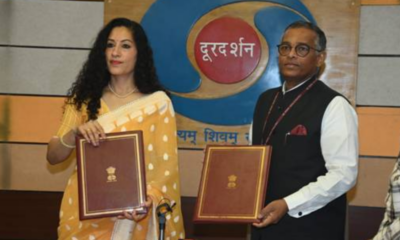
Additionally, the year 2000 saw the announcement of the deployment of NDS’ Open VideoGuard digital conditional access system for Doordarshan’s next generation of digital entertainment and interactive TV services.
The NDS Open VideoGuard conditional access system is integrated at Doordarshan’s broadcast center in New Delhi, The broadcast signal is delivered to authorized set-top boxes located in cable headends all across the country.
Reports indicate that the controversy is likely to impact the UK pay-TV industry. This is because ITV Digital, which also has a piracy problem, uses the same smart card technology as Canal Plus. Canal Plus claims a base of 6.1 million digital customers across 11 European countries. It also says that 12.5 million set-top boxes use its software through its subsidiary, Canal Plus Technologies.
NDS has announced that it plans launching a counterclaim once it fully studies the lawsuit.