Hardware
Broadcom to supply HEVC SoC for Tata Sky Ultra HD STBs


MUMBAI: Broadcom Corporation has announced that it will be providing its BCM7252 high efficiency video codec (HEVC) H.265 system-on-chip (SoC) to Tata Sky. This will be utilised in the DTH operator’s Ultra HD set top boxes (STBs).
Tata Sky and Technicolor have teamed up to design and deploy its 4K STBs by 2015. Broadcom’s HEVC-enabled chipsets provide the compression and high-throughput required by operators and OEMs to rapidly introduce Ultra HD subscriber hardware and content. The Broadcom BCM7252 Ultra HD SoC improves coding efficiency and reduces video bandwidth usage by 50 per cent.

“We are committed to delivering an innovative and world class TV viewing experience. With the arrival of HEVC technology, our subscribers will soon be some of the first in the region to experience the live-action quality that only Ultra HD can provide,” said Tata Sky MD and CEO Harit Nagpal. “As Ultra HD TVs continue to become more affordable and Ultra HD content becomes more widely available, we anticipate increased subscriber demand for Ultra HD-capable set top boxes.”
“Technicolor is at the forefront of Ultra HD, working to enhance the Ultra HD experience on all screens by providing content preparation and 4K image certification for high quality STBs and video gateways. By leveraging Broadcom’s advanced Ultra HD devices with integrated HEVC compression technology, we can deliver 4K resolution at a frame rate of 60 frames-per-second while substantially reducing the bandwidth required for video transmission, and providing the advanced features and capabilities needed to enable the ultimate home viewing experience,” said Technicolor Connected Home Division senior vice president APAC Georges Laplanche.
“As consumer interest in Ultra HD continues to grow, Broadcom is delivering advanced devices with market-specific features and price points that allow consumers to enjoy an enhanced viewing experience regardless of their geography,” said Broadcom senior vice president marketing BCG Rich Nelson. “Broadcom continues to demonstrate its commitment to furthering the Ultra HD ecosystem across the globe, providing the innovation required by our customers to drive this technology quickly into the market, particularly as lower-cost Ultra HD TVs drive consumer awareness.”
Key Features of the BCM7252 Ultra HD SoC
• High-performance dual-core Brahma15 10000 DMIPs ARMv7 processors
• 2180p60 or dual 1080p60 decode and transcode capabilities
• Integrated connectivity peripherals including USB 3.0, PCIe, Gigabit Ethernet and MoCA 2.0
• Highest level of platform security, content protection and DRM robustness
• Dual display allowing presentation of two simultaneous video channels from the same STB via independent HDMI outputs and remote control devices
• Dedicated interfaces to a range of Broadcom companion front end cable, DOCSIS, satellite and 802.11ac Wi-Fi devices





Hardware
India clears Rs 1.6 lakh crore semiconductor projects under Semicon India
Ten projects cleared as production begins and design ecosystem gathers pace
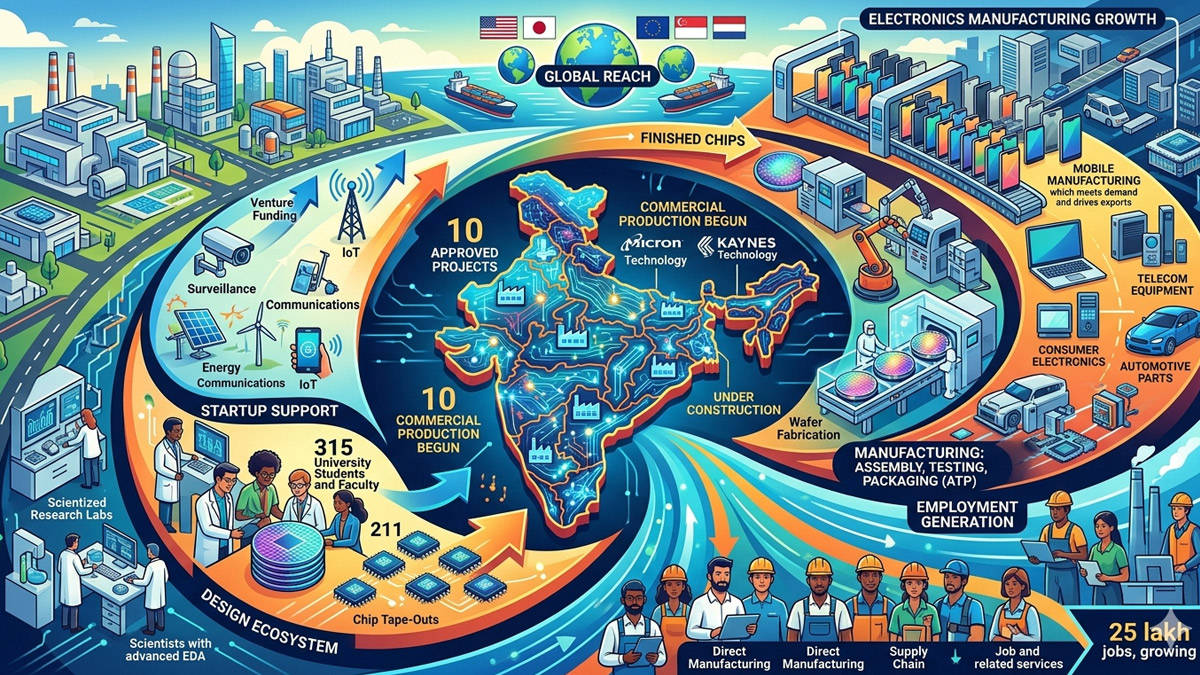
NEW DELHI: India’s push to become a global electronics powerhouse is gaining momentum, with the Semicon India Programme driving the creation of a full-fledged semiconductor ecosystem from design to manufacturing.
Launched in 2022, the programme aims to build capabilities across the entire value chain, including chip design, fabrication, assembly, testing and packaging. In just four years, the government has approved 10 semiconductor projects with a combined investment commitment of around Rs 1.6 lakh crore.
Two of these facilities have already begun commercial production, including units led by Micron Technology Inc. and Kaynes Technology India Limited. Two more plants are expected to go live later this year, signalling that India’s chip ambitions are moving from blueprint to factory floor.
The broader electronics manufacturing story has also seen sharp growth over the past decade. Production has jumped from roughly Rs 1.9 lakh crore in 2014-15 to about Rs 12 lakh crore in 2024-25, while exports have surged nearly eightfold. Mobile phone manufacturing, once heavily import-dependent, now meets almost all domestic demand and has become a major export driver.
Alongside manufacturing, the government is investing heavily in design capabilities. Through access to advanced chip design tools provided free to 315 universities, students and researchers have clocked over 200 lakh hours of usage. This effort has already resulted in 211 chip tape-outs from 75 institutions.
Support for startups is also picking up pace. Twenty-four chip design projects have been approved, targeting sectors such as surveillance, energy, communications and IoT. Of these, 14 companies have collectively raised over Rs 650 crore in venture funding, while several designs have progressed to fabrication, including at advanced nodes.
To strengthen supply chains, India has also signed semiconductor cooperation agreements with countries including the United States, Japan, the European Union, Singapore and the Netherlands. These partnerships aim to reduce global dependencies while boosting domestic capabilities.
The employment impact is equally significant. The electronics sector now supports an estimated 25 lakh jobs, with mobile manufacturing alone accounting for nearly half. As more semiconductor units come online under the India Semiconductor Mission, indirect job creation across supply chains is expected to rise further.
Sharing these updates in Parliament, Ministry of Electronics and Information Technology minister of state Jitin Prasada underscored the government’s focus on building a resilient, end-to-end semiconductor ecosystem.
With factories taking shape, designs moving to silicon and investments flowing in, India’s semiconductor story is steadily shifting gears from ambition to execution.






