iWorld
Broadband internet subscriber growth petering out?


BENGALURU: Has the broadband internet subscriber growth in the country started petering out in 2019? Analysis of Telecom subscription data furnished by the Telecom Regulatory Authority of India (TRAI) indicates that month-on-month subscriber growth rates are reducing despite the stupendous growth at the start of calendar year 2019 (CY 2019). The latest data from TRAI is for the month ended 30 September 2019 or Sep-19 (month under consideration). Sep-19 saw broadband internet subscribers grow by just 0.999 crore in net absolute numbers, or by 1.62 percent from the previous month Aug-19. In absolute number of subscriber additions, Sep-19 was ranked 15 over a 21 month period and was ranked 17 over the same period in percentage terms.
Please refer to the figure below:
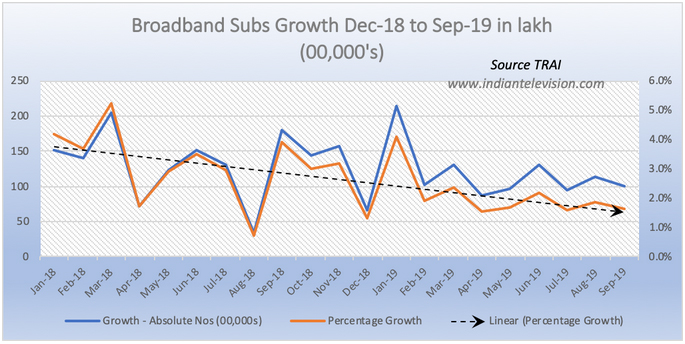
During the 21 month period under consideration in this paper, Jan-19 saw the highest number of subscriber additions at 2.149 crore (21.49 million or 214.9 lakh). Jan-19 was ranked third during the 21 month period in terms of percentage growth at 4.1 percent. Mar-18 saw the highest subscriber growth in percentage terms at 5.2%. In absolute numbers, Mar-19 saw the second highest number of subscriber addition at 2.054 crore (20.54 million, 205.4 lakh).
Please refer to the figure below:

Broadband Internet Segment Trends
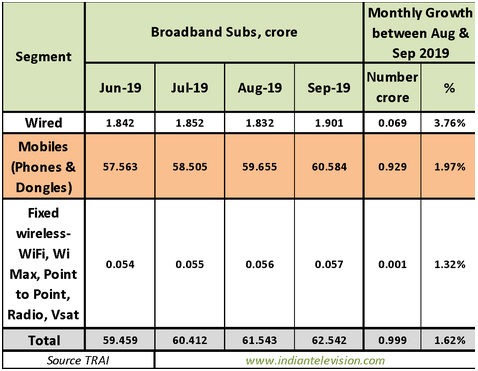
TRAI has segmented Broadband internet into 3 main platforms, viz. Wired; Mobiles (Phones and dongles); and Fixed wireless- WiFi, Wi Max, Point to Point, Radio, Vsat. As has been the norm, the Mobile (Phones and dongles) had the highest subscriber growth in terms of absolute numbers at 0.929 crore or 9.29 million or 92.9 lakh (at 1.97 percent) in Sep-19 over Aug-19. In percentage terms, the Wired Broadband internet segment had the highest growth in Sep-19 over Aug-19 at 3.96 percent. Please refer to the figure below:
Overall Broadband Internet Subscribers on all platforms
The top five service providers constituted 98.96 percent market share of the total broadband subscribers at the end of Sep-19. These service providers were Reliance Jio Infocom Ltd 35.593 crore (355.93 million, 3,559.3 lakh) subscribers, Bharti Airtel with 12.783 crore (127.83 million, 1,278.3 lakh) subscribers, Vodafone Idea with 11.219 crore (112.19 million, 1,121.9 lakh) subscribers, BSNL with 2.152 crore (21.52 million, 215.2 lakh) subscribers and Atria Convergence 0.148 crore (1.48 million, 14.8 lakh) subscribers. All the five players saw subscriber growth in Sep-19.
Wireless Broadband Internet Subscribers
The top five Wireless Broadband Service providers were Reliance Jio Infocom Ltd with 35.522 crore (355.22 million, 3,552.2 lakh) subscribers , Bharti Airtel with 12.542 crore (125.42 million, 1,254.2 lakh) subscribers, Vodafone Idea with 11.217 crore (112.17 million, 1,121.7 lakh) subscribers, BSNL with 1.282 crore (12.82 million, 128.2 lakh) subscribers and MTNL with 0.021 crore (0.21 million, 2.1 lakh) subscribers. The first four ranks saw their subscribers grow, while MTNL witnessed a flat growth in Sep-19.
Wired Broadband Internet Subscribers
The top five Wired Broadband Service providers were BSNL with 0.869 crore (8.69 million, 86.9 lakh) subscribers, Bharti Airtel with 0.241 crore (2.41 million, 24.1 lakh) subscribers, Atria Convergence Technologies with 0.148 crore (1.48 million, 14.8 lakh) subscribers, Hathway Cable & Datacom with 0.086 crore (0.86 million, 8.6 lakh) subscribers and You Broadband with 0.075 crore (0.75 million, 7.5 lakh) subscribers.
Wired broadband subscriber base grew by 69,000 according to TRAI data, but the top 5 Wired Broadband Internet players saw their combined subscriber base erode by 80,000. This indicates that the other internet service players which include MSOs’s and LCOs’ added 0.0149 crore (0.149 million or 1.49 lakh). Among the top 5 wired broadband internet players, it was only the public sector that saw erosion of its subscriber base – by 0.01 crore (0.1 million, 1 lakh). ACT and Hathway saw subscriber additions of 10,000, while Airtel and You Broadband saw no fresh subscriber additions.