Hindi
Biopics & sports-based films help popularise sporting culture in India

MUMBAI: “Sattar minute, sattar minute hai tumhare paas … shayad tumhari zindagi ke sabse khaas sattar minute … (Seventy minutes, seventy minutes is what you have … may be the most important seventy minutes of your life..)”.
These famous lines spoken in true Shah Rukh Khan style and many other such nuggets woven into a drama with various twists and turns, and ups and downs went on to make the 2007 Hindi film Chak De India — loosely based on real life incidents highlighting the Indian women’s hockey team’s journey from outcasts to gold and glory having being coached by a disgraced goalkeeper — one of the biggest hits of that decade. It also gave India an iconic phrase: ‘chak de India’, denoting winning against odds.
Though India is primarily a cricket-crazy nation and success of sports theme based films like Chak De and later Pan Singh Tomar (a national athlete’s life story from the sports tracks to that of an outlaw ultimately shot down by police) notwithstanding, the local film industry put more faith in action and romantic flicks. Unlike Hollywood that always turned to the sports field to get inspiration for gut-wrenching and raw drama. Remember Raging Bull, the Rocky series or flicks based on boxing legend Muhammad Ali’s life and footballer Pele? Or, for that matter, Escape to Victory?

However, India has witnessed a trend of late: movies being made on both popular and not-so-popular sports and sports personalities. The rationale being viewers convert into fans boosting the popularity of non-cricket sports desperately needed in India.
Bollywood suddenly discovered that biopics of sports personalities do get the cash registers ringing in theatres and, later, when the rights were sold to TV channels. Stars who won medals to empty stands or forgotten are now getting the glory they deserve.
If Chak De India pitchforked the much-neglected-in-need-of-a-boost hockey into limelight and also conceiving of fast-paced hockey leagues with foreign and domestic players, films like MS Dhoni, Sachin: A Billion Dreams,Azhar and Jannat capitalised on popular cricketers and the darker side of betting and match-fixing, respectively. Dangal and Sultan (wrestling), Mary Kom (boxing), Bhaag Milkha Bhaag (athletics) not only turned out to be box-office hits, but also did a lot of good to lesser followed sports, creating newer fan bases.
“Sports biopics have played an important role in inspiring generations of youth not just in India, but globally. They help in channelising youth’s energies positively and in a way that contributes towards society building. It also drives home a deeper message on life and showcases the pain and toil that go behind the achievement of fame, popularity and, above all, respect,” says Sportscomm Co-Founder Abhoy Chattopadhyay.
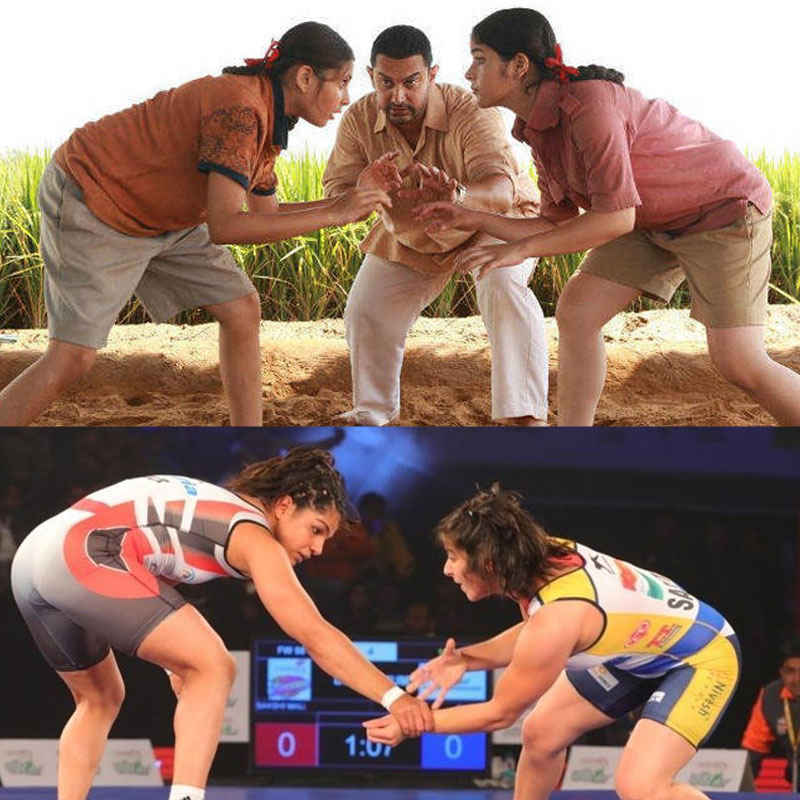
In recent years Dangal, undoubtedly, is the most popular sports films, highlighting the travails and glory of Haryana’s Phogat sisters, trained by their former national champ wrestler-father for the big stage and medals. Launched in December 2017 with a budget of Rs 70 crore, the box office collection went to clock Rs 2,122 crore worldwide, out of which more than Rs 1,300 crore was made only from the Chinese market where most viewers saw sub-titled versions to experience the true flavour and energy of the local language. The film has also been watched over 345 million times on Chinese streaming platforms.
The Broadcast Audience Research Council viewership of some of the top sports biopics premiered on TV includes Dangal (16.2 million impressions) followed by MS Dhoni (8 million impressions).
The movie Mary Kom helped boxing increase its reach and popularity in India as people started watching and following the game more fervently as they connected with players like Mary Kom and now-turned pro boxer Vijender Singh.
According to Chattopadhyay, by reproducing the life journey of a successful athlete on the silver screen, the target audience is “taught to appreciate the years of dedication and hard-work behind all that glitz and glamour” and the fact that there are no short-cuts to success – and in life.
Said a sports executive: “In a country bereft of a sports culture, sports biopics help in creating an ecosystem for the future where parents encourage children to take up a particular sport as a career option — a support system so vital to producing sporting champions — simply because movies play a huge influencing role in society.”
Chak De, for example, gave women’s hockey a new lease of life as well as contributed towards the growth of women sports in the country. Dangal too played a very critical role in helping wrestling reach out to various corners of the country and encourage many more girls to take up the sport in what is still a patriarchal society. Movies like MSD may not have boosted the popularity of cricket, already a craze, but, according to the sports executive, it helped many youngsters from smaller towns gather the courage to take up sports as a career option, including cricket that was earlier looked upon as an urban game with most cricketers coming from big cities and metros.
Speaking to Hindustan Times newspaper in September last, the 43-year-old actor Farhan Akhtar, who essayed the role of the Flying Sikh Milkha Singh in Bhaag Milkha Bhaag admitted that the film was a “turning point” for him with the rigorous training and strict diet for the shoot having positive side effects. “I have not been able to go back to the way I used to eat or drink before I started training for the film,” Akhtar explained, adding, “Working on the movie made me realise the true meaning of fitness and the value of getting enough rest.”
More biopics and sports-based films in the pipeline include Gold and Soorma on some now-forgotten Indian hockey stars, flicks based on the life and times of Indian badminton stars Saina Nehwal and PV Sindhu, and the country’s lone individual Olympics gold-finger shooter Abhinav Bindra.
A three-language biopic is also being readied on former badminton champ P Gopichand, the mentor of quite a few current sensations like Sindhu, Nehwal and K. Srikanth, in Telugu, Hindi and English. Another movie is dedicated to the great all-rounder and India’s first cricket World Cup lifting captain Kapil Dev.
Viacom18 Motion Pictures last year announced that it had acquired the rights of a film on the life and times of Indian woman cricket team captain and legend Mithila Raj, who also happens to be the highest run-getter in the world. It was under her captaincy that India went to reach the final in the women’s cricket World Cup 2017.
While Viacom18 Motion Pictures COO Ajit Andhare said the studio had always showcased content with strong women characters and was proud to be collaborating with the “young and inspirational” Raj, Varun Chopra, Director, Medallin Sports, who facilitated the Raj-Viacom association, went a step further to opine the proposed film would inspire and motivate future generations [of young girls].
Sports biopics nudge people’s interest in newer sports in a cricket-crazy nation. However, the sport on which no biopic has been made yet, but the game itself is a hit on TV (Pro Kabbadi League on Star Sports) is kabbadi. We hope that too will happen soon.
Also Read :
The year of big switch in sports broadcasting
PKL season 6 and 7 dates announced
Star ushers in IPL’s new era with a bang
Launch of 1st indian sports radio channel – sports flashes





In a music industry that often rewards speed, spectacle, and instant recall, Navjot Ahuja’s journey feels refreshingly different. His story is not built on noise. It is built on patience, discipline, emotional honesty, and a quiet commitment to becoming better with every passing year. After 14 years of struggle, learning, performing, and writing, Navjot stands today as an artist whose success has not changed his centre. If anything, it has only made his purpose clearer.
For Navjot, music has never been about chasing fame alone. It has always been about expression. It is about writing more truthfully, singing more skillfully, understanding himself more deeply, and becoming a kinder human being in the process. That rare clarity is what gives his journey its beauty.
Where It All Began: A Writer Before a Singer
Indian singer and songwriter Navjot Ahuja’s musical journey began in the most familiar of places: school assemblies. But even then, what was growing inside him was not only the desire to sing. It was the need to write.
Long before he saw himself as a performer, he had already discovered the emotional release that writing offered him. For Navjot, words became the first true channel for feeling. Songwriting came before singing because writing was the only way he could let emotions flow through him fully. That inner pull shaped his artistic identity early on.
Like many young musicians, he sharpened his craft by creating renditions of popular songs.
Those experiments became his training ground. But the turning point came in 2012, when he wrote his first original song. That moment did not just mark the beginning of songwriting. It marked the beginning of self-definition.
A Calling He Did Not Chase, But Accepted
What makes the latest Indian singer-songwriter Navjot’s story especially compelling is the way he describes his relationship with music. He does not frame it as a career he aggressively pursued. In his own understanding, music was not something he chose. It was something that chose him.
There was a time when he imagined a very different future for himself. He wanted to become a successful engineer, like many young people shaped by ambition and conventional expectations. But life had a different script waiting for him. During his college years, around 2021, music entered his life professionally and began taking a firmer shape.
That shift was not driven by image-building or industry ambition. It came from acceptance. Navjot embraced the fact that music had claimed him in a way no other path could. That sense of surrender continues to define the artist he is today.
An Artist Guided by Instinct, Not Influence
Unlike many singers who speak openly about idols, icons, and musical role models, Navjot’s creative world is built differently. He does not believe his music comes from imitation or inherited influence. He listens inward.
He has never considered himself shaped by ideals in the traditional sense. In fact, he admits that he does not particularly enjoy listening to songs, especially his own. His decisions as a songwriter and singer come from instinct. He writes what feels right. He trusts what his inner voice tells him. He positions his music according to what he honestly believes in, not what trends demand.
That creative independence gives his work a distinct emotional sincerity. His songs do not feel calculated. They feel alive.
The Long Years of Invisible Struggle

Every artist carries a chapter of struggle, and Navjot’s was long, demanding, and deeply formative. One of the biggest challenges he faced was building continuity as the best new indian singer songwriter in an era where musical collaboration is increasingly fluid.
For emerging singers, especially those trying to build with a band, consistency can be difficult. Instrumentalists today have more opportunities than ever to freelance and perform with multiple artists. While that growth is positive and well deserved, it can make things harder for singers who are still trying to establish a steady team and sound around their work.
For Navjot, one of the most difficult phases came during 2021 and 2022, when he was doing club shows almost every day. It was a period of relentless performance, but not always personal fulfillment. He was largely singing covers because clubs were not open to original songs that audiences did not yet know.
For a new Indian singer and songwriter, that can be a painful compromise. To perform constantly and still not have the freedom to share your own voice requires not just resilience, but restraint.
“Khat” and the Grace of Staying Unchanged
After 14 years of effort, Navjot’s new love song Khat became a defining milestone. Professionally, he acknowledges that the song changed how society viewed him as a musician. It strengthened his place in the public eye and altered his standing in meaningful ways.
Yet personally, he remains unchanged.
That is perhaps the most striking part of his story. Navjot says his routine is still the same. His calm is still the same. His writing process is still the same. He does not want success or failure to interfere with the purity of his art. For him, emotional detachment from public outcomes is essential because the moment an artist becomes too attached to validation, the writing begins to shift.
His joy comes not from numbers, but from the attempt. If he has tried to improve his skill today, if he has written his heart out more honestly than before, then he is at peace.
Growth, Not Glory, Remains the Real Goal
Even now, Navjot is not consumed by labels such as singles artist, performer, or digital success story. His focus remains deeply personal. He wants to sing better. He wants to play instruments better. He wants to understand himself more. And he wants to become a kinder person.
That is what makes Navjot Ahuja’s journey so moving. It is not simply the story of a musician finding recognition. It is the story of an artist who continues to grow inward, even as the world begins to look outward at him. In an age obsessed with applause, Navjot reminds us that the most meaningful success often begins in silence, honesty, and the courage to remain true to oneself.






