iWorld
Bharti Airtel added 17.06 mn subscribers in 2021: Trai


Mumbai: Bharti Airtel’s wireless subscribers increased and stood at 17.06 million last year, as per the Telecom Regulatory Authority of India’s (Trai) performance indicator report for 2021. Its subscriber base surged from 338.71 million to 355.77 million with yearly growth rate of 5.07 per cent.
Reliance Jio continued to be the market leader with 36 per cent market share of total wireless telephone subscriber base followed by Bharti Telemedia at 30.81 per cent. Reliance Jio added only 6.94 million subscribers during the year bringing its subscriber count from 408.77 million to 415.72 million at a growth rate of 1.70 per cent.
On the other hand, Vodafone Idea lost 18.74 million subscribers during the year, bringing its subscriber base from 284.26 million to 265.51 million. The company saw a 6.59 per cent rate of decline.
Reliance Jio had the greatest number of rural wireless subscribers at 179.93 million, as per the data. It was followed by Bharti Airtel at 170.15 million and Vodafone Idea at 134.33 million.
The total number of wireless subscribers increased from 1153.77 million to 1154.62 million with a net addition of 0.85 million wireless subscribers.
Internet penetration
The number of internet subscribers in India increased from 795.18 million to 829.30 million, as per the report. It showed that the total number of broadband internet subscribers increased from 747.41 million to 792.08 million and the number of wireless internet subscribers increased from 769.64 million to 802.72 million.
Out of total broadband subscribers, 26.43 million are wired broadband subscribers while 765.65 million are wireless broadband subscribers.
More than 96 per cent of total internet subscribers use wireless mobile technology to access internet services, as per Trai data.
The number of rural internet subscribers increased from 308.17 million to 333.10 million and the number of urban internet subscribers also increased from 487.01 million to 496.20 million.
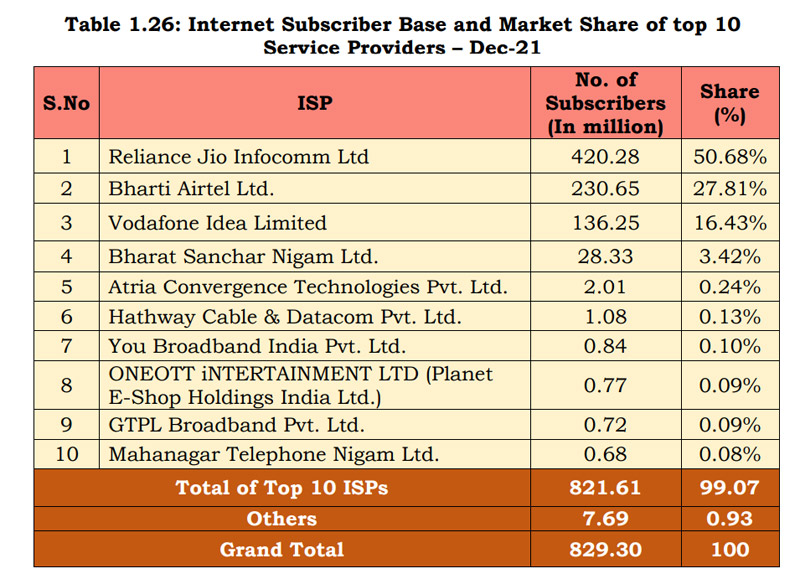
Reliance Jio Infocomm was the biggest internet service provider with 50.68 per cent market share and 420.28 million subscribers. It was followed by Bharti Airtel with 27.81 per cent share and 230.65 million subscribers. Vodafone Idea had 16.43 per cent share 136.25 million subscribers.
Revenue and usage
The average revenue per user (ARPU) from wireless subscribers in the telecom sector increased from Rs 94.87 in 2020 to Rs 108.40 an increase of 14.25 per cent.
The share of prepaid subscribers declined from 95.21 per cent to 93.62 per cent in 2021.
Revenue from data usage per subscriber increased from Rs 81.81 in 2020 to Rs 96.71 in 2021. The total volume of wireless data usage increased from 103,522 million GB to 135,657 million GB with a yearly growth of 31.04 per cent.
The average revenue per user for wireless data usage per data subscriber per month has been in an upward trend since 2014 where it stood at Rs 71.25 climbing till Rs 139 in 2021.
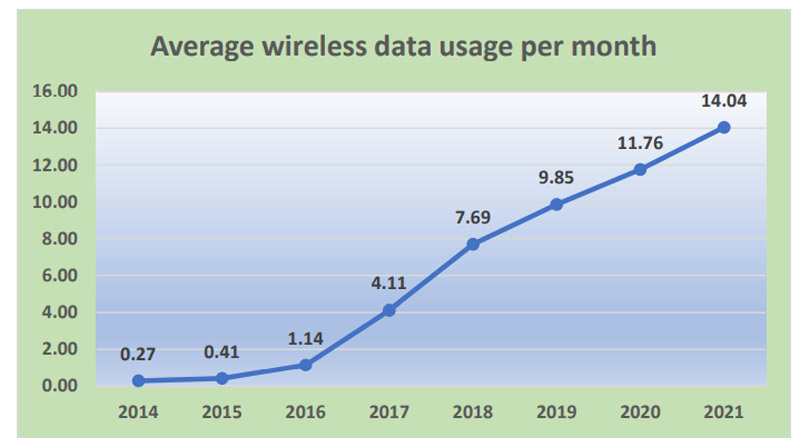
The average wireless data usage per wireless data subscriber per month increased from 11.76 GB during the year 2020 to 14.04 GB during the year 2021.