iWorld
Beyond the notes: Navigating the crossroads of AI and artistry in music: Part 2

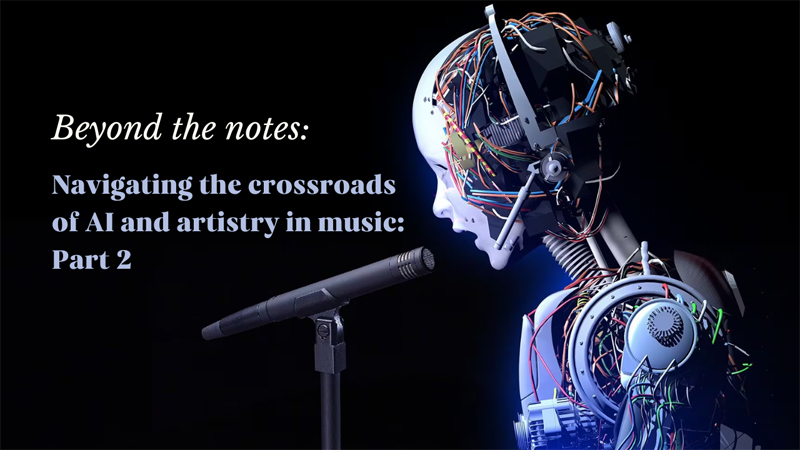
Mumbai: As technology continues to evolve with each passing day, artificial intelligence appears to gain a strong and steady foothold in the very existence of human beings. The inescapable integration of AI is becoming more palpable, shaping a formidable future that blurs the lines between the artificial and the human.
Soon, AI’s omnipresence threatens to permeate every industry, from the harmonies of music to the intricacies of architecture. In this era of rapid transformation, the ascent of artificial intelligence is not merely a paradigm shift; it is an indomitable force reshaping the narrative of our collective tomorrow.
Through conversations with industry experts, and key figures, we have gleaned insights into their perspective on AI causing a potential threat to the music industry and artists’ creative processes with the rising use of AI tools to make dubbed versions of a song in different artists or people’s voices.
The Hype Capital founder Sachin Shah
I do not perceive AI as a direct threat to the music industry or the creative processes of artists. This is primarily because AI is still in its early stages, and larger corporations and platforms have taken appropriate measures to prevent its misuse. One of the examples of this is YouTube, which disclosed on their blog on 14th November, “We’ll require creators to disclose when they’ve created altered or synthetic content that is realistic, including using AI tools.” I anticipate that more companies will follow this trend to ensure a safer space and prevent the abuse of AI technology.
Furthermore, artists can leverage AI to streamline their musical journey and processes, making use of the available tools to achieve better results. Although this may be easier said than done, it is always good to streamline things and use the available resources to make our lives better.
Serial entrepreneur, tech visionary & advisor Vinod K Singh
The rapid advancement of AI tools has opened up a new frontier in music production, enabling the creation of dubbed versions of songs in different voices. While this technology holds immense potential for creative expression, it also raises concerns about its potential impact on the music industry and the artistic process.
On one hand, AI-generated dubs could threaten artists’ control over their work and deprive them of rightful royalties. The ability to effortlessly create unauthorized versions of songs could potentially diminish the value of original recordings and undermine artists’ financial stability.
However, AI can also be harnessed as a powerful tool for musical exploration and innovation. By leveraging AI’s ability to analyze and mimic human vocal patterns, artists can expand their creative horizons and experiment with new sonic possibilities.To mitigate potential threats and maximize the benefits of AI in music creation, clear guidelines and ethical frameworks need to be established. This will ensure that artists’ rights are protected while encouraging the responsible and innovative use of AI in music production. By striking a balance between addressing concerns and embracing opportunities, we can foster a future where AI serves as a catalyst for artistic growth and creative expression.
Leadzen.ai co-founder and CEO Sonakshi Pratap
I believe it’s crucial to address the potential impacts of AI on the music industry, particularly regarding the creation of dubbed versions of songs in various artists’ voices. While AI offers incredible opportunities for innovation and accessibility in music, it also poses significant challenges to the integrity and authenticity of the artistic process.
AI’s ability to replicate voices and styles can lead to a dilution of the unique qualities that individual artists bring to their work. This technology, if unchecked, risks turning unique artistic expressions into commodities that can be easily replicated and distributed, undermining the value of original creations. Moreover, there’s a profound ethical consideration regarding consent and rights. Artists’ voices and styles are deeply personal and often a result of years of hard work and personal development. Using AI to replicate these without consent or proper attribution can be seen as a form of artistic identity theft.
However, it is important to recognize that AI is a tool, and like any other tool, its impact depends on how it is used. If employed responsibly, AI can enhance the creative process, opening new avenues for artists to explore and collaborate. It is essential for the industry to establish clear ethical guidelines and legal frameworks to ensure that AI is used to support artists rather than undermine them. This way, we can embrace the benefits of AI while protecting the heart and soul of musical creativity.
Langoor CEO Venugopal Ganganna
The way we collaborate and create music has changed. AI has not only democratised songwriting but is also being used by marketing agencies like ours to create stock music for video content. One disruptive way to work with AI is to use it as a music co-pilot to create all the backing instrumentals. Think of it as magically conjuring an extra band member. Google recently announced a new software that creates entire backing tracks for a melody line ingested into the LLM. So while AI presently does a functional job (at best) of replicating popular recording artists’ music (in its entirety), it doesn’t seem capable of putting them out of business — yet.
Dot Media co-founder & CEO Shubham Singhal
At Dot Media, we recognize the evolving landscape of the music industry with the increasing use of AI for creating dubbed versions. While AI tools offer exciting avenues, the potential threat lies in the delicate balance between innovation and the preservation of artists’ originality. We must ensure that the essence of a musician’s unique creative process remains intact amid technological advancements. Dot Media is committed to empowering artists through AI, emphasizing its role as a collaborator rather than a substitute. By prioritizing artists’ originality, we navigate the evolving landscape responsibly, fostering a future where technology augments, not hinders, the authenticity of musical expression.
Tagglabs founder Hariom Seth
During the ICC World Cup 2023, our use of AI revolutionized Royal Stag’s advertising strategy. We introduced personalized videos featuring Rohit Sharma addressing fans by name, a groundbreaking move that eliminated the need for repetitive recordings. This showcased the efficiency AI brought to the campaign, not only elevating fan engagement but also streamlining production and saving valuable time and resources.
On a broader scale, instances like the proliferation of fake Drake videos highlight the urgent need for new legislation regarding AI-generated content. Such exploitation, where creators use the voice of artists like Drake to profit, emphasizes the necessity to protect original artists from financial harm. It is imperative to establish stringent measures and regulations to penalize those who breach these boundaries.
Simultaneously, there’s a crucial need to differentiate between content that entirely replicates an artist and AI-generated content that draws inspiration from human work while introducing new elements. Striking this balance in regulation ensures the protection of creators and fosters a landscape where innovation thrives within ethical boundaries. By categorizing AI-generated content and implementing measures against misuse, we create a framework that not only safeguards artists’ interests but also encourages responsible and creative use of AI technology in the evolving landscape of content creation.
Entropik founder & CEO Ranjan Kumar
Deepfake technology utilizes a machine learning mechanism called the Generative Adversarial Network (GAN) to fabricate deceptive images and videos. In light of the growing threat posed by deepfake videos, there should be a concerted effort to develop and deploy effective deepfake detection technologies and establish robust regulations to mitigate the risks associated with deepfake technology. AI-manipulated media can be difficult to detect manually. Therefore, tech companies like Microsoft and Intel have introduced deepfake detection tools such as Video Authenticator, FakeCatcher, etc., and more global companies are now following suit by introducing user-friendly detection tools. There is a need for global cooperation on AI. Governments must enact stringent laws and run mass public awareness campaigns to educate people about how to protect their social media privacy and identify such content. AI regulation can be used to mitigate the creation of unlawful and non-consensual deepfakes and ensure accountability in their creation and distribution.
TreadBinary Technologies Pvt Ltd director Yuvraj Shidhaye
In the evolving landscape of the music industry, the rising use of AI tools poses a dual-edged sword. On one side, the potential threat to the uniqueness that defines each artist is palpable, as AI-generated voices and 3D simulations run the risk of homogenizing the creative landscape. The very essence that artists capitalize on for their careers—individuality—stands at the crossroads of technological advancement. If AI is not moderated correctly, it can become an imposter, posing a significant risk to the authenticity artists bring to their craft.
However, in a parallel narrative, where VFX and animation elevate the viewer experience, the strategic use of AI, with permission from the artist, has the power to transcend human capabilities. Imagine a music concert featuring not only living artists but also those who have passed, such as Michael Jackson or Elvis Presley. The experience offered transcends imagination.
Much like a hammer in the hands of a skilled worker can create furniture or tools, while in the hands of a psychopath, it can be destructive, AI, when used wisely, can either be a creative force or a destructive influence. The key lies in striking a balance and ensuring that AI serves as a tool for innovation, complementing artists rather than overshadowing the unique voices that make the music industry vibrant.
VijayBhoomi University dean of school, faculty – sound engineering Nilesh Thomas
From my perspective, I maintain the perspective that artificial intelligence does not present substantial threats to professions that rely heavily on creativity. What AI is potentially doing at the moment is in some ways democratizing music creation by making it more accessible to a wider range of people. Those who may not have traditional musical training can use AI to experiment and express their ideas to quickly generate original music for various purposes like videos.
Complete reliance on AI to create original music (or any form of art) will potentially lead to an erosion of human-centric artistic identity, which is an important factor in how we appreciate and relate to art. If AI tools become too involved in the creative process, the unique human touch, emotions, and personal experiences that artists bring to their work may be diminished. This could affect the emotional resonance and authenticity of the music. For example, would you rather go to a concert by a machine or Arijit Singh, for a perfect weekend evening with your loved one?
On the other hand, AI tools can be used to greatly augment and enhance the creative process. Artists can leverage AI to explore new sounds, generate unique compositions, or aid in the production process. This could lead to the creation of innovative and groundbreaking music. AI can significantly speed up the production process, helping artists experiment with different versions of their work more efficiently. This can free up time for artists to focus on the more nuanced aspects of their craft.
RV University, professor and dean, School of Film, Media and Creative Arts, Prof. (Dr.) Piyush Roy.
Music or any other creative output that has stood the test of time, or for it to withstand trends, the feeling has to be created among the audience. Has the best of CGI been able to replace the impact of shooting an epic in a literary epic scale, like Mughal-e-Azam, Gandhi, or Lagaan with real people? Will it work if the AI dubs in any voice? No, it has to be in the voice of a recognised artist, and that recognition happens for the achievement, vocal nuance, and uniqueness in rendition, brought about by that person’s signature. Such experimentation is no different from that of copying a signature, but the original is always original, and imitation will always remain so. AI creativity for sure will get mediocrity a competition, but true talent need not bother or fear, because their newness comes from an originality exclusive only to the human experience, ingenuity and mettle.
Red FM and Magic FM COO & director Nisha Narayanan
In the era of AI thrusting its way into the music scene, the potential ramifications for the industry and artists demand a strategic and nuanced perspective. At Red FM, we are not turning a blind eye to the efficiency gains that AI brings to the music-producing industry. However, in our own way, we are navigating the AI maze by protecting the value of human creativity. Our effort lies in balancing technological advancements with the human element to make the most out of musical artistry.
We just believe that AI needs to be the backup dancer and not the lead singer stealing the spotlight from humans. As we move forward, collaboration is the name of the game. Be it with fellow partners, industries, or now with machines. We will continue all our efforts in empowering artists as our innovative resources meanwhile preserving the soul of music amidst technological progress.