e-commerce
Beyond the big cities, Bharat is calling the shots on India’s growth

MUMBAI: India’s growth story is quietly changing address and it no longer reads Mumbai, Delhi or Bengaluru. A new report from Rukam Capital argues that the real momentum in consumption is now being driven by Tier 2 and Tier 3 cities, small towns and emerging urban clusters, where behaviour is shaped less by hype and more by trust, proof and relevance.
Titled Beyond Metros: The Real Story of Bharat’s Next 500 Million, the study lands at a moment when nearly 65 per cent of India’s population lives outside the metros. Backed by GST-led formalisation, rising affordability and deep digital penetration from near-universal 3G and 4G access to the everyday use of UPI, the report positions Bharat as the engine of India’s next phase of consumption-led growth.
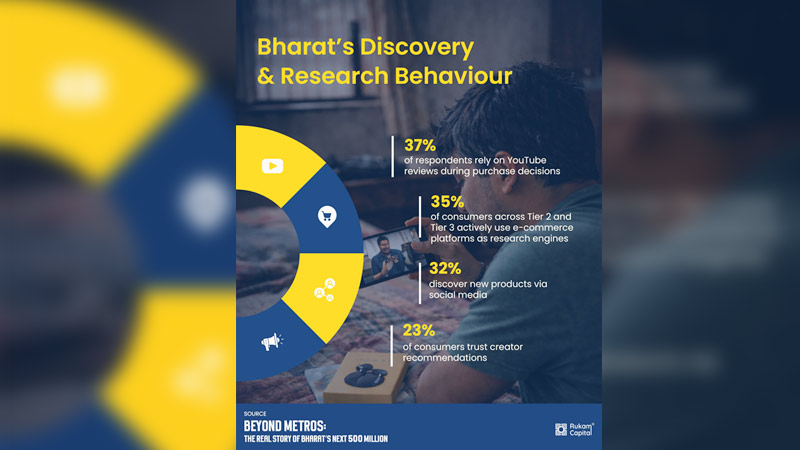
Crucially, the research overturns long-held assumptions about non-metro consumers. Far from being impulsive or easily swayed by celebrity endorsements, today’s Bharat shopper is deliberate and research-driven. Discovery is increasingly video-first and social-led, with Youtube emerging as a primary influence, 37 per cent of consumers rely on video reviews, while 32 per cent discover products via social platforms. E-commerce, too, has become a research tool, used by 35 per cent of consumers well before purchase decisions are made.

Trust, the report finds, is the real currency. Word-of-mouth influences 22 per cent of Tier 2 and Tier 3 buyers, while 43 per cent of Tier 3 consumers verify brands through official websites before buying. Customer service matters early, with 32 per cent factoring service interactions into pre-purchase decisions. Sustainability and safety cues also carry weight, influencing 23% of consumers but only when backed by peer reassurance rather than marketing gloss.
Spending patterns reflect discipline over impulse. UPI now powers transactions for 67 per cent of non-metro consumers, while discount tracking is common in Tier 2 cities. Festivals still drive discretionary spending in Tier 3 markets. Quick commerce adoption remains modest at 36 per cent, underscoring that instant gratification is not yet the default outside metros.
Platforms, meanwhile, are valued for utility, not noise. Whatsapp reaches close to 90 per cent penetration and functions as Bharat’s digital backbone. OTT consumption is driven by vernacular relevance, with JioHotstar leading usage at over 54 per cent across Tier 2 and Tier 3 markets. Gaming has also emerged as a serious influence channel, with over half of consumers in these regions responding to in-game advertising.
Commenting on the findings, Rukam Capital founder and managing partner Archana Jahagirdar said the study reveals a consumer who is confident, consistent and grounded. The opportunity for brands, she noted, lies not in aspiration-led messaging but in building trust early, designing for real use cases and staying rooted in local context.
Conducted with Yougov across more than 5,000 respondents in 18 states, the report makes one thing clear: Bharat’s next 500 million consumers are not waiting in the wings. They are already shaping demand, rewriting influence, and setting the terms for India’s trillion-dollar retail ambition.







e-commerce
Flipkart rolls out 105 per cent bonus for 20,000 employees
Strong FY25 performance drives payouts even as layoffs and shifts unfold.

MUMBAI: In a year where belts were tightened and rewards loosened, Flipkart seems to be playing both offence and defence trimming roles on one hand while handing out a generous 105 per cent bonus on the other. The Walmart owned e commerce major has rolled out a 105 per cent bonus payout for 2025, covering nearly 20,000 employees, signalling a year of steady operational momentum even as the company navigates restructuring pressures. The payout, communicated internally by chief human resources officer Seema Nair, is tied to performance across key metrics including growth, operational efficiency, financial outcomes and people indicators, a combination that suggests the company is inching closer to its long stated goal of sustainable profitability.
Employees at SD level and below are set to receive their bonuses in March, while payouts for senior leadership, including vice presidents and senior vice presidents, will follow after the close of the performance cycle. The elevated 105 per cent multiplier stands out in a sector where cautious payouts have increasingly become the norm, pointing to what appears to be a relatively strong internal scorecard for FY25.
Yet, the announcement arrives with a noticeable contrast. Earlier this year, Flipkart reduced its workforce by around 300 roles as part of its annual performance review process. While officially framed as performance driven, the juxtaposition of layoffs alongside above target bonuses reflects a more nuanced balancing act, one that prioritises cost discipline while continuing to reward and retain high performing talent.
This dual approach is becoming increasingly common across the technology and e commerce landscape, where companies are navigating an uneven hiring environment while under pressure to deliver profitability. Rewarding top contributors, even amid selective workforce reductions, allows firms to maintain morale and retain critical talent without losing sight of financial prudence.
At the same time, Flipkart is also undergoing leadership shifts that hint at a broader strategic recalibration. Nishant Verman has been appointed senior vice president for corporate development and partnerships, while group chief financial officer Sriram Venkataraman is set to step down. Ravi Iyer will take on expanded responsibilities within the finance function, marking a reshuffle at the top as the company gears up for its next phase.
These changes come amid reports that Flipkart is planning to shift its holding structure back to India, a move widely interpreted as groundwork for a potential public listing. While timelines remain fluid, the combination of stronger financial discipline, leadership restructuring and employee incentivisation suggests a company preparing itself for greater scrutiny and scale.
For employees, the 105 per cent payout offers a welcome boost in what has otherwise been a period of adjustment. For Flipkart, it is a signal that even as it cuts where necessary, it is willing to spend where it counts. In the high stakes game of growth versus profitability, the company appears to be hedging its bets carefully, rewarding performance while reshaping itself for what could be its most defining chapter yet.






