News Headline
Behind the scenes of ‘Zhunj Marathmoli’

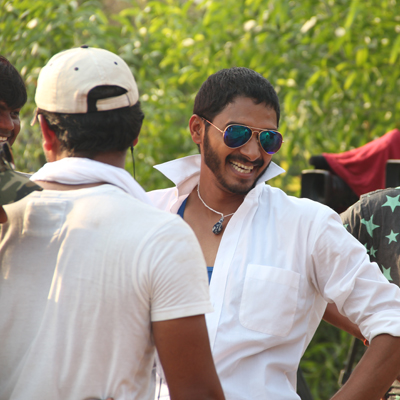
MUMBAI: It’s a full plate and more for the cast and crew of ETV Marathi’s new show Zhunj Marathmoli as they travel the length and breadth of Maharashtra, fulfilling cultural tasks and braving temperatures of up to 47 degree celsius in certain parts.
So much so, not a single day has gone off without someone falling sick or getting injured. In fact, a doctor from Mumbai has been hired to be with the unit full time to take care of casualties.

However, this has deterred neither the 14 contestants nor celebrity host Shreyas Talpade from making season one a grand success.
“It didn’t come as a surprise to us that we will have to shoot in such high temperatures. We knew it would be excruciatingly hot,” says Talpade, who along with the participants have taken time out from 15 April to 2 June to shoot the show.
90 technicians, including 11 from Ramesh Deo Productions (RDP) and the rest hired crewmen, are ferried from one location to another in 11 cars and buses. “The technicians are freelancers who have worked on shows like Roadies and Khatron Ke Khiladi. Our director of production (DOP) has done 11 seasons of Roadies,” says RDP director Ketan Mangaokar about DOP Sanjay Chawda.
Each location is given four days’ time where the first two days are taken up by the production team to try out tasks and ensure their safety for the participants while shooting happens in the remaining two days, with two tasks per day. The day starts at 6:30am for the production team and 8:00am for the contestants, going up to 10:00pm or 11:00pm at times. Participants are allowed cell phones only on the days ‘task testing’ is done to avoid any kind of distraction.
A 20-day recce was undertaken by Mangaokar, art director Sandeep Bhamkar and a channel representative before the show started. The team scouted the interiors for regions and tasks of interest. “First, we selected the regions and then found out their specialty by talking to the locals. Each task also has a substitute task but fortunately, we haven’t had to use any of those,” says Mangaokar.
Of the 26 episodes, the 20 second one was shot at Ganpatipule in Konkan amidst soaring mercury levels coupled with intense humidity. A visit to the Ganpatipule set revealed nothing more than a patch of land near a hen house. Eight normal HD cameras were set around the frame and six GoPro cameras – hired from ColorPlus in Mumbai – were set inside the task zone. Of the eight HD cameras, one was a master frame focused on the entire set, another a wide-angle camera shot focused on Talpade, yet another a close-up of Talpade and the rest focused on the contestants.
A sufficient number of good quality lapel microphones were used to capture sound on the set with normal ones given to the participants and two advanced ones given to Talpade for his solo link. No part of the episode was dubbed. By the same token, no part of the show has been dubbed.
Also, video diaries were shot in between tasks, encapsulating contestants’ emotions. Additionally, the over the fly (OTF) or byte of the participant before he/she performs the given task was taken.
For the hen-catching task at Ganpatipule, two cameras were placed atop a car for a higher view of the task area. “It’s a practical and cost effective measure as we don’t have cranes and jibs,” says RDP head of operations Rekha Vaid.
The coordination of cameras was done by Chawda who says, “I have been working on similar shows for years so I am aware of the kind of shots that are required.” The show’s creative director is Santosh Kolhe, executive producer Praveen Das, production controller Manohar Desai, sound engineer Mushtaq Sheikh and art director Sandeep Bhamkar. Generally, once any footage is shot, it is transferred onto a hard disk and backup is taken.
Judges for all the tasks are not from the Zhunj Marathmoli team but experts or panch hailing from that region who are either asked to observe the tasks live or watch recorded footage and offer inputs to Talpade. This over, the entire terabytes of footage is despatched to the Mumbai office for post production.
Talpade motivates the team in his usual boyish manner. Not only does he deliver his dialogues but also improvises them. Zhunj is his way to connect to his Maharashtrian roots which he says he missed growing up as a Mumbai kid. He is in awe of the efforts the channel has taken for Zhunj Marathmoli. “You need guts to execute such a show. Constant travelling, setting up new locations, arranging for food and stay of so many people. The channel and production house are going to additional lengths to make the show different and innovative,” he says.
According to sources, nearly Rs 6 to Rs 8 crore is being spent on the show which may not be too much but is definitely on the higher side, where the economics of Marathi television is considered.
Khatron Ke Khiladi and Roadies have higher budgets but with Zhunj Marathmoli, ETV is trying to give viewers maximum quality with a minimum budget.






NEW DELHI: Hamdard Laboratories gathered a cross-section of India’s achievers in New Delhi on Friday, handing out the Hakeem Abdul Hameed Excellence Awards to figures who have left their mark across healthcare, education, sport, public service and the arts.
The ceremony, attended by minister of state for defence Sanjay Seth and senior officials from the ministry of Ayush, celebrated individuals whose work blends professional success with a sense of public purpose. It was as much a roll call of achievement as it was a reminder that influence is not measured only in profits or podiums, but in people reached and lives improved.
Among the headline awardees was Alakh Pandey, founder and chief executive of PhysicsWallah, recognised for turning affordable digital learning into a mass movement. On the sporting front, Arjuna Awardee and kabaddi player Sakshi Puniya was honoured for her contribution to the game and for pushing women’s participation onto bigger stages.
The cultural spotlight fell on veteran lyricist and poet Santosh Anand, whose songs have echoed across generations of Hindi cinema. At 97, Anand accepted the honour with characteristic humility, reflecting on a life shaped by perseverance and hope.
Healthcare honours spanned both modern and traditional systems. Manoj N. Nesari was recognised for strengthening Ayurveda’s place in national and global health frameworks. Padma shri Mohammed Abdul Waheed was honoured for his research-backed work in Unani medicine, while padma shri Mohsin Wali received recognition for his long-standing contribution to patient-centred care.
Education and social development also featured prominently. Padma shri Zahir Ishaq Kazi was honoured for decades of work in education, while former Meghalaya superintendent of Police T. C. Chacko was recognised for public service. Goonj founder Anshu Gupta received an award for his dignity-centred rural development initiatives, and the Hunar Shakti Foundation was honoured for empowering women and young girls through skill development.
The Lifetime Achievement Award went to former IAS officer Shailaja Chandra for her long career in public healthcare and governance, particularly in the traditional systems under Ayush.
Speaking at the event, Hamdard chairman Abdul Majeed said the awards were a tribute to those who combine excellence with empathy. “These awardees reflect Hakeem Sahib’s belief that healthcare, education and public service must ultimately serve humanity,” he said.
Minister Seth struck a forward-looking note, saying India’s young population gives the country a unique opportunity to become a global destination for learning, health and wellness by 2047.
The ceremony also featured the trailer launch of Unani Ki Kahaani, an upcoming documentary starring actor Jim Sarbh, set to premiere on Discovery on 11 February.
Instituted in memory of Unani scholar and educationist Hakeem Abdul Hameed, the awards have grown into a national platform that celebrates those building a more inclusive and resilient India. For one evening at least, the spotlight was not just on success, but on service with substance.







