Factual
BBC DG Dyke says TV broadcasting should not be left to the market

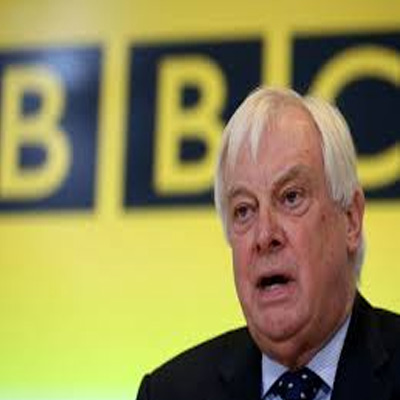
MUMBAI: “Broadcasting is too important to be left purely to the market”. The remark was made by BBC Director-General Greg Dyke in New York.
Dyke was in the US to receive the prestigious International Emmy Directorate Award for outstanding services to broadcasting.
He said that television is not “just another commodity” like Starbucks or Coca Cola and disagreed with those who argued that television should be left to the market. “What is at stake is the kind of television people have a right to expect in their society TV which reflects their culture and their values.

“Television is only different from coffee or Coke if we recognise that fact. If we treat TV like these things, it will become like them. We end up with nothing more than a briefly enjoyable experience devoid of any lasting value.”
He added, “It’s wrong to see the BBC as a separate entity, divorced from the rest of the UK broadcasting system. “A strong, publicly-funded broadcaster at the heart of our industry has a positive influence far beyond the confines of our own channels and services.”
Dyke added that, with the continuing take-up of subscription television and the advent of discussions on Charter Review, the role of all broadcasters was more vital than ever. He said that the BBC must and would continue to have a leading part by producing indigenous programming that reflected British tastes, British values and British culture.
He also sounded a warning note regarding the ‘Americanisation’ of the UK media. This is happening because of the size of the American market and the recent legislation that made it possible for an US company to buy any of the UK’s commercial broadcasters. This would, argued Dyke, threaten a television landscape that reflected national culture and values. Programming would evolve into a commodity rather that something of intrinsic value and unbiased. As a direct result challenging news and current affairs would be the first to suffer.
Dyke went on to use the recent Iraq war to illustrate the difference in news coverage of the BBC and US networks. “News organisations should be in the business of balancing their coverage, not banging the drum for one side or the other. This is something which seemed to get lost in American reporting during the war.”
Coming back to the UK Dyke noted that despite its size, Britain spent more money per person on home-grown programming. Compared to the US where annual spend per person was $65, in the UK broadcasters spent $75 dollars per head, of which $40 was spent by the BBC.
“The BBC uses public money to create a powerful incentive for domestic investment across the board. Our freedom from commercial pressures allows us to set the benchmark for quality and range which the other networks must be willing to match if they are to compete” he said.
Any move to cut the BBC out of the equation would have a detrimental effect. Its commitment to indigenous programming across all its services meant that the UK’s main commercial broadcasters were similarly committed. Without the BBC the UK broadcasting industry would follow natural market forces to maximise profit by increasing the amount of imported programming with less money spent on original programming.
Therefore, despite the arguments put forward by some commercial broadcasters, the BBC was vital as a catalyst for competition, quality and creativity. However, together with the rest of the UK broadcasters, the BBC faced the threat posed by globalisation Dyke added.





Factual
National Geographic launches ‘Postcards from Hong Kong’ with Ridhi Dogra
New series explores the city’s hidden gems and vibrant contrasts, premiering 28 March.
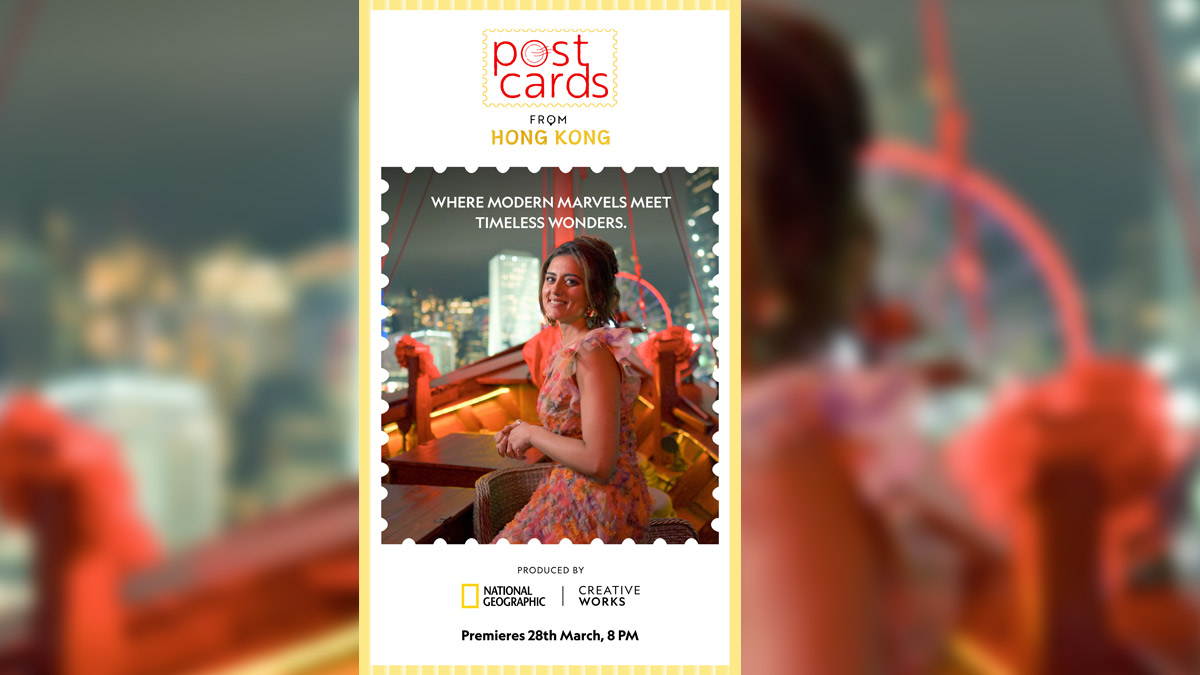
MUMBAI: Ridhi Dogra just sent a postcard from Hong Kong that’s worth framing because when a bustling metropolis reveals its quiet trails and timeless traditions, even the skyline takes a back seat. National Geographic has unveiled Postcards from Hong Kong, a refreshing travel series hosted and curated by actor Ridhi Dogra. Produced by National Geographic Creative Works in collaboration with the Hong Kong Tourism Board, the show offers an intimate, Indian traveller’s perspective on one of Asia’s most iconic cities, moving beyond its glittering harbour and skyscrapers to uncover serene beaches, scenic hiking trails and deep cultural traditions.
Across three visually rich episodes, Ridhi journeys through contrasting sides of Hong Kong. The first episode takes her on a quieter path of self-discovery to places like Sai Kung, Big Wave Bay, Dragon’s Back, Tai O, Ngong Ping, Po Lin Monastery and the Tian Tan Buddha. The second episode dives into the city’s energetic side, from the bustling streets of Causeway Bay to Happy Valley Racecourse, Michelin-starred spots and luxury shopping at Landmark.
Ridhi Dogra said, “Being part of Postcards from Hong Kong with Nat Geo was a deeply enriching experience. What I love about this journey is that it goes beyond the obvious; it’s not just about the skyline or the speed of the city but about the stories that live in its quieter corners.”
A National Geographic India spokesperson added, “With Postcards from Hong Kong, we set out to go beyond the familiar and explore the city through a more intimate, human lens.”
Hong Kong Tourism Board director of South Asia Puneet Kumar noted, “Postcards from Hong Kong is a reflection of meaningful storytelling that brings the city to life in an immersive way. It beautifully captures the diversity and spirit that define Hong Kong.”
Blending travel, culture and personal storytelling, the series celebrates Hong Kong as a city of contrasts where modern life meets tradition and every corner holds a story waiting to be discovered. It premieres on 28 March at 8 pm on the National Geographic Channel and will also stream on JioHotstar.
In a world of hurried travel reels, Postcards from Hong Kong slows things down just enough to let viewers truly see the city not just its lights, but its layers, proving that the best souvenirs are the stories you bring home.






