News Broadcasting
Bappa Majha brings Maharashtra together for Ganeshotsav on ABP Majha


MUMBAI: When Bappa arrives, even differences take a holiday. This Ganesh Chaturthi, ABP Majha is once again turning television screens into pandals with its flagship festive programming Bappa Majha, celebrating Maharashtra’s favourite season of devotion, spectacle, and unity.
Carrying the theme “Bappa Ale, Bhed Nimale” (As Bappa arrives, differences disappear), Bappa Majha is more than just programming, it’s a 10-day cultural immersion. From the grandeur of Mumbai’s iconic pandals to the intimacy of household traditions, the channel promises to capture every beat of Ganeshotsav.
The line-up is as elaborate as a traditional sadhya:

. Live Aartis from Maharashtra’s most renowned temples and pandals at 6:30 am and 6:30 pm daily ( 27 Aug – 5 Sept).
. Ganesh Pujan at ABP Majha’s office on Aug 27 at 9:30 am, giving viewers a peek into the channel’s own festive rituals.
. Kaladhipati at 2:30 pm, where celebrities bring personal stories of devotion and celebration.
. Daily festival bulletins, Bappa Majha, at 5:30 pm (repeat at 11:30 am), offering updates and stories from every corner of Maharashtra.
. Maha Ganesh Mandal Contest (7 – 16 Sept), spotlighting the three most spectacular pandals from each of the state’s eight regions.
. Anant Chaturdashi Special (Sept 6 from 7 am onwards), capturing the emotional farewell as Bappa is immersed with pomp and tears.
With Ganeshotsav being Maharashtra’s most widely celebrated festival, the numbers tell their own story: over 10 days of immersive coverage, across 8 regions, spotlighting thousands of pandals and lakhs of devotees, all brought home by ABP Majha.
ABP Majha’s Bappa Majha is co-presented by Gowardhan, Punit Balan group and Nirma Advance; powered by Hint, Royal Enfield and Kayam Churna; with Mahindra Tractor and Porter as supporting partners, and ABP Live as digital partner.
In a state where Ganeshotsav is less a festival and more a way of life, ABP Majha has once again positioned itself as not just a broadcaster, but a cultural companion telling the stories, sharing the chants, and ensuring that when Maharashtra says “Ganpati Bappa Morya”, the whole state says it together.





News Broadcasting
Network18 channels lead YouTube news viewership in March 2026
CNN-News18, News18 India and CNBC channels top categories with record views
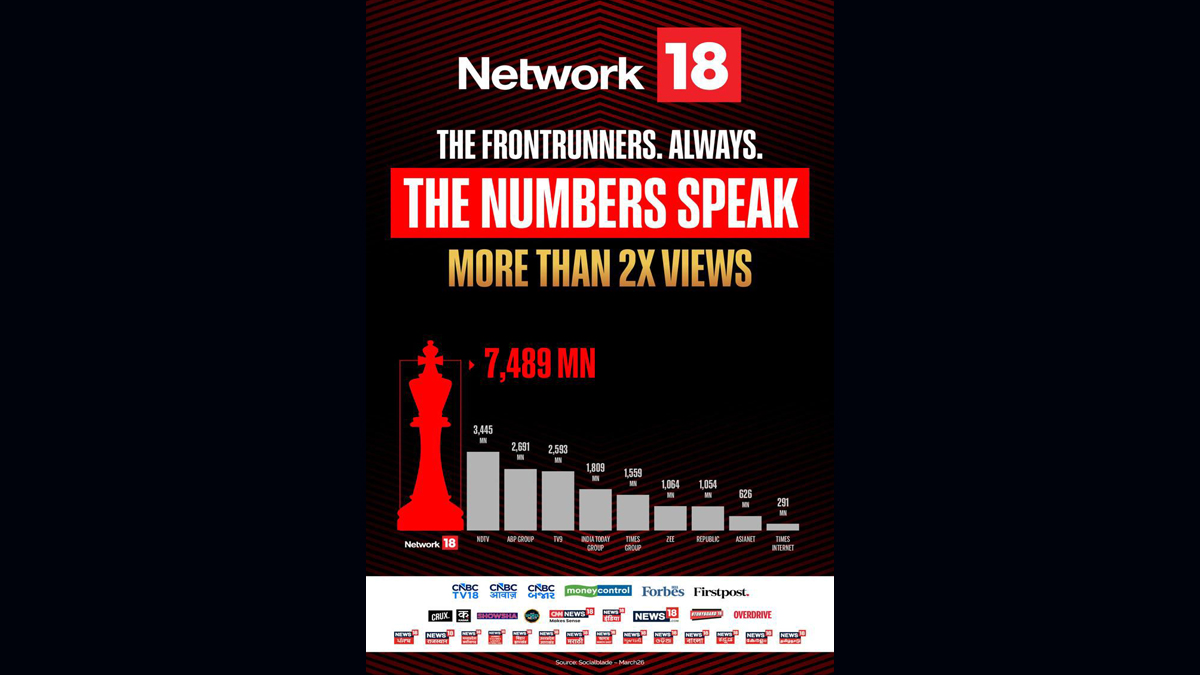
MUMBAI: When the world hit refresh on breaking news, Network18’s channels were already streaming ahead. As geopolitical tensions and war-driven headlines fuelled a surge in global news consumption, the network’s digital playbook delivered big clocking record Youtube viewership across English, Hindi and business news categories in March 2026.
At the forefront was CNN-News18, which emerged as the clear leader in the English news segment with 130 million live and video-on-demand views. The channel edged past competitors such as Times of India (126.5 million), Times Now (101.1 million), India Today (88.2 million) and NDTV (77.5 million), according to Databeings data for March.
In the Hindi news arena, News18 India delivered a commanding performance, racking up a staggering 3,297 million views on YouTube. The channel comfortably outpaced NDTV India, which recorded 3,119 million views, underlining its deep reach and consistent engagement with mass audiences, as per Playboard data.
The network’s dominance wasn’t confined to general news. In the Hindi business segment, CNBC Awaaz topped the charts with 92 million views, narrowly ahead of Zee Business (90 million) and well ahead of ET Now Swadesh (57 million). Meanwhile, its English counterpart CNBC-TV18 posted a strong 58 million views, reinforcing the network’s cross-category strength.
The spike in viewership reflects a broader shift in audience behaviour, with viewers increasingly turning to digital platforms particularly Youtube for real-time updates and in-depth coverage during high-intensity news cycles. For Network18, the numbers signal more than just scale; they underline the effectiveness of a multi-platform strategy that blends speed, credibility and continuous coverage.
In a month where the news never paused, it seems viewers chose to stay tuned where the stream never stopped.






