Cable TV
Bandwidth key to convergence economy

MUMBAI: Television will become the centre of communication convergence in India as computer penetration is still very low, experts at a seminar on Monday said.
Content, infrastructure and telecom service providers will come together to exploit cross products and cross platforms. “Convergence is a catalyst to the building of an information society that has the capacity to generate productivity gains and new forms of communication,” said Hamadoun Toure, director of telecommunication development bureau, International Telecommunications Union, Geneva.
Toure was delivering the keynote address at the third International conference on “Communication Convergence – The Change Agent”, organised by Indian Merchants’ Chamber.

Inaugurating the two-day conference, Maharashtra minister for finance and planning Jayantrao Patil said India had the world’s sixth largest telecom network. “We have 43.18 million fixed connections and 36.32 million mobile connections, putting the total at 79.50 million till May 2004. The government has set a target to establish 175 million connections by 2010”, he said.
Elaborating e-governance as a priority area, Patil said Maharashtra was the first state in India to digitise its revenue records, village maps and individual land titles. “We will soon update and digitise the maps of villages by using remote sensing technology”, he added.
Speaking on the occasion, Reliance Industries Ltd. Executive director Hital Meswani said voice, data, video and Internet will come together at the physical and commercial level. “Convergence is happening at the service, network and device levels. It is bandwidth that is spurring the convergence economy,” he added.
Education, healthcare, banking system and telecom will be some of the areas where convergence will make its impact felt. Home shopping through television, e-commerce, customer care at the retail level, stock quotes and transactions will be enabled by the convergence economy.
“Play and plug will soon become a way of life. Voice over Internet Protocol will emerge through the common cable. Video-on-demand and time-shifted TV will be possible on IP networks,” Meswani said.
Visual entertainment will integrate various value chains and movie broadband streaming will become a commercial possibility. E-learning will also become big in India, laying the foundation for a strong business process outsourcing (BPO) base for the world. “Reliance Infocomm is conscious of this convergence economy and intends to play a leadership role in it,” Meswani said.
Opening the session on “Living, Learning and working in Convergence Age”, F C Kohli, former deputy chairman, Tata Consultancy Services said digital technology was becoming the infrastructure in the manner that it has become the enabling technology for automation and controls, manufacturing operations, healthcare systems, agriculture, education and in providing solutions to complex societal problems.
In computers, China has grown four to five times than India over the last 10 years. This was achieved by writing large amounts of software in Mandarin language for manufacturing, utilities, government and education sectors. Computerisation contributes to developing competitive exports of Chinese electronic and manufactured goods worth $40 – $50 billion per year compared with direct Indian software exports to the tune of $15 billion. “By overemphasising the direct exporting of software, India has neglected to write software in its local languages. It has missed the opportunity to create a larger and deeper foundation for its participation in globalisation. If India was to grow as fast as China, it would require ten million computers a year, much more than the three million computers imported in 2004,” he said.
Speaking on the topic “The Net in Service of People”, Vijay Mukhi’s Computer Institute MD Vijay Mukhi said high-speed Internet would make video blogs popular in the near future.
“With high-speed Internet becoming popular, normal blogs will be replaced by video blogs. This will be like opening your personal TV channels,” he said.
Other noted speakers included State Bank of India chairman AK Purwar, Universal Service Obligation Fund administrator Shyamal Ghosh and India-Israel Ventures director and former HTMT director KV Seshasayee.







Cable TV
Hathway Cable appoints Gurjeev Singh Kapoor as CEO
Leadership change comes as cable TV faces shrinking subscriber base and modest earnings pressure
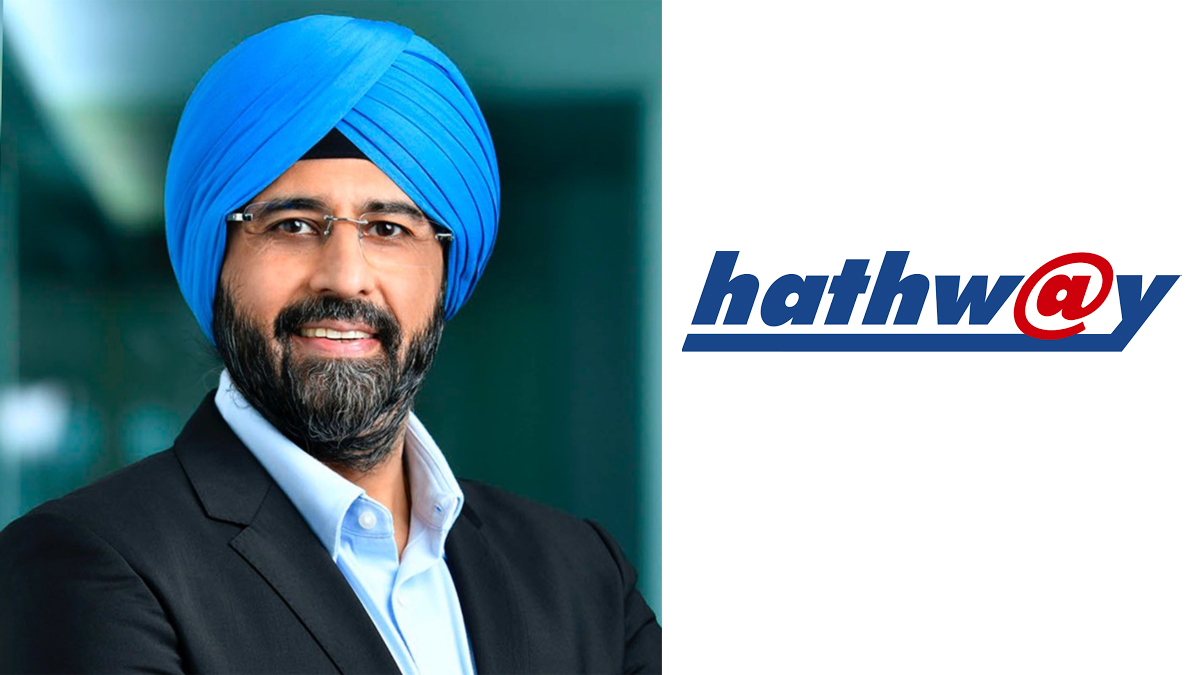
MUMBAI: Hathway Cable and Datacom has tapped industry veteran Gurjeev Singh Kapoor as chief executive officer, marking a leadership pivot at a time when India’s cable television business is under mounting strain.
Kapoor will take over from Tavinderjit Singh Panesar, who is set to retire in August after a long innings with the company. Panesar, chief executive since 2023, has held multiple leadership roles at Hathway, including his latest stint beginning in 2022.
Kapoor brings more than three decades of experience in media and entertainment. He most recently led distribution at The Walt Disney Company’s Star India business, now part of JioStar. His career spans television distribution and affiliate partnerships, with stints at Sony Pictures Networks India, Discovery Communications and Zee Entertainment.
Panesar, with over three decades in the industry, has worked across strategic planning, distribution and business development in media, broadcasting and manufacturing. His past associations include ESPN Star Sports, Star India, Apollo Tyres and JK Industries.
The transition lands as the cable sector grapples with structural disruption. Traditional operators are losing ground to streaming platforms, while telecom and broadband players tighten the squeeze with bundled offerings.
An EY report estimates India’s pay-TV base could shrink by a further 30 to 40 million households by 2030, taking the total down to 71 to 81 million. The slide follows a loss of nearly 40 million homes between 2018 and 2024, a contraction that has already wiped out more than 37,000 jobs in the local cable operator ecosystem.
Hathway’s numbers reflect the strain. The company reported a consolidated net profit of Rs 93 crore for FY25, down from Rs 99 crore a year earlier. Revenue inched up to Rs 2,040 crore from Rs 1,981 crore. As of December 2025, it had about 4.7 million cable TV subscribers and roughly 1.02 million broadband users.
Kapoor steps in with a familiar brief but a shrinking playbook. In a market where viewers are cutting cords faster than companies can reinvent them, the new chief executive inherits a business fighting to stay plugged in.






