News Broadcasting
B4U set for launch on 6 May


B4U, the music channel, which is making a hard play at finding its place in the crowded channel bazaar in India, is slated to debut tomorrow, 6 May. The satellite: PAS-4. The service: digital and free to air.
The channel is starting with an eight hour original programming band, to be expanded to 12 hours in the not too distant future. Distribution is in the hands of Modi Entertainment Network,which is distributing the three other channels in the B4U bouquet, FTV, MCM and B4U Movies (to be launched in the next two months).

The Benjamin digital receivers which cable operators need to to receive the service are being given away on payment of a Rs 3,000 deposit with the monthly rental being Rs 250. Gupta says they can be bought outright on payment of Rs 13,000.
B4U CEO Ravi Gupta says the music channel’s purpose is to promote its movie channel. Nevertheless, his target is to get B4U Music into 50 per cent of all Indian cable and satellite homes, that is about 14 million. He points that reports are that B4U is available in 60 per cent of all cable and satellite home in the metros, even before its official launch. “Tests have been on for 10-12 days,” he points out.
The veejay line up is believed to have some former Channel V veejays, apart from some new and young faces.
What chances does it have despite its late entry? The regular Indian urban TV viewing home already receives six music channels: Channel V (in the guise of a youth channel), etc, MTV, Music Asia, Channel Oxygen and ITV. The last two are request channels operated by local cable operators.
Gupta says that the channel is differently positioned as compared to the other channels. “Our Bollywood songs will be whole and not just clips. This apart, we are simply not Bollywood. We have Indipop and fusion music not just from India but from all over the world,” says Gupta. “But our plus point is our packaging; it helps us stand out from the rest.”
The launch ads, however, are emblazoned with leading Bollywood stars like Govinda and Sunjay Dutt. The ads have stars exhorting them to watch them on B4U Music.
” B4U Music is designed to appeal to those individuals who are young at heart,” says Gupta.
The B4U bouquet has backing from four heavyweights: Kishore Lulla (who is the chairman, and also runs movie rights owner Eros), Bharatbhai Shah (who is heavily into Bollywood productions and is also in the diamond trade), Gokul Binani (a metals businessman) and L.N. Mittal (a steel manufacturer and trader).







News Broadcasting
UDF poised to return to power in Kerala, says Manorama-CVoter survey
Massive opinion poll projects shift in Kerala politics ahead of 2026 Assembly elections.
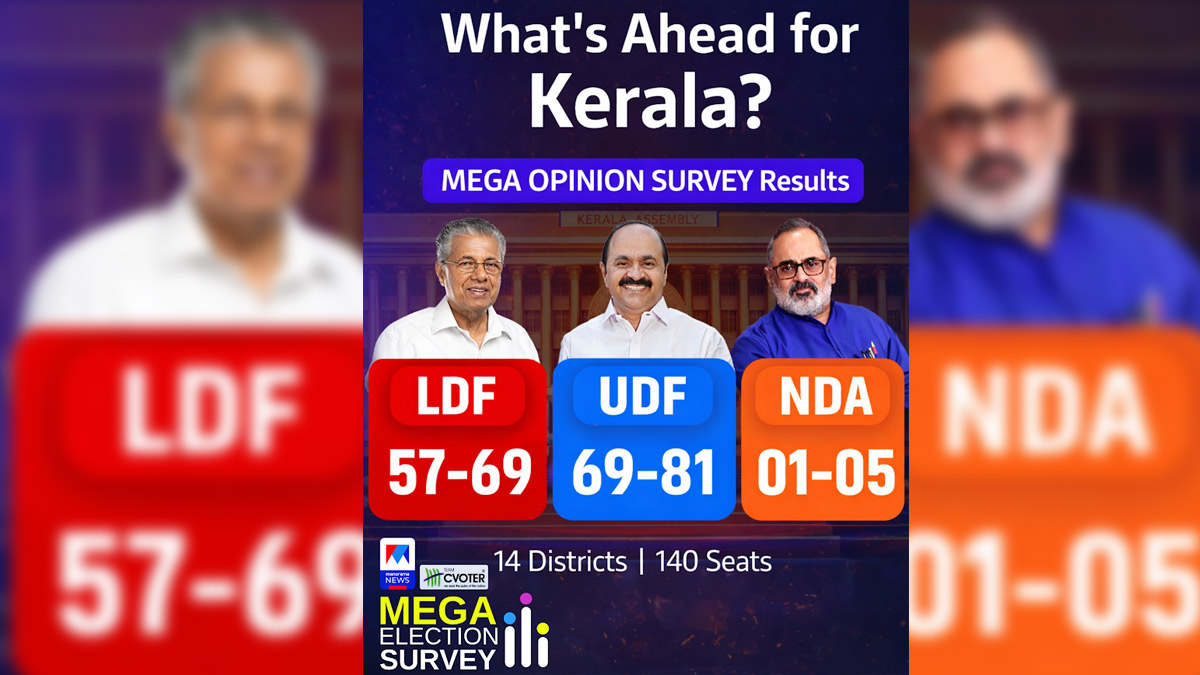
MUMBAI: The winds of change appear to be blowing through Kerala’s political landscape and this time, they seem to favour the United Democratic Front. A comprehensive mega opinion survey conducted by Manorama News in partnership with CVoter projects a potential comeback for the UDF in the upcoming Kerala Legislative Assembly Elections 2026. The survey, covering all 140 constituencies with a massive sample size of nearly 90,000 respondents, predicts the UDF could win between 69 and 81 seats.
The ruling Left Democratic Front (LDF) is expected to secure 57 to 69 seats, a significant drop from the 99 seats it won in the 2021 elections. This would mean the LDF losing 30 to 42 of its sitting seats. Meanwhile, the National Democratic Alliance (NDA), which drew a blank in 2021, is projected to open its account with 1 to 5 seats.
Region-wise, the UDF is expected to make strong gains in Malabar, winning 25 to 34 out of 48 seats, and in Central Kerala, where it could bag 29 to 33 out of 53 seats. In South Kerala, the LDF is likely to retain an edge with 21 to 25 seats, while the UDF may improve to 12 to 16 seats. The NDA could pick up 1 to 3 seats in the southern region.
The survey was conducted between 14 and 26 March 2026, with additional tracker and snap polls carried out from December 2025 to March 2026. A total of 89,693 respondents participated, ensuring representation across all demographics and social segments.
Manorama News has a strong track record of accuracy, with its previous projections closely matching the actual results of the 2019 and 2024 Lok Sabha elections as well as the 2021 Kerala Assembly polls.
In Kerala’s famously fierce political battles, this survey suggests the pendulum may be swinging back. Whether the final verdict matches these numbers or throws up another surprise, one thing is clear, the 2026 Assembly elections are shaping up to be one of the most keenly watched contests in the state’s history.






