Hardware
Are Android STBs a step too far for India?

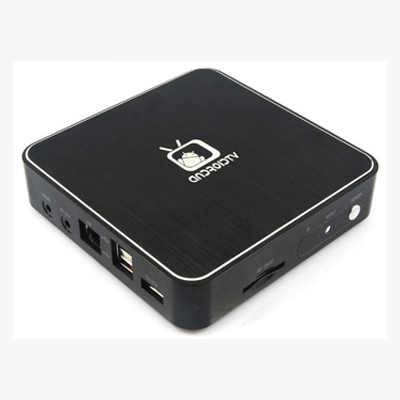
MUMBAI: Even as the cable and television industry prepares to take on digitisation, there’s another advanced technology which has arrived rather quietly on Indian shores.
We’re talking Android set top boxes (STBs) from Willett STB Technologies which are in the market since sometime last month. These hybrid STBs carry all the applications available on the Android Play Store and allow customers to switch seamlessly between television and the internet. Given the recent buzz about Google bringing YouTube on TV, such a technology may just be what the doctor ordered. However, for a variety of reasons, the Android STBs don’t seem to be finding enough traction in the industry.

Speaking to indiantelevision.com, Willett STB Technologies director Deepak Wadhwa refuted the MSOs’ claim that STBs are not upgraded to carry YouTube as a Video-on-demand (VoD) service on television. “The STBs come in different models and frankly, we are ready with the technology. The Android box is the answer to this new development.”
However, Wadhwa was quick to point out that the problem lies in MSOs’ unwillingness to accept the technology. “The MSOs are not ready to promote the boxes. Even though we are ready with the upgraded technology, there are deployment issues,” he said.
So what was keeping MSOs from adopting the new technology? A major reason, according to Wadhwa, was the cost, where each Android STB carried a price tag of Rs 4,000. Additionally, customers would have to pay for video services.
The Willett Android 4.2 STB is a hybrid box, with both Android and DVBC features. “The box allows customers to switch between Android play store and TV channels. It also converts a normal TV to a smart TV,” informed Wadhwa.
Elaborating on the cost factor, he said: “The MSOs are already tied up with MPEG2 boxes. Also in smaller cities, where people are used to viewing TV at Rs 75 to Rs 100, they are opposing STBs which cost Rs 1000, so accepting the Android boxes seems a far thing to imagine.”
Meanwhile, an MSO defended cable operators’ stance saying: “These OTT boxes don’t give us revenue which goes to the service provider instead. So why should we use them?”
Media consultant Sanjeev Hiremath opined: “As far as the cable industry is concerned, technology gets adapted step-by-step. No one is ready to take two steps at a time. Obviously, the advantage of the Android box is that you can incorporate the experience of OTT service also in that. So then you can avoid cable and can directly take a broadband connection and experience both TV and the world of internet. If customers are not ready to pay Rs 1000-2000 for normal STBs, of course they will not buy these at double the rate.”
Maybe, India needs to work towards faster adoption of new technologies just as it has in developing them…






Hardware
India clears Rs 1.6 lakh crore semiconductor projects under Semicon India
Ten projects cleared as production begins and design ecosystem gathers pace
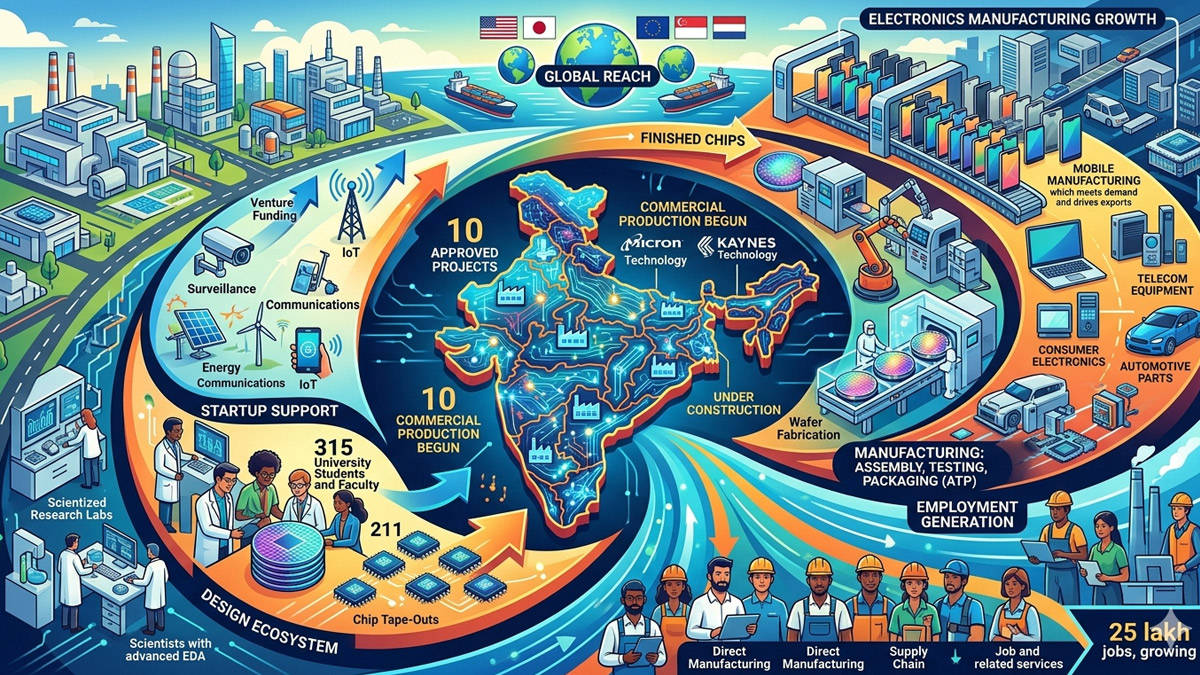
NEW DELHI: India’s push to become a global electronics powerhouse is gaining momentum, with the Semicon India Programme driving the creation of a full-fledged semiconductor ecosystem from design to manufacturing.
Launched in 2022, the programme aims to build capabilities across the entire value chain, including chip design, fabrication, assembly, testing and packaging. In just four years, the government has approved 10 semiconductor projects with a combined investment commitment of around Rs 1.6 lakh crore.
Two of these facilities have already begun commercial production, including units led by Micron Technology Inc. and Kaynes Technology India Limited. Two more plants are expected to go live later this year, signalling that India’s chip ambitions are moving from blueprint to factory floor.
The broader electronics manufacturing story has also seen sharp growth over the past decade. Production has jumped from roughly Rs 1.9 lakh crore in 2014-15 to about Rs 12 lakh crore in 2024-25, while exports have surged nearly eightfold. Mobile phone manufacturing, once heavily import-dependent, now meets almost all domestic demand and has become a major export driver.
Alongside manufacturing, the government is investing heavily in design capabilities. Through access to advanced chip design tools provided free to 315 universities, students and researchers have clocked over 200 lakh hours of usage. This effort has already resulted in 211 chip tape-outs from 75 institutions.
Support for startups is also picking up pace. Twenty-four chip design projects have been approved, targeting sectors such as surveillance, energy, communications and IoT. Of these, 14 companies have collectively raised over Rs 650 crore in venture funding, while several designs have progressed to fabrication, including at advanced nodes.
To strengthen supply chains, India has also signed semiconductor cooperation agreements with countries including the United States, Japan, the European Union, Singapore and the Netherlands. These partnerships aim to reduce global dependencies while boosting domestic capabilities.
The employment impact is equally significant. The electronics sector now supports an estimated 25 lakh jobs, with mobile manufacturing alone accounting for nearly half. As more semiconductor units come online under the India Semiconductor Mission, indirect job creation across supply chains is expected to rise further.
Sharing these updates in Parliament, Ministry of Electronics and Information Technology minister of state Jitin Prasada underscored the government’s focus on building a resilient, end-to-end semiconductor ecosystem.
With factories taking shape, designs moving to silicon and investments flowing in, India’s semiconductor story is steadily shifting gears from ambition to execution.






