iWorld
Ambani’s disruptive digital India Jio “datagiri” gameplan

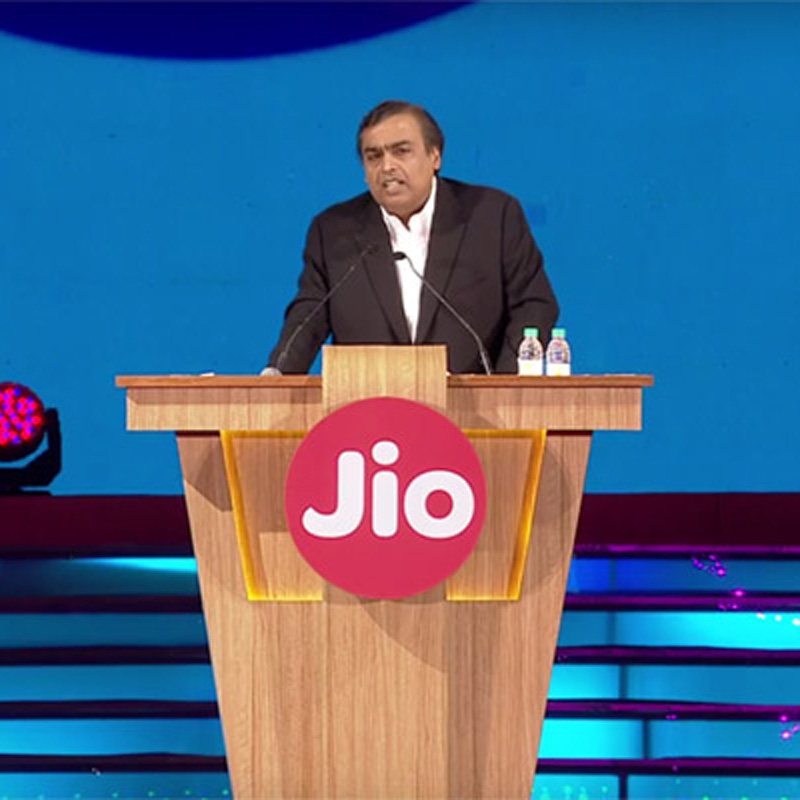
MUMBAI: The Mukesh Ambani-promoted Reliance Industries Ltd on 1 September unveiled ‘datagiri’ (dominace via data services) coupled with disruptive marketing tactics in classic Reliance style — all dedicated to Prime Minister Modi’s Digital India dream.
And while Ambani enumerated the many features of Reliance Jio service, the group’s telecoms and value-added services company, for about 45 minutes in a speech at RIL’s AGM here, there was mayhem on the stock markets. Crores of rupees were wiped off in fortunes as share prices of incumbent telcos tumbled. An analysis by a business news paper estimated that many listed telecoms companies, including younger brother Anil Ambani’s Reliance Communications, lost over Rs 11,0000 crore on the markets.
While the stock markets were witnessing a bloodbath, Ambani told his shareholders, “In the journey of time, there comes a few life changing movements. Our Prime Minister Shri Narendra Modi’s inspiring vision of a “Digital India” is one such movement. Jio is dedicated to realizing our Prime Minister’s vision for 1.2 billion Indians. Jio will give the `power of data’ to each Indian to fulfill every dream and to collectively take India to global digital leadership.”

Sample some facts: free voice call for Jio customers; data at almost 1/10the the price of those prevailing now; no roaming charges; one million Wi-Fi hotspots around the country by middle of next year; 100 per cent VolTe network that allows simultaneous usage of voice and data services; all customers to get freebies of voice calls, data usage and video streaming totally free 5 September to 31 December, 2016; a 4G network coverage of 18,000 cities and towns & and over 200,000 villages; student discount of 25% on data usage and a promised investment of about US$ 14 billion in the Reliance Jio ecosystem.
“The Jio ecosystem stands tall on five fundamental pillars (of) best quality broadband network with the highest capacity; a world of affordable 4G smartphones and wireless IP devices; compelling applications and content; superior digital service experiences and affordable and simple tariffs,” Ambani said, sending the Indian telecoms consumers, reeling under indifferent services provided by the present from incumbents, into a tizzy and queuing up for a Reliance Jio connection that has plans to cover 90 per cent of India’s population y March 2017.
Jio’s suite looks compelling. Apart from a state-of-the-art pan-India digital services business and fixed and wireless broadband connectivity offering superior voice and data services on an all-IP network, Jio will also offer end-to-end solutions that address the entire value chain across various digital services in key domains such as education, healthcare, security, communication, financial services, government-citizen interfaces and entertainment.
According to reports, the company filed its tariff plans with the Telecom Regulatory Authority of India (TRAI) on 1 September 2016.
Reliance Retail Ltd, another subsidiary of RIL, has introduced a slew of affordable 4G LTE smart-phones under the LYF brand, starting at Rs. 2,999. More feature-rich models will be available at progressively higher price-points like Rs. 3,999, Rs. 4999 and so on. The company has also tied up with smart-phone makers like LG, Samsung and Micromax to bundle Jio SIM and other free services.
If all these were not enough, Ambani announced setting-up of the a venture capital fund, where Jio will work on creating Jio Digital Entrepreneurship Hubs in key cities and towns of India. The Jio Digital India Start- up Fund has set aside Rs. 5,000 crore to be invested over the next five years.
“In this era, if you are not digital, and if you don’t have globally competitive digital tools and skills, you simply will not survive. You will get disrupted. You will be outcompeted. You will be left behind. You will become irrelevant. India and Indians cannot afford to be left behind. Today, India is ranked 155th in the world for mobile broadband Internet access, out of 230 countries,” Ambani elaborated, adding that Jio services are aimed at bringing India at par with developed telecoms market.
If things work out as planned, then India’s broadcast ecosystem can start seeing an even great shift in consumption of video on mobile handsets, smart TVs, and on on-the-go devices.
“Clearly, the data plans could lead to a price war in the segment with others being forced to follow suit,” says an industry observer. “All this is good for the consumer as prices will only head further south and the more they do, the more video will be consumed digitally. Which is fabulous for the OTT ecosystem that is currently being nurtured by independents and the broadcast majors.”
Jio Welcome Offer
The Jio ‘Welcome Offer’ provides an opportunity to every Indian to learn, try, customise and experience high quality digital services, without paying for the services up to 31 December, 2016 after which the applicable tariffs will apply.
The company also proposes to use this time period to fine-tune its services and resolving interconnection issues with incumbent players.
“In the last month alone, Jio customers suffered over 5 crore (50 million) call failures to other networks because of insufficient interconnect capacity,” Ambani said hinting at the all-out war being played out with incumbents accusing Reliance of not playing fair— an allegation tossed back by Reliance to competitors. “The onus is rightly on the incumbent operators not to misuse their market power by creating unfair hurdles,” Ambani reiterated.
Jio may extend the period of free services in case Jio subscribers are not able to get adequate experience of seamless connectivity across the network due to point of inter-connect congestion, mobile number portability restrictions and if the quality of service parameters are not as per the benchmarked by desired by company management.
Existing `invited’ or test users of Jio, who enrolled for the Jio Preview Offer, will be transitioned to the Jio Welcome Offer.
Tariff Plans
The Company filed detailed tariff plans with TRAI. Ambani enumerated the following principles used for formulating the tariff plans:
i) Benefits of technology would be passed onto customers. All domestic voice calls for Jio customers will be absolutely free, across India and at any time. Domestic roaming charges will not apply in Jio tariffs.
ii) Data tariffs have been made highly affordable, with full transparency, without any associated conditions. The company is offering the lowest LTE data rates in the world. Additionally, it would offer unlimited night time LTE data.
iii) The Jio-Apps bouquet, which is worth Rs. 15,000 for an annual subscription, will be available complimentary for all active Jio customers up to 31 December 2017. This has been done to make digital life available to everyone.
iv) A special student discount offer, with 25% more data on the main tariff plans, would be offered to all students.
v) Jio has introduced a simple tariff structure with only 10 main plans, designed to fit every budget, as against the 22,000 tariff plans prevailing in the country today.
These are summarised here:

Industry Reactions
An official statement from British telecoms giant Vodafone India said, “We have always offered great value to our customers, backed by excellent customer service, a nationwide presence, and Vodafone SuperNet, our best network ever. We will continue to do so for our hundreds of million customers across the country.”
Cellular Operators Association of India (COAI), an apex body of telcos in India, which had gone public over differences with member Reliance Jio taking the war of words to the Prime Minister’s Office, welcomed the announcements.
“Reliance Jio is a valued member of the COAI. We wish to congratulate them on the announcement of the launch of their services. As a valuable member of the association, we welcome them with great warmth and applaud the bold vision of Mukesh Ambani and the innovation he proposes to bring to the industry,” Director General COAI Rajan S. Mathews said in a statement.
“We welcome Reliance Jio’s entry to the digital world and wish them the very best. We also welcome Jio’s call to leading operators to work together. As a responsible operator, we will fulfill all our regulatory obligations as we have always done,” Bharti Airtel, India’s largest telecom operator in terms of subscribers, said in a statement, adding,”Over the last 20 years, Airtel has been contributing towards building a digitally enabled India and remains fully committed to and take leadership in supporting the government’s Digital India vision. We will continue to innovate and deliver best-in-class products and services to our customers.”
Content aggregators and OTT players were also quick to hail Jio’s game plan. Zee Entertainment Enterprises MD and CEO Punit Goenka tweeted: “Mukesh Ambani’s #datagiri opens up a new chapter for the telecom industry and for the consumers! The data plans launched, which are cheapest across the world, are indeed a boon for content creators and consumers!”
Viacom 18 Group CEO Sudhanshu Vats said in a tweet that Reliance Jio is truly changing the face of India’s telecom sector. “This is #digitalrevolution!” he added. Viacom18 is a joint venture between Viacom Inc and RIL-controlled Network18 group that operates several news and entertainment TV channels, including Colors and Colors Infinity, apart from other media properties.
As many years back Reliance Telecommunications, part of an unified RIL under Dhirubhai Ambani, had created disruptions in the nascent Indian telecoms market, over a decade later his elder son, Mukesh, is replaying the disruption saga, albeit more digitally. Déjà vu indeed!




iWorld
Netflix cuts jobs in product division amid restructuring
Layoffs hit creative studio unit as leadership and strategy shifts unfold.
MUMBAI: The streaming wars may be fought on screen, but the latest plot twist is unfolding behind the scenes. Netflix has reportedly begun laying off several dozen employees from its product division as part of an internal reorganisation, according to a report by Variety. The cuts are believed to have primarily affected the company’s creative studio unit, which works on marketing assets such as in app trailers, promotional visuals and live experience content for the streaming platform.
The company has not disclosed the exact number of employees impacted.
According to the report, the layoffs were not tied to employee performance. Instead, the restructuring eliminated certain roles while other employees were reassigned to different teams within the organisation.
The roles affected are understood to include designers, producers and creative specialists responsible for marketing and brand experience initiatives.
The job cuts come as Netflix adjusts its leadership structure and reshapes its product and creative teams. Last month, Elizabeth Stone was promoted from chief technology officer to chief product and technology officer, giving her oversight of product, engineering and data operations across the company.
Earlier, in December 2025, Netflix also appointed Martin Rose as head of creative for global brand and partnerships, a move seen as part of a broader restructuring of the company’s brand and product functions.
Despite the layoffs, Netflix remains one of the largest employers in the streaming sector. The company is estimated to employ around 16,000 people globally, with roughly 70 percent of its workforce based in the United States and Canada. In 2023, the company reported approximately 13,000 employees, indicating that its headcount had grown significantly before the latest restructuring.
The workforce changes arrive at a time when Netflix is navigating a shifting financial and strategic landscape in the global entertainment industry.
The streaming giant recently secured $2.8 billion in additional cash after receiving a breakup fee from Paramount Skydance following its withdrawal from a deal involving Warner Bros. Discovery.
Speaking to Bloomberg, Netflix co chief executive Ted Sarandos explained that the company had evaluated multiple scenarios during the negotiations but chose not to match the competing offer once it learned that a higher bid had been submitted.
Netflix had capped its offer at $27.75 per share and ultimately stepped back rather than pursue Paramount’s $111 billion acquisition deal, which included a personal guarantee.
Sarandos also cautioned that the financing structure behind the Paramount Skydance transaction could have ripple effects across the entertainment industry.
According to him, the debt heavy deal could trigger significant cost cutting, with David Ellison, chief executive of Paramount Skydance, expected to eliminate about $16 billion in costs and potentially cut thousands of jobs as part of the integration process.
For Netflix, the current restructuring appears to be part of a broader attempt to streamline operations while continuing to invest in product, technology and global content even as the streaming industry enters a new phase of consolidation and financial discipline.